

What Is a Simile for Anxiety?
A simile for anxiety compares anxious feelings, thoughts, physical sensations, or behavior with something else using like or as.
For example:
Her anxiety fluttered in her chest like a trapped bird.
The comparison gives the reader a physical image of nervous energy.
Another example:
His thoughts raced like a train with no station in sight.
This emphasizes the feeling of thoughts that are difficult to slow down.
85+ Similes for Anxiety

Similes for Feeling Anxious
- Anxiety felt like a storm gathering inside her.
- His nervousness fluttered like a trapped bird in his chest.
- She felt as uneasy as a traveler lost in an unfamiliar city.
- Anxiety wrapped around him like a tight rope.
- Her worry followed her like a shadow.
- He felt like a small boat caught in rough water.
- Her nerves trembled like leaves in a strong wind.
- Anxiety sat on his shoulders like a heavy backpack.
- She felt as restless as a bird trapped indoors.
- His uneasiness crawled through him like a cold draft.
- Anxiety hovered over her like a dark cloud.
- He felt as tense as a bow pulled to its limit.
- Her worry clung to her like wet clothing.
- He felt like he was standing on the edge of a cliff.
- Anxiety surrounded her like thick fog.
Similes for Racing Thoughts
Anxiety often becomes especially vivid when writers describe the mind rather than simply naming the emotion.
- His thoughts raced like cars on a crowded highway.
- Her mind spun like a wheel that would not stop turning.
- Thoughts bounced around his head like balls in a pinball machine.
- Her worries multiplied like ripples spreading across a pond.
- His mind buzzed like a room full of bees.
- Her thoughts rushed like water through a broken pipe.
- His worries crowded his mind like people rushing through a doorway.
- Her thoughts tangled like threads in a ball of yarn.
- His mind raced like a train speeding through the night.
- Worry moved through her thoughts like a storm through treetops.
- His thoughts spun like leaves caught in a whirlwind.
- Her mind jumped from one worry to another like a restless rabbit.
- Questions filled his head like waves filling a boat.
- Her thoughts scattered like birds startled from a tree.
- His mind churned like water in a washing machine.
Similes for Anxiety in the Chest
Physical imagery can help readers understand how anxiety affects a character.
- Anxiety fluttered in her chest like a trapped bird.
- His heart pounded like a drum in a quiet room.
- Her chest felt as tight as a locked box.
- His heart raced like a runner sprinting toward a finish line.
- Her heartbeat thudded like footsteps approaching in the dark.
- Anxiety pressed against his chest like a heavy stone.
- Her heart jumped like a startled rabbit.
- His heartbeat hammered like rain against a window.
- Her chest tightened like a fist closing slowly.
- His heart beat like a drum played too quickly.
Similes for Nervousness
- She was as nervous as a student waiting outside an exam room.
- He felt like a performer waiting behind a curtain.
- Her nerves shook like leaves in a storm.
- He was as jittery as a phone vibrating on a table.
- Her hands trembled like leaves caught in the wind.
- He shifted like a person sitting on a chair that was too hot.
- She felt as restless as a horse waiting behind a starting gate.
- His fingers moved like nervous little insects.
- Her voice trembled like a candle flame in a draft.
- He stood as stiff as a statue waiting for something to happen.
Similes for Worry
- Worry followed her like a shadow.
- His concern hung over him like a dark cloud.
- Her worries piled up like books on an already crowded desk.
- Worry gnawed at him like a mouse at a piece of wood.
- His concern grew like a small crack spreading across glass.
- Her worries circled her mind like vultures overhead.
- Worry clung to him like a stubborn burr.
- Her thoughts weighed on her like a stone in her pocket.
- His concern lingered like smoke in a closed room.
- Worry spread through his mind like ink in water.
Similes for Fear and Dread
Anxiety and fear can overlap, but context matters. A character may feel anxious about what might happen without actually being afraid of an immediate threat.
- Dread settled over her like a heavy blanket.
- Fear moved through him like a sudden chill.
- Her dread hung in the air like an approaching storm.
- He felt as uneasy as someone hearing footsteps behind them at night.
- Fear gripped him like an icy hand.
- Her stomach dropped like an elevator suddenly losing speed.
- Dread grew inside him like a storm cloud on the horizon.
- The fear crept over her like a shadow at sunset.
- He felt as exposed as a candle burning in an empty room.
- A sense of dread followed him like distant thunder.
Similes for Anxiety and Uncertainty
- Uncertainty hung over her like fog.
- He felt like a traveler walking without a map.
- Her future seemed as unclear as a road hidden by mist.
- Anxiety made every possibility feel like a door leading into darkness.
- He stood like a sailor waiting for the sea to reveal its next wave.
- Her uncertainty spread like fog across a valley.
- The unanswered question hovered like a storm cloud overhead.
- He felt as uncertain as someone standing at a crossroads without a sign.
- Her worries drifted through her mind like fog through an open window.
- The unknown stretched ahead like a road disappearing into mist.
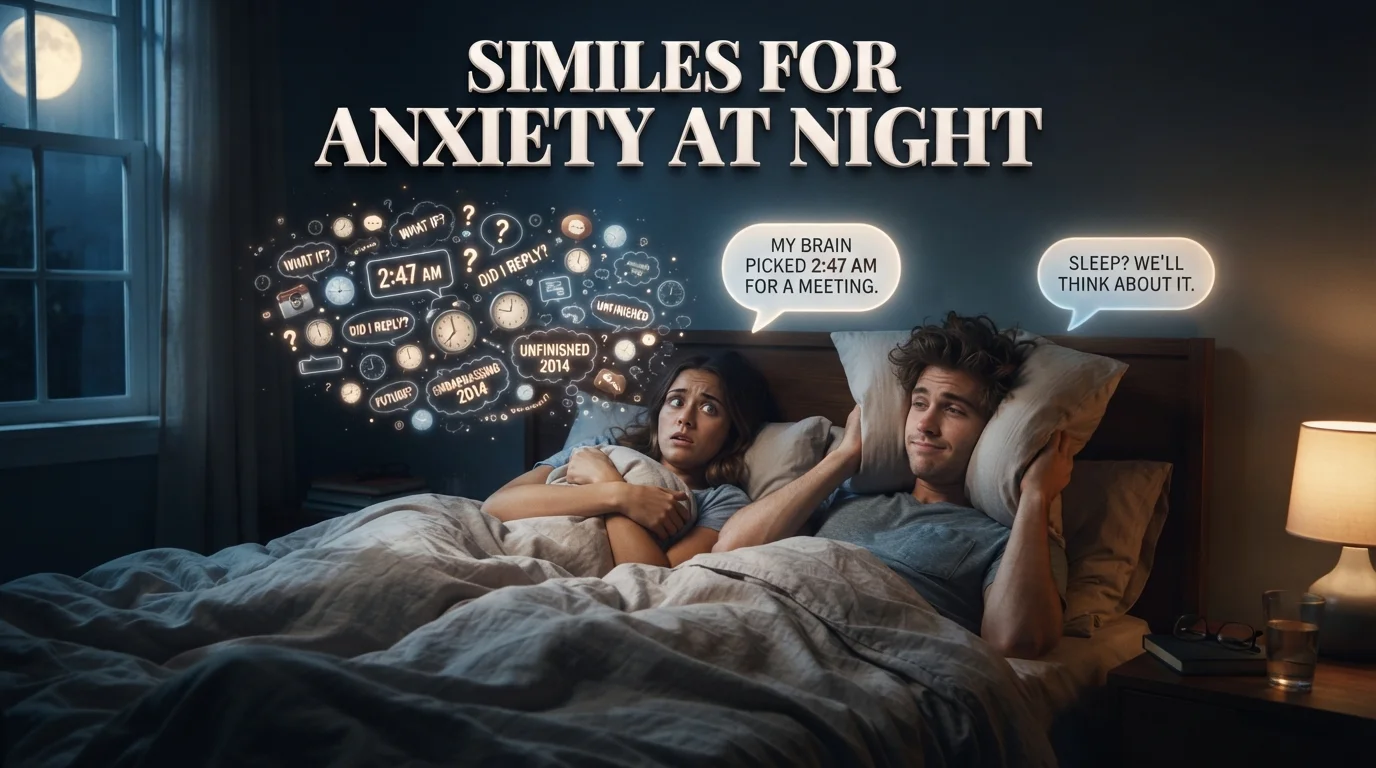
Similes for Anxiety at Night
- Her worries grew like shadows after sunset.
- His thoughts buzzed like insects trapped in a room.
- Anxiety followed him through the night like a restless shadow.
- Her mind raced like a train running through darkness.
- Every small sound seemed as loud as a door slamming shut.
- His thoughts circled like moths around a light.
- Worry lingered like a streetlight glowing outside the window.
- The silence felt as tense as a held breath.
- Her fears hovered like clouds beneath the moon.
- His thoughts spun like leaves caught in a midnight wind.
Similes for Overwhelming Anxiety
- Anxiety crashed over him like a giant wave.
- Her worries felt as heavy as a mountain.
- The fear surrounded her like rising water.
- His thoughts crowded together like people rushing through a narrow doorway.
- Anxiety pressed down on him like a heavy ceiling.
- Her emotions churned like a stormy sea.
- Worry flooded his mind like water rushing through an open door.
- Her anxiety felt like being caught in a spinning storm.
- His thoughts piled up like clouds before a thunderstorm.
- Anxiety wrapped around her like a tightening net.
Similes for Anxiety by Mood
The same feeling can be presented differently depending on the scene.
| Mood | Simile | Effect |
|---|---|---|
| Nervous | Like a bird trapped in a room | Restless |
| Overwhelmed | Like a wave crashing over someone | Powerful |
| Uncertain | Like walking through fog | Confusing |
| Tense | Like a bow pulled tight | Restrained |
| Restless | Like a horse behind a starting gate | Energetic |
| Frightened | Like an icy hand | Chilling |
| Persistent | Like a shadow | Difficult to escape |
| Heavy | Like a stone on the chest | Burdensome |
| Chaotic | Like leaves in a whirlwind | Disorganized |
| Anticipatory | Like waiting behind a curtain | Expectant |
The comparison should match the character’s specific experience rather than treating all anxiety as identical.
Similes for Anxiety in School Writing
A good school-writing description can combine internal thoughts with physical imagery.
For example:
Maya waited outside the classroom, her thoughts racing like cars on a crowded highway. Her hands trembled like leaves in the wind, and anxiety sat on her shoulders like a heavy backpack.
Each comparison contributes something different:
- racing cars → fast thoughts
- trembling leaves → physical nervousness
- heavy backpack → emotional burden
This is generally more effective than repeating several ways of saying that the character was “very anxious.”
Similes for Anxiety in Stories
Quiet anxiety
His worry followed him like a shadow, never quite leaving.
Sudden anxiety
Panic rushed through her like cold water.
Anticipation
He felt as tense as a bow pulled tight, waiting for the moment it would release.
Uncertainty
The future stretched before her like a road disappearing into fog.
Restlessness
His thoughts jumped around like birds startled from a tree.
Persistent worry
The question stayed in his mind like a song he couldn’t stop hearing.

Similes for Anxiety in Poetry
Anxiety can work particularly well in poetry because comparisons allow an invisible emotion to become something visual or physical.
For example:
Anxiety fluttered in my chest
like a bird behind glass,
while every thought
circled my mind
like leaves inside a storm.
Or:
Worry followed me
like a shadow at noon,
never far away,
never quite gone.
The imagery can communicate emotional tension without repeatedly naming the feeling.
How to Create Your Own Similes for Anxiety
Start with the specific quality of anxiety you want to describe.
1. Identify the feeling
Ask:
- Is it nervousness?
- Worry?
- Dread?
- Restlessness?
- Uncertainty?
- Racing thoughts?
- Physical tension?
2. Identify what the feeling does
For example:
Racing thoughts → move quickly and refuse to settle.
3. Find something with the same quality
Possible images:
- speeding cars
- rushing water
- spinning wheels
- startled birds
- swirling leaves
4. Build the comparison
Her thoughts raced like cars on a highway.
5. Make it fit the scene
Her thoughts raced like cars on a highway while she waited for the phone to ring.
The context makes the comparison more meaningful.
How to Make Anxiety Similes More Original
Some anxiety comparisons are familiar:
Worry followed him like a shadow.
This is easy to understand and can work well.
For a fresher image, focus on the exact behavior of the anxiety:
Her worries gathered like unopened messages, each one demanding attention.
Or:
His thoughts tangled like headphones pulled from a pocket.
The goal isn’t to make every comparison unusual. The goal is to find an image that matches the specific experience you’re trying to describe.
Physical vs. Emotional Anxiety Similes
You can approach anxiety from two directions.
| Type | Example | What It Describes |
|---|---|---|
| Mental | Thoughts raced like cars | Racing thoughts |
| Emotional | Worry followed her like a shadow | Persistent concern |
| Physical | Chest tightened like a locked box | Bodily sensation |
| Behavioral | He shifted like a restless animal | Nervous behavior |
| Atmospheric | Anxiety hung like fog | Overall mood |
Using different dimensions can make a character feel more complete.
Common Mistakes When Writing Anxiety Similes
1. Treating all anxiety as fear
Anxiety can involve worry, uncertainty, nervousness, tension, anticipation, or restlessness. Choose imagery that matches the specific emotion.
2. Describing only physical symptoms
Physical details can be powerful, but thoughts and behavior can reveal anxiety too.
3. Using the same image repeatedly
If anxiety is already described as a storm, switching to another storm-based comparison may add little.
4. Making every comparison extremely dramatic
Not every anxious moment feels like a catastrophe. Sometimes anxiety is subtle:
Her worry lingered like a low hum in the background.
5. Using similes without context
A comparison becomes stronger when the surrounding sentence shows why the character feels anxious.
Simile vs. Metaphor for Anxiety
A simile uses like or as:
Anxiety felt like a knot tightening in her stomach.
A metaphor makes the comparison directly:
Anxiety was a knot tightening in her stomach.
Both can create vivid figurative language.
The basic distinction is:
Simile → uses “like” or “as”
Metaphor → makes a direct comparison
25 Short Similes for Anxiety
For quick reference:
- Anxiety felt like a storm inside her.
- Her nerves fluttered like a trapped bird.
- Worry followed him like a shadow.
- His thoughts raced like cars on a highway.
- Her mind spun like a wheel.
- Anxiety sat on him like a heavy backpack.
- His heart pounded like a drum.
- Her chest felt as tight as a locked box.
- His thoughts tangled like threads.
- Worry spread like ink in water.
- Her anxiety hovered like a dark cloud.
- His fear arrived like a sudden chill.
- Her thoughts scattered like startled birds.
- He felt like a boat in rough water.
- Her nerves shook like leaves in the wind.
- Anxiety wrapped around him like a tight rope.
- His mind buzzed like a room full of bees.
- Dread settled like a heavy blanket.
- Uncertainty surrounded her like fog.
- His worries piled up like books on a desk.
- Her heart jumped like a startled rabbit.
- His thoughts churned like stormy water.
- Anxiety pressed on her like a heavy stone.
- His worry lingered like smoke in a room.
- Her mind raced like a train in the night.