

What Is a Simile for Sadness?
A simile for sadness compares an emotional state to something else, usually with “like” or “as.”
For example:
She felt as empty as an abandoned room.
Or:
His sadness followed him like a shadow.
The emotion itself is abstract, but the comparison gives it a concrete image.
A sadness simile can help communicate:
- Emotional heaviness
- Loneliness
- Emptiness
- Grief
- Disappointment
- Heartbreak
- Vulnerability
- Silence
- Isolation
- Emotional exhaustion
- Loss of hope
- Quiet melancholy
The strongest comparison is usually the one that matches the specific emotional experience, rather than simply choosing something that looks gloomy.
60 Similes for Sadness
Like a cloud covering the sun
This suggests sadness blocking warmth, happiness, or optimism.
Her sadness was like a cloud covering the sun, changing the mood of the entire afternoon.
As heavy as a stone in the chest
This conveys emotional weight and difficulty moving forward.
After hearing the news, his heart felt as heavy as a stone in his chest.
Like a rainy afternoon that never seems to end
This works for sadness that feels prolonged.
The week passed like a rainy afternoon that never seemed to end.
As empty as an abandoned house
This suggests loneliness and emotional emptiness.
Without her best friend, the apartment felt as empty as an abandoned house.
Like a fading photograph
This comparison works particularly well for memories, loss, and nostalgia.
The memory felt like a fading photograph, still visible but slowly losing its details.
As quiet as a room after everyone has gone
This communicates a subdued, lonely kind of sadness.
His grief was as quiet as a room after everyone had gone home.
Like a shadow that follows everywhere
This describes sadness that remains difficult to escape.
The disappointment followed her like a shadow that stretched across every part of the day.
As gray as an overcast sky
This emphasizes dullness and a lack of emotional brightness.
His mood was as gray as an overcast sky.
Like a flower bending beneath the rain
This suggests vulnerability and emotional weariness.
She stood there like a flower bending beneath the rain.
As cold as an empty winter morning
This comparison combines emotional distance with loneliness.
The house felt as cold as an empty winter morning after everyone left.
Similes for Deep Sadness
Deep sadness can feel heavier and more consuming than ordinary disappointment.
Like carrying a suitcase full of stones
Grief felt like carrying a suitcase full of stones everywhere he went.
The image communicates a burden that is both emotional and exhausting.
As deep as an ocean at night
Her sadness felt as deep as an ocean at night, impossible to see all the way through.
Like sinking slowly beneath dark water
He felt like he was sinking slowly beneath dark water, unable to find solid ground.
As heavy as the sky before a storm
The silence between them was as heavy as the sky before a storm.
Like a door closing on a familiar world
Losing the opportunity felt like a door closing on a familiar world.
As dark as a room with every window covered
Her thoughts became as dark as a room with every window covered.
Like a long winter with no sign of spring
The lonely months stretched ahead like a long winter with no sign of spring.
As endless as a road disappearing into fog
His sorrow seemed as endless as a road disappearing into fog.
These comparisons work best when the scene genuinely involves profound emotional difficulty. Using extremely intense imagery for a minor disappointment can make the writing feel exaggerated.
Similes for Quiet Sadness
Not all sadness involves crying or dramatic emotional reactions. Sometimes it is almost invisible.
Like mist settling over a field
Sadness settled over her thoughts like mist settling over a field.
As quiet as falling snow
His disappointment was as quiet as falling snow.
Like an unfinished song
The memory remained like an unfinished song she could never quite forget.
As still as a pond before sunrise
He sat in silence, as still as a pond before sunrise.
Like a candle burning low
Her hope felt like a candle burning low in an empty room.
As soft as a whisper behind a closed door
The sadness arrived as softly as a whisper behind a closed door.
Like autumn leaves slowly leaving a tree
Their friendship faded like autumn leaves slowly leaving a tree.
These comparisons can work especially well in reflective essays, literary fiction, and poetry.
Similes for Loneliness
Loneliness is related to sadness, but it has a distinct quality: the feeling of being emotionally or physically separated from others.
Like a single light in a deserted street
He felt like a single light in a deserted street.
As lonely as a house at the end of an empty road
The old cabin looked as lonely as a house at the end of an empty road.
Like a voice nobody could hear
Her thoughts felt like a voice nobody could hear.
As isolated as an island in a vast sea
He felt as isolated as an island in a vast sea.
Like sitting at a table after everyone has left
The silence felt like sitting at a table after everyone else had left.
As distant as a star at the edge of the night sky
Her old life seemed as distant as a star at the edge of the night sky.
Like a letter with no address
He felt like a letter with no address, unsure where he belonged.
These comparisons focus less on sadness itself and more on the absence of connection that can accompany it.
Similes for Heartbreak
Heartbreak often combines sadness with loss, longing, shock, or emotional vulnerability.
Like a favorite song suddenly stopping
Their goodbye felt like a favorite song suddenly stopping halfway through.
As painful as a bruise that keeps being touched
The memory was as painful as a bruise that keeps being touched.
Like watching a door close on someone you love
Saying goodbye felt like watching a door close on someone you love.
As fragile as glass after a hard fall
Her trust felt as fragile as glass after a hard fall.
Like an empty seat where someone used to sit
His absence felt like an empty seat where someone used to sit every day.
As hollow as a house after a family moves away
The room seemed as hollow as a house after a family moves away.
These comparisons work because they connect heartbreak with absence, interruption, fragility, and change.
Similes for Disappointment
Disappointment does not always reach the depth of grief. Sometimes it is a smaller emotional drop after expecting something better.
Like a balloon slowly losing air
Her excitement disappeared like a balloon slowly losing air.
As flat as a joke nobody laughed at
The celebration felt as flat as a joke nobody laughed at.
Like opening a gift and finding nothing you expected
The result felt like opening a gift and finding something completely different from what you hoped for.
As dull as a gray afternoon
The rest of the day seemed as dull as a gray afternoon.
Like a door closing just before you reach it
Missing the opportunity felt like a door closing just before you reached it.
As deflated as a balloon after a party
His enthusiasm was as deflated as a balloon after a party.
These comparisons are useful when the emotion is frustration, letdown, or discouragement rather than profound grief.
Similes for Sadness and Tears
Tears are an outward expression of emotion, but not every person cries in the same way.
Like rain sliding down a window
Tears moved down her cheeks like rain sliding down a window.
As quiet as morning dew
A few tears rested on his face as quietly as morning dew on grass.
Like drops falling from a leaking roof
Her tears came like drops falling from a leaking roof, one after another.
Like rain after a long drought
Once she finally began to cry, the tears came like rain after a long drought.
As sudden as a summer shower
His tears arrived as suddenly as a summer shower.
Like a stream breaking through a dam
Her emotions finally surfaced like a stream breaking through a dam.
These examples should be matched to the scene. A quiet character may need a restrained comparison, while an emotional release may call for stronger imagery.
Poetic Similes for Sadness
Poetry often benefits from comparisons that leave room for interpretation.
Try:
- Like moonlight trapped behind clouds
- Like a fading echo in an empty hall
- Like autumn refusing to become spring
- Like a candle trembling in a cold room
- Like a letter written but never sent
- Like footsteps disappearing in fresh snow
- Like a song fading beyond an open window
- Like a garden waiting for rain
- Like a star disappearing before dawn
- Like a photograph losing its colors
Example
Her memory lingered like a song fading beyond an open window.
The comparison suggests that something meaningful is disappearing, but not necessarily completely forgotten.
Simple Similes for Sadness
For students, English learners, or readers who need straightforward examples, simpler comparisons are often more useful.
- Sad like a rainy day
- Sad like a wilted flower
- Sad like an empty room
- Sad like a broken toy
- Sad like a cloudy sky
- Sad like a lonely road
- Sad like a candle going out
- Sad like a forgotten song
- Sad like a cold morning
- Sad like a bird with nowhere to fly
Example
After her friend moved away, she felt as sad as a rainy day.
Simple does not mean ineffective. A clear image can be more useful than an elaborate comparison when the audience is young or the writing needs to remain accessible.
Similes for Sadness in Creative Writing
In fiction, the best simile often reveals something about the character or situation, not just the emotion.
Compare:
Daniel was sad.
with:
Daniel carried the news like a heavy box he could not put down.
The second sentence suggests emotional burden while also giving the reader something physical to imagine.
Another example:
Maya missed her mother.
could become:
The empty kitchen felt like a photograph with its most important person cut out.
This does more than label Maya’s emotion. It connects the sadness to the physical environment.
How to Match a Sad Simile to the Emotional Intensity
Not every sad scene needs the same level of imagery.
| Emotional Situation | Possible Image | Effect |
|---|---|---|
| Mild disappointment | Deflating balloon | Light but noticeable |
| Quiet melancholy | Mist | Subtle |
| Loneliness | Empty room | Isolated |
| Missing someone | Empty chair | Personal absence |
| Heartbreak | Broken glass | Pain and fragility |
| Deep grief | Heavy stones | Emotional burden |
| Loss of hope | Fading candle | Diminishing light |
| Emotional numbness | Winter landscape | Cold distance |
| Sudden sadness | Unexpected storm | Abrupt change |
| Long-lasting sorrow | Endless rain | Persistence |
These are not fixed meanings. Context matters. A writer can use the same image differently depending on the surrounding scene.
How to Choose the Right Simile for Sadness
Before choosing a comparison, ask what kind of sadness you are actually describing.
Is the sadness heavy?
Think about:
- stones
- weights
- thick clouds
- heavy rain
- burdens
Is it lonely?
Consider:
- empty houses
- deserted roads
- distant stars
- abandoned places
- unanswered letters
Is it fading?
Consider:
- dying light
- fading photographs
- autumn leaves
- disappearing sounds
- melting snow
Is it sudden?
Try images involving:
- storms
- broken glass
- slammed doors
- sudden darkness
- falling objects
Is it peaceful or reflective?
Consider:
- mist
- falling snow
- quiet water
- distant music
- twilight
This approach makes the comparison more intentional.
How to Create Your Own Similes for Sadness
You do not need to rely on familiar phrases. You can build a new comparison from the emotion itself.
1. Name the Specific Emotion
Instead of starting with “sad,” ask:
Is the character lonely, disappointed, grieving, homesick, heartbroken, discouraged, or emotionally exhausted?
2. Identify What the Emotion Feels Like
For example:
Loneliness → distance
Grief → weight
Disappointment → deflation
Heartbreak → emptiness
Homesickness → longing
Despair → darkness
3. Find a Concrete Image
Turn that quality into something readers can visualize.
For example:
Loneliness → an empty train station
Grief → a suitcase filled with stones
Disappointment → a balloon losing air
Longing → a light visible far away
4. Connect the Ideas
Use like or as.
Her loneliness stretched around her like an empty train station after the last departure.
5. Check the Tone
Ask whether the comparison belongs in the scene.
A playful comparison might work in a humorous story, but a serious scene may need something quieter.
6. Remove Anything Unnecessary
A strong simile does not need five layers of explanation.
Let the image do some of the emotional work.
How to Make Sad Similes More Original
Many sadness comparisons rely on familiar images such as rain, dark clouds, broken hearts, empty rooms, and fading flowers. These images are understandable, but using them repeatedly can make writing predictable.
Instead of immediately asking:
What is something sad?
ask:
What physical experience behaves like this particular kind of sadness?
For example, disappointment might behave like:
A notification that disappears before you can read it.
Loneliness might feel like:
Being the only light left on in a building after midnight.
Longing might resemble:
A radio station that almost comes into focus but never quite does.
These comparisons create more specific imagery because they begin with the behavior or quality of the emotion.
Originality does not require making a comparison bizarre. The image should still be recognizable enough for the reader to understand.
Common Mistakes When Using Similes for Sadness
1. Making every comparison extremely dramatic
A character who is mildly disappointed probably does not need an image suggesting complete emotional destruction.
Match the intensity to the situation.
2. Using too many dark images
If every sentence contains storms, graves, darkness, broken glass, and despair, the emotional effect can become monotonous.
Sadness has quieter shades too.
3. Explaining every simile
Sometimes writers explain a comparison immediately after using it.
If the image is clear, let readers experience it without excessive explanation.
4. Mixing incompatible images
A comparison should have a meaningful connection.
If the reader has to stop and figure out why two unrelated things were connected, the simile may need revision.
5. Repeating the same idea
Using five different versions of “sadness is heavy” does not necessarily create five useful examples.
Explore different dimensions of sadness instead.
6. Using clichés when a more specific image would work better
Familiar expressions are not automatically bad. They become less effective when they are used mechanically.
Ask whether the familiar phrase genuinely suits the sentence.
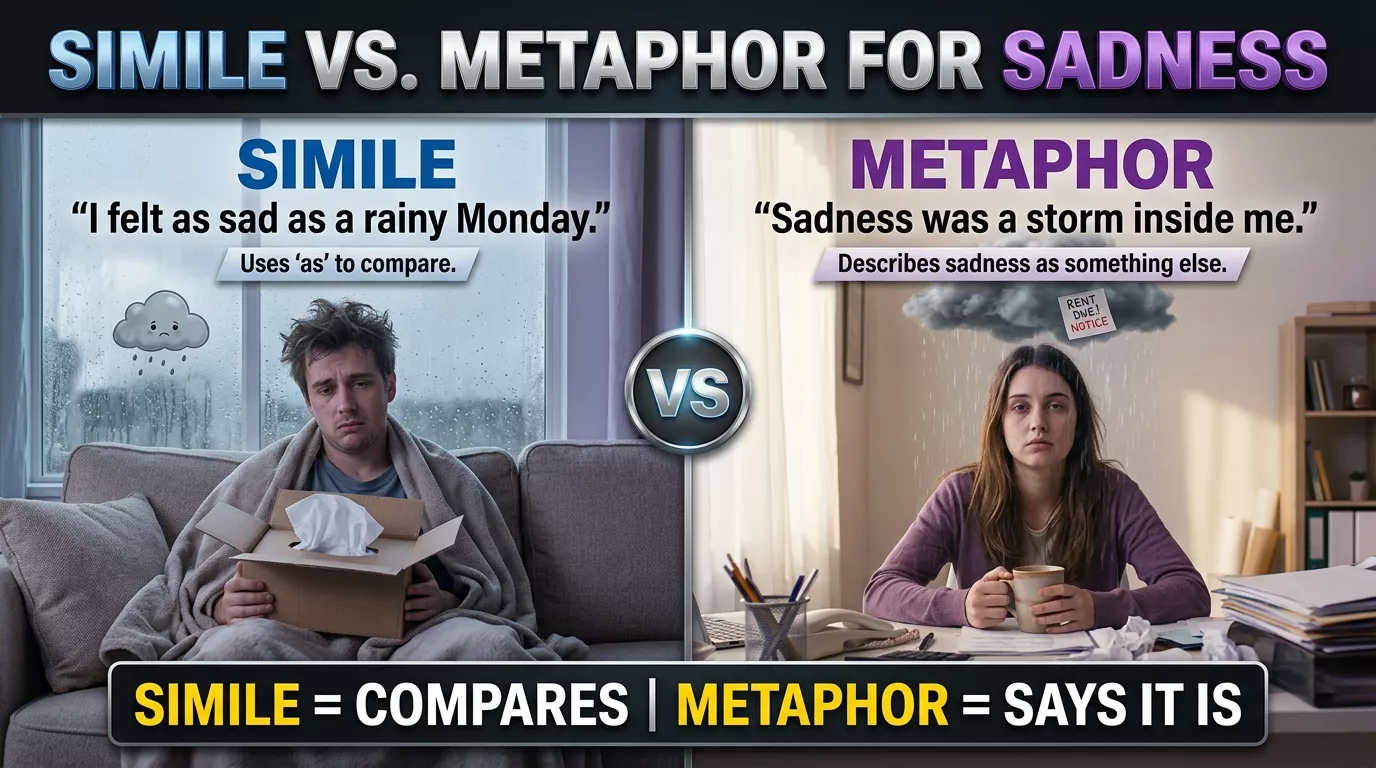
Simile vs. Metaphor for Sadness
A simile explicitly compares two things, commonly with like or as.
Her sadness was like a dark cloud.
A metaphor makes the comparison directly.
Her sadness was a dark cloud.
Both can create imagery, but the structure differs.
Simile
He felt as empty as an abandoned house.
Metaphor
He was an abandoned house.
The simile leaves the comparison visible, while the metaphor presents the image more directly.
Using Personification With Sadness
Sadness can also be given human-like behavior.
For example:
Sadness followed him down the hallway.
That is personification because sadness is treated as if it can physically follow someone.
You can combine personification and simile:
Sadness followed him like an unwanted guest who refused to leave.
This creates a stronger sense of emotional persistence.
Practice: Create Your Own Sadness Similes
Use these prompts to develop original comparisons.
Quiet sadness
Her sadness was as quiet as __________________.
Loneliness
He felt like __________________.
Disappointment
Her excitement disappeared like __________________.
Heartbreak
The goodbye felt like __________________.
Grief
His grief was as heavy as __________________.
Missing someone
Her longing was like __________________.
Loss of hope
His hope faded like __________________.
Emotional exhaustion
She felt as drained as __________________.
Challenge
Create three different similes for the same emotion without using:
- rain
- clouds
- broken hearts
- flowers
- darkness
This forces you to search for less predictable imagery.
Turning Plain Sentences Into Stronger Sad Similes
Plain
She was sad.
With imagery
She felt like a room after everyone had gone home.
Plain
He missed his friend.
With imagery
The empty chair beside him felt like a missing sentence in a familiar story.
Plain
She was disappointed.
With imagery
Her excitement disappeared like air slowly escaping a balloon.
Plain
He was lonely.
With imagery
He felt like the last light left on in an empty building.
Plain
She was grieving.
With imagery
Her grief followed her like a suitcase she could not put down.
The purpose is not to make every sentence poetic. The purpose is to give the reader a more precise emotional experience when the scene benefits from imagery.