
What Is a Simile for Heavy Rain?
A simile for heavy rain compares intense rainfall with a familiar object, action, image, or experience. Similes commonly use “like” or “as” to make the comparison explicit.
For example:
The rain fell like a waterfall.
The rain isn’t literally a waterfall. The comparison gives the reader a quick sense of its volume, force, and continuous movement.
Another example is:
Rain hammered the roof like a thousand tiny drums.
Here, the comparison isn’t mainly about how the rain looks. It draws attention to the repeated sound and impact of the drops.
That distinction matters when choosing a simile. A good comparison should add something specific to the description rather than simply replacing the words “heavy rain.”
35 Similes for Heavy Rain
The examples below focus on different qualities of rainfall, including intensity, sound, appearance, movement, physical sensation, persistence, and mood.
1. The Rain Fell Like a Waterfall
The rain fell like a waterfall, turning the narrow street into a rushing stream.
The waterfall image communicates both the amount of water and its forceful downward movement.
2. Rain Came Down Like a Curtain
Rain came down like a curtain, hiding the houses beyond the road.
This comparison is more about visibility than volume. It works when the rain is so dense that distant objects become difficult to see.
3. Rain Pounded Like Drums
Rain pounded against the windows like drums, filling the room with a steady roar.
This focuses on the repetitive sound of heavy rain. It is particularly effective in an indoor scene where the characters can hear the storm but cannot see all of it.
4. Rain Fell Like Silver Needles
The rain fell like silver needles, stinging her face as she ran toward the shelter.
The needle comparison gives the rain a sharp, uncomfortable physical quality. The surrounding context makes clear that the comparison refers to the sensation of the drops.
5. Rain Rushed Down Like a River
Rain rushed down the street like a river, carrying leaves toward the storm drain.
This comparison emphasizes movement and accumulation rather than the rain falling from the sky.
6. Rain Hit the Roof Like a Thousand Fingers
Heavy rain hit the roof like a thousand fingers tapping at once.
This creates a rhythmic sound image without making the storm seem unnecessarily violent.
7. Rain Fell Like Sheets of Glass
Rain fell like sheets of glass beneath the streetlights.
This creates a sharp visual image of dense, straight rainfall catching the light. It is especially suited to nighttime or urban scenes.
8. Rain Poured Like an Open Faucet
The rain poured like an open faucet that someone had forgotten to shut off.
This is a simple, accessible comparison for beginner writers. It suggests a continuous flow rather than a sudden burst.
9. Rain Roared Like an Angry Crowd
The rain roared like an angry crowd outside the walls.
The comparison gives the storm an overwhelming and threatening sound, making it suitable for tense scenes.
10. Rain Fell Like Water Released From a Broken Dam
Rain fell like water released from a broken dam, overwhelming the roads within minutes.
The image suggests sudden force and a large volume of water. It gives the reader a stronger picture than simply calling the rain “heavy.”
11. Rain Streaked the Windows Like Tears
Rain streaked the window like tears running down a tired face.
This comparison connects the physical movement of rain with sadness or emotional exhaustion, making it useful in reflective scenes.
12. Rain Came Down Like a Wall
Rain came down like a wall, separating the porch from the road beyond it.
A “wall” of rain suggests density and separation. It is useful when the rainfall makes the outside world seem distant or inaccessible.
13. Rain Fell Like a Veil
The rain fell like a gray veil over the sleeping town.
A veil suggests that the landscape is partly hidden and softened, making this a better choice for atmospheric writing than for an action-heavy storm.
14. Rain Struck the Ground Like Pebbles
The heavy drops struck the pavement like tiny pebbles thrown from the sky.
This comparison draws attention to the impact of individual drops hitting a hard surface.
15. Rain Beat Against the Roof Like a Drumline
Rain beat against the tin roof like a drumline racing through the night.
The fast rhythm makes this especially effective when the sound of the storm is an important part of the scene.
16. Rain Fell Like a Thousand Ropes
Rain fell like a thousand ropes stretching from the clouds to the earth.
This creates a strong vertical image of dense rainfall connecting sky and ground.
17. Rain Came Down Like a Waterfall of Diamonds
Under the streetlights, the rain came down like a waterfall of diamonds.
The comparison changes the emphasis from the storm’s force to its reflected light and visual beauty.
18. Rain Raced Down the Glass Like Tiny Runners
Drops raced down the window like tiny runners competing for the finish line.
This playful comparison focuses on the movement of individual drops and works well in imaginative or lighthearted writing.
19. Rain Fell Like a Broken Dam
The rain fell like water released from a broken dam.
This image communicates suddenness, force, and overwhelming volume without requiring a long description.
20. Rain Hammered the City Like a Blacksmith
Rain hammered the city like a blacksmith pounding hot iron.
The comparison emphasizes the repeated force and noise of the storm.
21. Rain Covered the Fields Like a Blanket
The rain covered the fields like a heavy gray blanket.
This emphasizes how the rainfall spreads across and visually conceals the landscape.
22. Rain Fell Like a Flood of Silver
Rain poured from the clouds like a flood of silver beneath the afternoon light.
This is a more poetic comparison that combines heavy rainfall with visual brightness.
23. Rain Stung Like Needles
The cold rain stung his cheeks like needles.
This is useful when the character is outdoors and the writer wants the reader to notice the cold, sharp sensation of the rainfall.
24. Rain Crashed Down Like Waves
Rain crashed down like waves breaking over a rocky shore.
The wave comparison creates a sense of force, movement, and turbulence.
25. Rain Beat Against the Windows Like Fists
The rain beat against the windows like fists demanding to be let inside.
This personification adds tension by making the storm seem aggressive and persistent.
26. Rain Fell Like a Thousand Strings
Rain fell like a thousand strings connecting the clouds to the earth.
This creates a visual impression of continuous vertical lines, making it suitable for descriptive scenes.
27. Rain Poured Like the Sky Had Split Open
Rain poured as if the sky had split open above the town.
This dramatic image makes the rainfall feel sudden and overwhelming.
28. Rain Rolled Across the Roof Like Marbles
Rain rolled across the sloping roof like handfuls of glass marbles.
This works particularly well for a pitched roof because the comparison captures the rapid movement and scattered sound of drops traveling across the surface.
29. Rain Fell Like a Gray Flood
The rain fell like a gray flood, swallowing the horizon in minutes.
The image combines heavy rainfall with reduced visibility, making it useful for broad landscape descriptions.
30. Rain Fell Like a Roaring Waterfall
Rain fell like a roaring waterfall, drowning out every other sound in the neighborhood.
This combines visual intensity with overwhelming noise, making it stronger than a waterfall comparison used only for appearance.
31. Rain Covered the Town Like a Thick Curtain
The downpour covered the town like a thick curtain drawn across a stage.
The comparison suggests that the rain has temporarily hidden the familiar landscape, creating a sense of isolation.
32. Rain Fell Like Endless Beads
Rain fell like endless beads of glass, bouncing from the pavement.
This gives individual drops a visual quality while also suggesting that the rainfall continues without a clear break.
33. Rain Hit the Tin Roof Like a Rapid Drumbeat
Rain hit the old tin roof like a rapid drumbeat that refused to stop.
This focuses on the relentless rhythm of the storm and naturally suits an indoor scene.
34. Rain Moved Across the Landscape Like a Dark Tide
The storm moved across the landscape like a dark tide, swallowing fields and roads behind it.
This comparison works for a storm approaching from a distance. It emphasizes the visible spread of the storm across the setting, rather than individual raindrops.
35. Rain Fell Like Tears From a Broken Sky
The rain fell like tears from a broken sky, washing the streets in silence.
This gives heavy rain an emotional and melancholy quality, making it more appropriate for reflective writing than a neutral weather description.
How to Choose the Right Simile for Heavy Rain
The most useful question isn’t “Which simile sounds the fanciest?” It’s “What do I want the reader to experience?”
| What you want to show | Imagery that fits |
|---|---|
| Extreme intensity | waterfall, broken dam, wall of water |
| Loud sound | drums, hammers, fists |
| Sharp physical sensation | needles, pebbles |
| Poor visibility | curtain, wall, veil |
| Continuous movement | river, stream, tide |
| Long duration | endless stream, repeating rhythm |
| Beauty | diamonds, silver, glass |
| Sadness | tears, mourning |
| Tension or threat | fists, hammers, crashing waves |
For example, a waterfall communicates volume and force, while a curtain is more useful when the important detail is how rainfall blocks the view. A drumbeat focuses on sound, while needles focus on physical sensation.
This makes the choice purposeful. Instead of adding a random figurative phrase, you are using the simile to control what the reader notices first.
Similes for Raining Hard
When the goal is to show that it is raining extremely hard, comparisons involving waterfalls, walls of water, broken dams, rivers, and crashing waves can communicate intensity quickly.
Examples include:
- The rain came down like a wall of water.
- The rain fell like a waterfall from the clouds.
- Rain poured like water released from a broken dam.
- Rain rushed through the street like a river.
- Rain crashed down like waves against the shore.
- The downpour swept across the town like a rushing tide.
These comparisons aren’t interchangeable. A waterfall emphasizes falling volume, a wall of water emphasizes density, a broken dam suggests sudden force, and a river shifts attention toward water moving along the ground.
Similes for the Sound of Heavy Rain
Rain can be described through sound just as effectively as through sight.
Rain drummed on the roof like hundreds of impatient fingers.
The downpour roared like a crowd filling a stadium.
Rain pounded the windows like fists against a locked door.
The drops tapped the glass like restless fingertips.
The storm drummed against the roof like an enormous marching band.
These descriptions let the reader hear the storm through the language rather than simply being told that it is loud. This is particularly useful when the scene takes place indoors.
Why Sound-Based Similes Work
Sound comparisons are especially useful when characters are inside a house, cabin, car, or other enclosed space.
For example:
Inside the cabin, the rain drummed against the metal roof like a thousand tiny hands.
The comparison establishes the weather outside while keeping the reader anchored in the character’s experience.
Sound can also change the emotional tone of a scene. Soft tapping may feel intimate or peaceful, while pounding, crashing, or roaring can create tension. The words surrounding the simile therefore matter as much as the comparison itself.
Similes for Heavy Rain Hitting a Roof
A roof gives you a natural surface for describing both sound and impact. The material can also influence which comparison feels convincing.
Tin or Metal Roof
The rain battered the tin roof like a thousand tiny hammers.
The hard surface supports a sharp, repetitive sound.
Wooden Roof
Rain tapped across the wooden roof like restless fingertips.
This creates a more subdued, rhythmic image.
Tile Roof
The downpour rattled across the tiles like handfuls of pebbles.
The comparison emphasizes the scattered sound of drops striking a hard surface.
The key is to make the comparison fit the setting rather than using the same roof image for every storm scene.
Similes for Rain Falling in Sheets
When heavy rain blocks the view, comparisons to curtains, walls, sheets, and veils are particularly useful.
Rain fell in sheets like a curtain pulled across the landscape.
The downpour hung like a wall between the road and the hills.
Rain covered the valley like a gray veil.
Sheets of rain blurred the houses like wet paint running down a canvas.
These descriptions focus on the overall appearance and density of the rainfall, rather than individual drops.
Powerful Similes for a Downpour
A downpour can be sudden, noisy, forceful, or prolonged. The comparison should match the particular quality you want to emphasize.
Forceful Downpour
The downpour struck the streets like a battering ram.
This gives the rain a sense of repeated impact.
Sudden Downpour
The rain arrived like a bucket overturned above the city.
This emphasizes how quickly the rainfall begins.
Overwhelming Downpour
The downpour spread across the neighborhood like a rising river.
This focuses on the way water begins to dominate the setting.
Noisy Downpour
The rain crashed onto the rooftops like an army of drummers.
This makes sound the defining feature of the storm.
Choosing one dominant quality keeps the description focused instead of making every downpour sound identical.
Similes for Relentless or Endless Rain
Sometimes the defining feature of rainfall isn’t its violence but its persistence.
The rain continued like a song stuck on repeat.
The downpour persisted like a clock that refused to stop ticking.
Rain fell hour after hour like an endless stream.
The storm lingered like an unwanted guest.
The rain kept falling as if the clouds had forgotten how to close.
These comparisons work well when the scene depends on nonstop or prolonged rainfall rather than a short burst of intense weather.
Poetic Similes for Heavy Rain
Poetic writing often benefits from comparisons that create atmosphere rather than simply communicate intensity.
Rain fell like silver threads stitched from the clouds to the earth.
The downpour wrapped the city like a gray silk veil.
Rain shimmered like diamonds scattered across the night.
The clouds wept like mourners beneath a darkened sky.
Rain poured like a river of silver through the moonlight.
The storm moved like a dark ocean across the horizon.
A poetic comparison can make heavy rain represent beauty, mystery, loneliness, sadness, or renewal, depending on the surrounding context. The surrounding details should support that mood; otherwise, the imagery can feel disconnected from the scene.
Dramatic Similes for Heavy Rain
For a suspenseful story or intense storm scene, stronger imagery can make the weather feel like an active force.
The rain hammered the streets like an invading army.
The storm crashed down like an enormous beast awakening.
Rain struck the windows like fists in the darkness.
The downpour swept across the town like a black tide.
The rain attacked the rooftops like a thousand tiny hammers.
Dramatic comparisons work best when the surrounding scene genuinely contains tension, danger, urgency, or conflict. If every rainy scene uses aggressive imagery, the writing can quickly become predictable.
Beautiful Similes for Heavy Rain
Heavy rainfall can also be beautiful, particularly when light catches the falling drops or wet surfaces.
The rain sparkled like diamonds beneath the streetlights.
Raindrops shimmered like tiny crystals in the evening light.
The downpour looked like a silver curtain hanging from the clouds.
Rain glittered like beads of glass across the pavement.
The falling water looked like threads of silver woven through the air.
These comparisons are useful when the purpose is to create beauty and atmosphere rather than emphasize danger or discomfort.
Emotional Similes for Heavy Rain
Rain is often used in literary writing to reinforce feelings such as loneliness, grief, reflection, or emotional release.
The rain fell like tears from a grieving sky.
The storm wept like someone who had held back their sorrow for too long.
Rain slid down the window like tears on a lonely face.
The downpour sounded like the sky mourning in the darkness.
The rain covered the city like a blanket of sorrow.
These comparisons can be effective when the emotional context is already present. Rain itself doesn’t automatically mean sadness; the character, setting, and surrounding language determine how the reader interprets it.
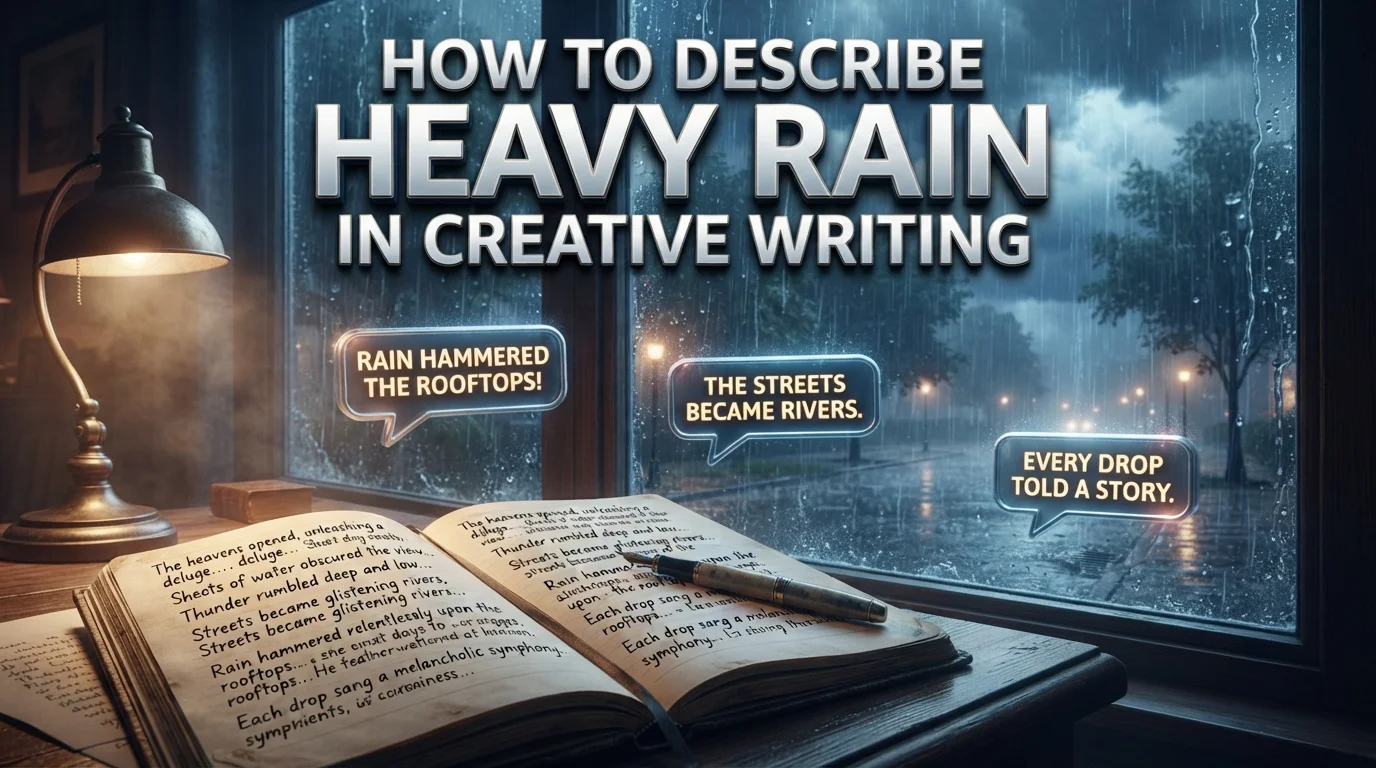
How to Describe Heavy Rain in Creative Writing
A vivid description of rain usually combines several sensory details instead of depending on one adjective.
Instead of:
It was raining very hard.
Try:
Rain fell like a thick curtain, hammering the tin roof while streams raced along the street.
This gives the reader several layers of information:
- Sight: the rain resembles a thick curtain.
- Sound: it hammers the roof.
- Movement: streams race along the street.
- Intensity: the setting feels overwhelmed by rainfall.
You can make the scene more immersive by adding a character’s surroundings:
Rain hammered the roof like a thousand drummers while cold water rushed along the porch and blurred the lights beyond the gate.
Notice that the description doesn’t need a simile in every sentence. One well-chosen comparison surrounded by specific sensory details can be more effective than several competing similes.
Use More Than Visual Imagery
When describing heavy rain, consider several senses where they naturally fit the scene.
Sight
Describe curtains of rain, blurred buildings, reflective pavement, streams along the road, or silver drops catching the light.
Sound
Describe drumming, pounding, rattling, roaring, tapping, or crashing.
Touch
Describe cold drops, stinging rain, soaked clothing, or water running down the skin.
Smell
When relevant to the scene, mention the earthy or wet smell of soil, pavement, or vegetation.
Movement
Describe water rushing through gutters, drops racing down windows, or streams forming along roads.
The goal isn’t to use every sense. Choose the details that help the reader experience this particular storm.
Using Heavy Rain Similes in Stories, Essays, and Poetry
In Stories
Use a simile to establish setting, tension, or atmosphere.
Rain hammered the windows like impatient fists as Maya waited for the lights to return.
The comparison contributes to the tension instead of merely announcing that it is raining.
In Descriptive Essays
Choose an image that helps the reader visualize the environment.
The rain fell like a silver curtain, turning the distant trees into blurred shadows.
This creates a concrete picture while keeping the sentence focused.
In Poetry
Poetry gives you more freedom to combine imagery and emotion.
The sky wept like a forgotten soul,
while rain stitched silver lines
across the sleeping street.
Here, the comparison contributes to the poem’s emotional atmosphere rather than functioning only as a description of weather.
How to Create Your Own Simile for Heavy Rain
You don’t need to memorize dozens of comparisons. You can create an original one by identifying the specific quality of the rain.
Step 1: Identify the Main Quality
Ask whether the rain is:
- loud
- fast
- forceful
- cold
- relentless
- beautiful
- frightening
- gloomy
- sudden
- overwhelming
Step 2: Find a Familiar Image
For example:
Loud → drums
Forceful → hammers
Dense → curtain
Fast → rushing river
Sharp → needles
Beautiful → diamonds
Relentless → endless stream
Step 3: Connect the Image to the Scene
Instead of simply writing:
The rain was like drums.
Make the comparison specific:
Rain drummed against the tin roof like a thousand impatient fingers.
Now the reader knows what the rain sounds like and where that sound is happening.
Step 4: Check the Mood and Context
Ask whether the comparison fits the scene.
A comparison to diamonds may suit rain beneath streetlights, while the same image could feel out of place during a frightening night storm. Likewise, fists can create tension but may be too aggressive for a peaceful description.
Step 5: Don’t Overuse It
Once you’ve established the rain through one strong comparison, let ordinary sensory details carry the description forward.
That usually creates more natural prose than stacking similes into every sentence.
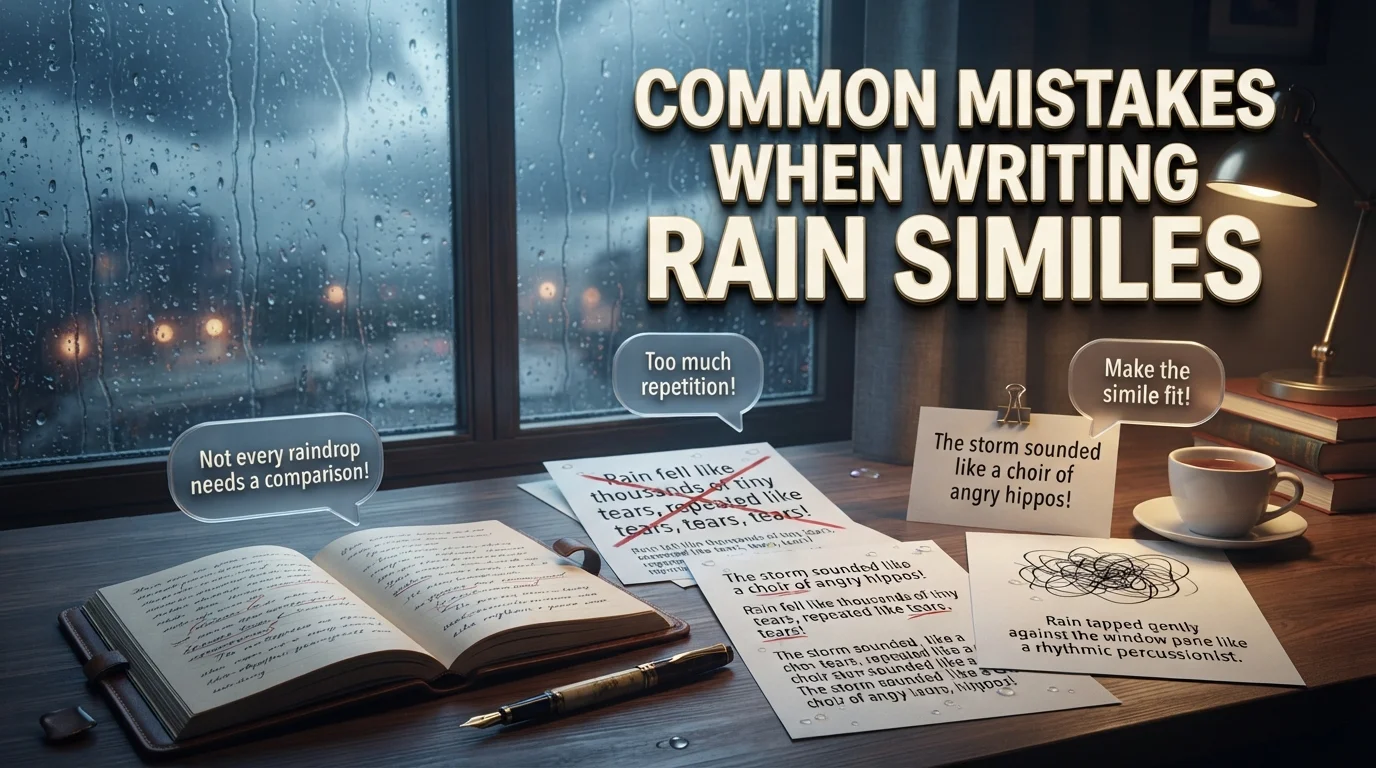
Common Mistakes When Writing Rain Similes
Repeating the Same Comparison
If every description compares rain to a waterfall, the imagery quickly becomes predictable.
Instead, vary the focus:
- waterfall for volume
- drums for sound
- curtain for visibility
- needles for sensation
- river for movement
A familiar comparison isn’t automatically weak. It becomes less effective when it stops adding a specific image to the scene.
Mixing Too Many Images
Avoid packing several unrelated comparisons into one sentence.
Weak:
The rain fell like a waterfall, sounded like drums, looked like diamonds, and moved like a river.
The sentence asks the reader to process too many images at once.
A stronger version chooses the detail that matters most:
Rain hammered the roof like a thousand drums, drowning out every conversation inside.
Using a Simile Only to Sound Fancy
A complicated comparison isn’t automatically a better one.
The best simile makes the scene clearer, stronger, or more memorable. If removing the comparison would make no meaningful difference, it may not be doing enough work.
Ignoring the Mood
A playful comparison may weaken a frightening storm scene. Similarly, violent imagery may feel out of place in a peaceful description of summer rain.
Telling Instead of Showing
The rain was extremely heavy.
This tells the reader about the intensity.
Compare it with:
Rain came down like a wall, hiding the road beyond the gate.
The second sentence gives the reader a visible consequence of the rainfall.
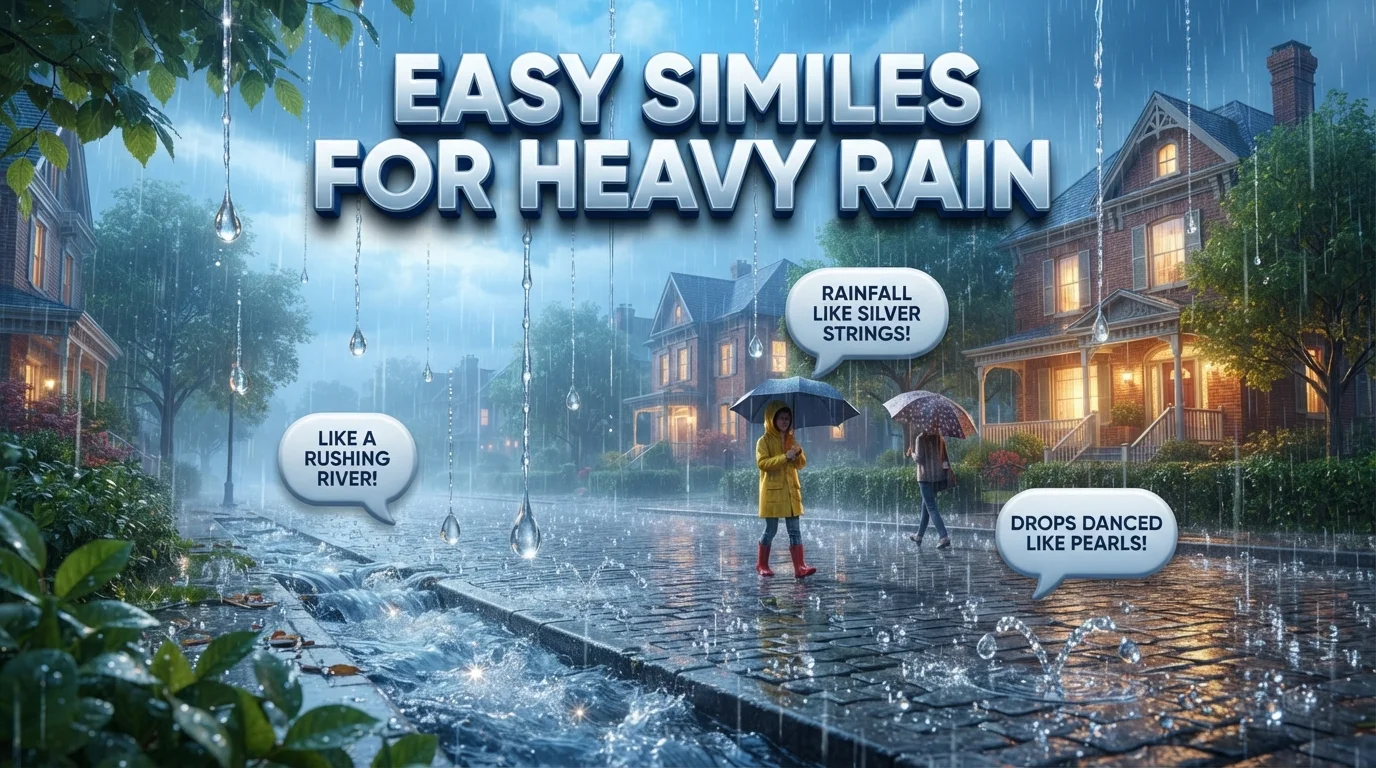
Easy Similes for Heavy Rain
For beginner writers, school assignments, or straightforward descriptive writing, these comparisons are easy to understand:
- The rain fell like a waterfall.
- Rain hit the roof like drums.
- The rain fell like a curtain.
- Rain poured like a river.
- The drops stung like needles.
- Rain covered the town like a veil.
- The rain sounded like tapping fingers.
- The storm came down like a wall of water.
Simple imagery can still be effective. What matters most is that the comparison fits the scene and adds a clear visual, auditory, physical, or emotional detail.