

What Is a Simile for Selfishness?
A simile for selfishness compares self-centered behavior with a familiar object, animal, person, or situation. It commonly uses like or as to make the comparison clear.
For example, “as selfish as a child guarding candy” describes someone who refuses to share something desirable. Similarly, “like a one-way street” can describe a relationship in which one person expects support but rarely gives anything in return.
Different comparisons emphasize different aspects of selfishness:
Greed: Wanting more than one’s fair share.
Possessiveness: Refusing to share belongings, opportunities, or recognition.
Self-centeredness: Focusing mainly on personal needs and interests.
Lack of reciprocity: Accepting help without returning kindness.
Attention-seeking: Wanting the spotlight or constant praise.
The best simile depends on the behavior you want to describe and the tone of your writing.

Best Similes for Selfish With Meanings
These comparisons offer different ways to describe selfishness in everyday situations, essays, stories, and character descriptions.
Simile | Meaning |
|---|---|
As selfish as a child guarding candy | Refuses to share something desirable |
Like a dragon guarding treasure | Fiercely protects possessions or wealth |
Like a one-way street | Expects others to give without giving back |
As greedy as a hand reaching for every cookie | Wants more than a fair share |
Like a mirror reflecting only itself | Focuses almost entirely on personal concerns |
Like a player who never passes the ball | Prioritizes individual success over teamwork |
As possessive as a dog with a bone | Refuses to let go of something valuable |
Like a locked chest full of gold | Keeps resources or benefits to oneself |
Like a spotlight that follows one actor | Constantly seeks attention |
As reluctant to share as a locked pantry | Keeps useful things inaccessible to others |
Like a guest who eats the entire feast | Takes more than others reasonably should |
Like a gate that opens only inward | Accepts benefits but rarely offers them |
As hungry for praise as a plant for sunlight | Constantly seeks admiration |
Like a collector who keeps every prize | Refuses to share rewards or recognition |
As cold as stone toward another’s suffering | Shows little concern for someone else’s hardship |
Like a river flowing only toward itself | Directs every benefit toward personal gain |
Like a child clutching every toy | Insists on keeping everything |
As protective of credit as a cat with its favorite toy | Refuses to acknowledge others’ contributions |
Like a conversation with only one speaker | Leaves little room for other people’s thoughts |
Like a captain taking every lifeboat seat | Puts personal survival ahead of everyone else |
These similes are creative comparisons, not fixed dictionary expressions. Adapt their wording to match your own voice and the situation you are describing.
Simple Similes for Selfish for Students
Simple similes work especially well for classroom assignments, worksheets, and beginner-level creative writing. Their familiar imagery makes the meaning easy to understand.
Easy Similes With Example Sentences
1. As selfish as a child hiding candy. Ethan was as selfish as a child hiding candy when he refused to share his treats.
2. Like a player who never passes. The soccer player acted like someone who never passed the ball, even when teammates were in better positions.
3. As greedy as someone taking every cookie. She was as greedy as someone taking every cookie from the plate.
4. Like a locked toy box. His generosity was like a locked toy box because he never let anyone borrow his belongings.
5. As self-centered as a mirror. He was as self-centered as a mirror, noticing only his own achievements.
6. Like a friend who never returns a favor. Their friendship felt like a one-way street because she always asked for help but never offered any.
7. As possessive as a child with a new toy. Liam was as possessive as a child with a new toy when his cousin asked to play with his action figures.
8. Like a student keeping all the crayons. The student acted like someone keeping all the crayons instead of letting the class use them.
How to Use These Similes in Schoolwork
Choose a comparison that clearly illustrates the behavior in your sentence. Then, if the assignment requires an explanation, describe what the comparison communicates.
For example:
The boy was as selfish as a child hiding candy because he refused to share his supplies with classmates.
The second part explains the behavior, so the simile feels connected to the meaning rather than added just for decoration.
Funny Similes for Selfish People
Humorous similes can describe selfish behavior without making the writing unnecessarily harsh. They are useful in lighthearted stories, playful dialogue, and informal descriptions.
Funny Comparisons for Everyday Situations
As selfish as someone guarding the last slice of pizza. This playfully describes a person who refuses to share a favorite food.
Like a squirrel preparing for a winter that lasts forever. This suggests someone who keeps collecting supplies long after they have enough.
Like a dog who thinks every toy in the park belongs to him. This portrays someone who acts as if everything should be theirs.
As hungry for attention as a performer who refuses to leave the stage. This describes someone who always wants to be noticed.
Like a guest who mistakes the entire buffet for a personal plate. This suggests someone who takes far more than their fair share.
Like a child who wins a game and keeps all the prizes. This describes someone unwilling to share the rewards of success.
As generous as a vending machine with a broken coin slot. This humorous comparison portrays someone who gives very little.
Like a roommate who labels every inch of the refrigerator. This suggests excessive possessiveness over shared space.
Funny Similes in Sentences
Noah guarded the popcorn like a squirrel preparing for a winter that lasted forever, even though the kitchen was full of snacks.
She was as hungry for attention as a performer who refused to leave the stage, turning every conversation back to herself.
Humor works best when the image matches the situation. A playful food comparison may fit a comedy scene, while a joke about taking credit might suit a story about a competitive coworker.
Powerful Similes That Describe Extreme Selfishness
When a character’s selfishness causes conflict or hurts others, a stronger comparison can communicate the seriousness of the behavior.
Similes That Emphasize Greed and Possessiveness
Like a dragon guarding a mountain of gold. This conveys intense attachment to wealth, possessions, or power.
Like a hand grabbing every prize on the table. This portrays someone who refuses to leave opportunities for others.
As possessive as a treasure chest with a hundred locks. This emphasizes the lengths a person goes to keep things for themselves.
Like a ruler claiming every harvest for the palace. This illustrates someone taking the rewards while disregarding the needs of others.
Like a fire consuming every branch in its path. This suggests self-interest that continues even when it causes damage.
Similes That Emphasize a Lack of Empathy
As cold as stone toward a friend’s suffering. This describes a person who appears unmoved by someone else’s pain.
Like a wall between two people reaching for help. This suggests emotional distance or an unwillingness to support someone.
As deaf to others’ needs as a wall is to a whisper. This conveys an unwillingness to listen or respond.
Like a shadow covering every candle. This portrays someone whose presence overshadows other people’s achievements or happiness.
Like a captain taking every lifeboat seat. This conveys extreme self-preservation at the expense of others.
These comparisons are most effective when the surrounding scene demonstrates the selfish behavior. The image should deepen the reader’s understanding rather than replace the story itself.
Similes for Selfishness in Relationships and Friendships
Selfishness in relationships often appears as an imbalance: one person expects time, affection, favors, or emotional support but rarely offers the same in return.
Comparisons for One-Sided Relationships
Simile | Example sentence |
|---|---|
Like a one-way street | Their friendship felt like a one-way street because he always needed help but was never available when others needed him. |
Like a bridge that carries traffic in only one direction | Their relationship lacked balance because support flowed mainly from one person. |
Like a guest who never helps clean up | She enjoyed everyone’s hospitality but disappeared whenever it was time to help. |
Like a plant taking all the sunlight | He demanded so much attention that his partner had little room to express their own feelings. |
Like a gate that opens only inward | He accepted every favor but rarely returned one. |
Comparisons for Possessiveness and Attention-Seeking
As possessive as a child guarding a favorite toy. This describes someone who struggles to share a person’s time or attention.
Like a spotlight that follows only one actor. This suggests someone who repeatedly redirects attention toward themselves.
Like a conversation with only one speaker. This describes someone who talks about their own concerns without listening to others.
As hungry for compliments as dry earth for rain. This conveys a constant need for praise and reassurance.
For example:
Whenever her friends discussed their own problems, Mia redirected the conversation toward herself like a spotlight that followed only one actor.
This example makes the behavior visible instead of simply labeling Mia as selfish.
Remember that protecting personal boundaries, needing time alone, or declining a request does not automatically make someone selfish. The surrounding behavior and circumstances matter.
Similes for Selfish Characters in Stories
A simile can reveal a character’s personality through actions, giving readers a more memorable impression than a simple label.
Showing Greed Through Character Behavior
Martin guarded the prize money like a dragon guarding treasure. When his teammates asked to divide the reward fairly, he tucked the envelope into his coat and began explaining why he deserved the largest share.
The dragon comparison establishes Martin’s possessiveness, while his actions demonstrate it.
Other useful comparisons include:
Like a guest determined to empty the buffet. Suitable for a character who takes more than their share.
Like a collector who refuses to display a single treasure. Useful for someone who accumulates things but never shares their value.
Like a player who keeps every trophy. Appropriate for a character who takes all the credit for a group achievement.
Showing Self-Centeredness Through Dialogue
“That’s wonderful,” Alex said, glancing at his friend’s award. “But wait until you hear what happened to me today.” He pulled his chair closer, eager to reclaim the conversation like a performer returning to the center of the stage.
This example uses a comparison to reinforce a character’s attention-seeking behavior without repeatedly calling him selfish.
Showing Selfishness Through Small Actions
Not every selfish character needs to be cruel or villainous. Small habits can reveal the trait more naturally:
Taking the last piece of food without asking whether anyone else wants it.
Accepting praise for work completed by an entire team.
Expecting friends to rearrange their plans for every personal inconvenience.
Refusing to listen when someone else needs support.
Pair a relevant simile with one or two specific actions to make the characterization believable.
Short Similes for Selfishness
Short comparisons are useful for quick descriptions, poems, dialogue, and writing exercises.
Like a one-way street
Like a locked chest
As greedy as a miser
Like a dragon with gold
As possessive as a dog with a bone
Like a mirror facing itself
As cold as stone
Like a player who never passes
Like a spotlight following one actor
Like a gate that opens one way
As hungry for praise as a plant for sunlight
Like a collector keeping every prize
Example: He treated teamwork like a one-way street, expecting everyone to support him while refusing to help them.
A short simile is most useful when the context makes its meaning obvious.
Similes for Selfishness in Poetry
Poetry often benefits from imagery drawn from nature, light, distance, and enclosed spaces. These comparisons can make selfishness feel emotional or symbolic rather than merely descriptive.
Poetic Comparisons With Strong Imagery
Like winter stealing warmth from a garden. Suggests behavior that leaves others feeling deprived.
As distant as a star that never looks down. Portrays someone absorbed in their own world.
Like a river that refuses to feed the fields. Suggests withholding something that could benefit others.
As closed as a flower that never opens. Can symbolize emotional guardedness or an unwillingness to give.
Like a shadow stretching over every flame. Depicts someone who overshadows other people’s happiness or accomplishments.
As hungry as a fire searching for wood. Conveys an appetite for more that never seems satisfied.
Like a wall built between two open hands. Represents a barrier to generosity and mutual support.
Example in a Poetic Passage
He held his treasures close, like winter holding frost, And counted every kindness by the price it cost. While others shared their sunlight, he guarded every flame, Then wondered why the garden never bloomed the same.
This original passage uses imagery to portray possessiveness and the consequences of withholding. The comparisons are creative choices, so their emotional effect depends on the poem’s wider context.
Similes for Selfishness and Greed: What’s the Difference?
Selfishness and greed are related, but they emphasize different behaviors.
Selfishness focuses on putting personal interests ahead of other people’s needs or interests.
Greed focuses on an excessive desire to acquire or keep money, possessions, power, or other benefits.
For example, like a player who never passes the ball emphasizes prioritizing personal success over teamwork. Like a dragon guarding a mountain of gold emphasizes possessiveness and the desire to keep wealth.
Choose the comparison according to the behavior you want readers to notice. A character can be selfish without being motivated by money, and greed can be one expression of selfishness.
How to Create Your Own Similes for Selfishness
Creating an original simile starts with understanding the behavior rather than simply finding another word for selfish.
A Simple Creative Process
Identify the specific behavior. Decide whether the person is hoarding possessions, seeking praise, taking credit, or refusing to help.
Find a vivid image. Consider objects, animals, places, or everyday situations that illustrate the behavior.
Make the comparison clear. Connect the behavior to the image using like or as.
Match the tone to the situation. A funny comparison may suit dialogue, while a more serious image may suit a dramatic scene.
Remove unnecessary words. Keep the image focused so readers understand it immediately.
Check for originality and naturalness. Avoid changing only one noun in a familiar expression and calling the result new.
Examples of Turning Behavior Into Similes
Behavior: Taking all the credit
Simile: Like a player who keeps every trophy in a team locker.
This image connects selfishness with the refusal to share recognition.
Behavior: Interrupting others to talk about oneself
Simile: Like a radio that never lets another station play.
The comparison conveys a conversation dominated by one voice.
Behavior: Taking all the shared food
Simile: Like a guest who mistakes the entire buffet for a personal plate.
The familiar setting makes the behavior easy to visualize.
Behavior: Accepting help without returning it
Simile: Like a bridge that carries everyone else’s weight but never lets anyone cross back.
The image emphasizes an unequal exchange rather than simple greed.
These examples work because each comparison targets a particular behavior. That specificity helps keep the writing fresh and meaningful.
Common Mistakes When Using Similes for Selfishness
Choosing an Unclear Comparison
A simile should make the behavior easier to understand. If readers cannot see the connection between the image and selfishness, the comparison may distract them.
Repeating the Same Idea
Several comparisons about hoarding gold may communicate nearly identical meanings. Use different images to explore distinct traits, such as greed, possessiveness, attention-seeking, and lack of reciprocity.
Making Every Character Cruel
Selfish behavior can range from a small act of thoughtlessness to serious exploitation. Match the intensity of the simile to the situation instead of making every character sound like a villain.
Confusing a Simile With a Metaphor
A simile makes an explicit comparison using like or as. A metaphor presents one thing as another.
Simile: He guarded his money like a dragon guarding treasure.
Metaphor: He was a dragon guarding his treasure.
Treating Personal Boundaries as Selfishness
A person who protects their privacy, declines an unreasonable request, or pursues a personal goal is not automatically selfish. Consider the context before choosing a negative comparison.
Overloading Sentences With Imagery
One well-chosen simile can be more powerful than several competing comparisons. Give the reader enough context to understand the image, then let the sentence continue naturally.
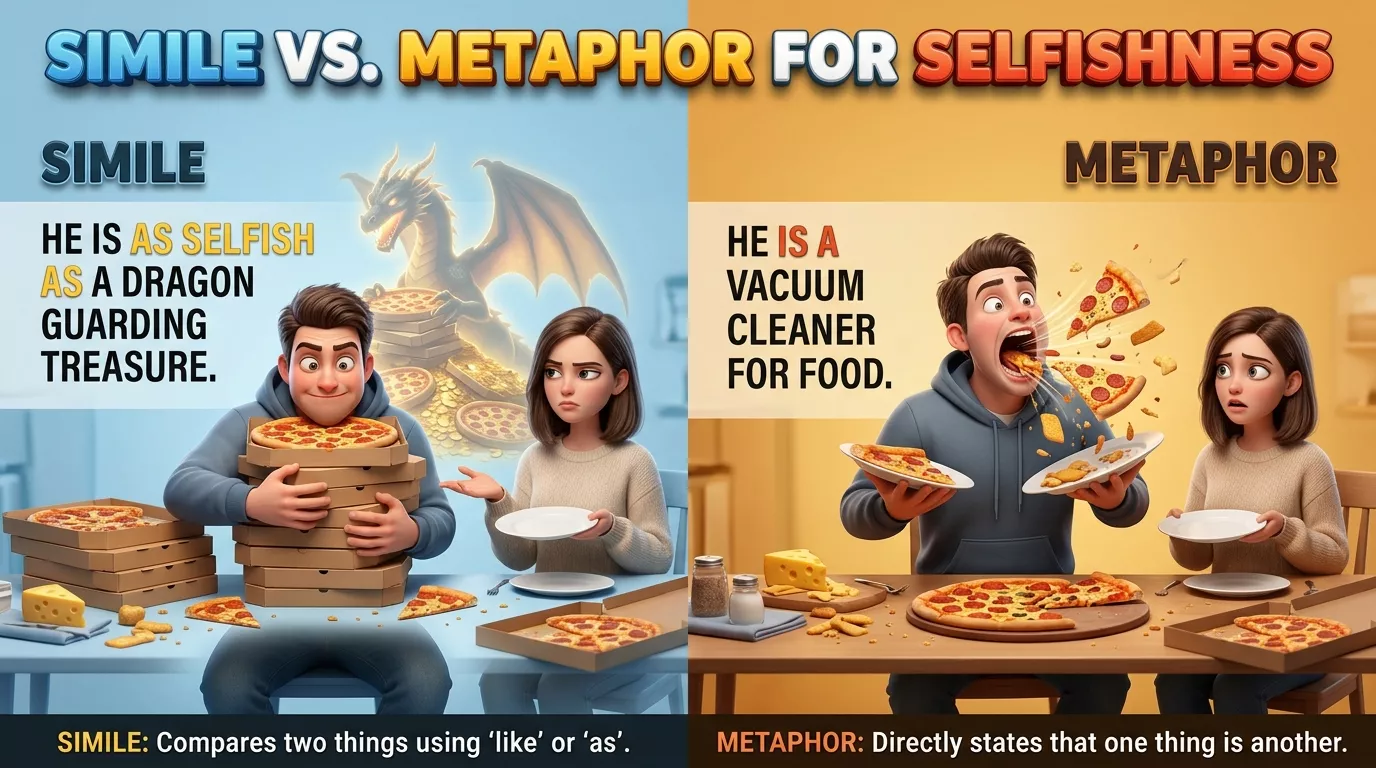
Simile vs. Metaphor for Selfishness
A simile compares two things explicitly, usually with like or as. A metaphor makes the comparison directly without those words.
Simile | Metaphor |
|---|---|
He guarded his money like a dragon guarding treasure. | He was a dragon guarding his treasure. |
She was as self-centered as a mirror. | She was a mirror reflecting only herself. |
Their friendship was like a one-way street. | Their friendship was a one-way street. |
He sought attention like a spotlight attracts an audience. | He was a spotlight that left no room for others. |
Use a simile when you want readers to picture a specific comparison. A metaphor can make the image feel more direct and integrated into the description.