

What Is a Simile for Worms?
A simile for worms compares a worm’s appearance, movement, shape, texture, or behavior with something familiar, usually using like or as.
For example:
The worm twisted like a ribbon in the wind.
The worm is not literally a ribbon. The comparison simply helps the reader imagine its flexible, twisting movement.
Worm-related similes can focus on several characteristics:
- Shape
- Length
- Thinness
- Movement
- Flexibility
- Texture
- Setting
- Behavior
- Color
- Mood
The best comparison depends on what you want the reader to notice.
Best Similes for Worms
Here are some versatile comparisons that work across stories, essays, poems, school assignments, and descriptive writing.
1. Like a tiny piece of string
The little worm lay on the damp soil like a piece of string.
This is a simple comparison for a thin worm.
2. Like a ribbon in the wind
The worm twisted like a ribbon caught in the wind.
This emphasizes flexible, winding movement.
3. Like a living shoelace
The worm crawled across the pavement like a living shoelace.
A playful comparison that works especially well in children’s writing.
4. Like a loose thread
The pale worm looked like a loose thread against the dark soil.
This highlights its thin appearance.
5. Like a wriggling noodle
The worm squirmed like a wriggling noodle.
This creates a humorous, informal image.
6. Like a piece of spaghetti
The worm curled like a piece of spaghetti.
A familiar comparison for a long, flexible body.
7. Like a miniature rope
The earthworm rested across the garden bed like a miniature rope.
This works better for a thicker worm.
8. Like a tiny spring
The worm curled like a tiny spring beneath the leaf.
This emphasizes curling and contracting.
9. Like a moving pencil line
The worm crossed the soil like a moving pencil line.
This creates a simple visual image.
10. Like a thread through fabric
The worm disappeared into the soil like a thread pulled through fabric.
This is particularly effective for describing burrowing.
Similes for Worm Movement
Movement is one of the most interesting features to describe because worms can stretch, contract, bend, curl, and wriggle.
Wiggling and Squirming
For a worm that is constantly moving, comparisons involving flexible objects work naturally.
- Like a ribbon caught in a breeze
- Like a loose shoelace
- Like a noodle being stirred
- Like a string being shaken
- Like spaghetti in boiling water
- Like a spring stretching and curling
- Like a rope being twisted
- Like a ribbon dancing in the breeze
- Like a flexible wire bending
- Like a tiny wave moving across the ground
Example
The little worm wiggled like a loose shoelace.
Stretching and Contracting
When a worm repeatedly lengthens and shortens, use comparisons that suggest changing shape.
- Like a rubber band being stretched
- Like an accordion opening and closing
- Like a spring expanding and contracting
- Like a rope being pulled
- Like elastic being stretched
- Like a flexible cord being tightened
Example
The worm stretched and shortened like a rubber band being pulled.
Crawling and Slipping
For a worm moving steadily across a surface:
- Like a tiny train without wheels
- Like a thread being pulled
- Like a ribbon sliding across glass
- Like a noodle sliding across a plate
- Like a snake winding through grass
- Like a soft cord being dragged
- Like a tiny river changing course
Example
The worm slid across the wet pavement like a ribbon on glass.
Similes for the Shape of a Worm
A worm’s elongated shape naturally lends itself to comparisons with thin, flexible objects.
Long Worms
For a worm that appears unusually long:
- Like a shoelace
- Like a piece of string
- Like a thin rope
- Like a strand of spaghetti
- Like a ribbon
- Like a stretched rubber band
- Like a narrow vine
- Like a cord
- Like a pencil line
Example
The long earthworm stretched across the garden bed like a brown shoelace.
Thin Worms
For a very slender worm:
- Like a strand of thread
- Like a piece of fishing line
- Like a fine wire
- Like a pencil line
- Like a thin ribbon
- Like a strand of string
- Like a narrow shoelace
- Like a hair
Example
The tiny worm was as thin as a strand of thread.
Curled Worms
When a worm curls into a loop or coil:
- Like a tiny spring
- Like a loose coil of string
- Like a curled ribbon
- Like a miniature spiral
- Like a looped shoelace
- Like a piece of spaghetti curling in a bowl
Example
The worm curled beneath the leaf like a tiny spring.
Similes for Worms in Soil
Worms moving through soil provide excellent opportunities for comparisons involving tunnels, threads, roots, and underground paths.
Burrowing Through the Earth
- Like a thread passing through fabric
- Like a train entering a tunnel
- Like a root spreading through soil
- Like a needle passing through cloth
- Like a tiny tunnel worker
- Like a ribbon sliding through mud
- Like a thread disappearing into fabric
Example
The earthworm vanished beneath the soil like a thread pulled through dark fabric.
Worms in a Garden
- Like brown ribbons among the leaves
- Like moving threads on the soil
- Like tiny roots that can move
- Like loose shoelaces in the garden
- Like soft cords beneath the leaves
- Like living pieces of string
- Like narrow vines crossing the dirt
Example
The earthworms moved beneath the leaves like brown ribbons.
Similes for Slimy or Wet Worms
When the setting emphasizes moisture, comparisons with wet or slippery objects can create a stronger sensory image.
Wet and Slippery Comparisons
- Like wet spaghetti
- Like a slick piece of string
- Like a wet shoelace
- Like a ribbon fresh from the rain
- Like a slippery cord
- Like soaked thread
- Like a noodle sliding across a plate
- Like a wet piece of rubber
Example
The worm felt as slippery as wet spaghetti.
This type of comparison should match the actual scene. If the writing does not involve moisture, there is no need to describe the worm as slimy.
Similes for Earthworms
Earthworms naturally fit comparisons involving gardens, soil, roots, and underground movement.
Nature-Focused Comparisons
- Like a brown ribbon beneath the soil
- Like a thread weaving through earth
- Like a soft cord in the garden
- Like a tiny underground train
- Like a living piece of string
- Like a narrow root that can move
- Like a thread beneath the leaves
- Like a quiet worker beneath the ground
Example
The earthworm moved through the garden soil like a thread weaving through dark fabric.
These comparisons work particularly well in nature writing and descriptive school assignments.
Funny Similes for Worms
Worms can become surprisingly entertaining characters when described through playful comparisons.
Playful Comparisons
- Like a shoelace that escaped its shoe
- Like spaghetti trying to leave the plate
- Like a noodle with somewhere to be
- Like a tiny rope doing gymnastics
- Like a string that learned to dance
- Like a shoelace running away from home
- Like a pencil line that came to life
- Like a noodle late for dinner
- Like a tiny rope with a mission
- Like spaghetti having a bad day
Example
The worm wriggled away like a shoelace that had escaped its shoe.
These comparisons are especially useful for children’s stories, humorous descriptions, and playful dialogue.
Cute Similes for Worms
For younger readers, friendly imagery can make worms seem curious rather than unpleasant.
Child-Friendly Comparisons
- Like a tiny ribbon
- Like a little noodle
- Like a dancing shoelace
- Like a wiggly string
- Like a soft brown ribbon
- Like a tiny garden helper
- Like a moving thread
- Like a little earth train
- Like a noodle crawling through the dirt
Example
The little worm wiggled like a dancing ribbon.
Scary Similes for Worms
The same creature can feel completely different when described in a dark or suspenseful scene.
Dark and Unsettling Comparisons
- Like pale threads crawling from the darkness
- Like living strings beneath the floor
- Like tiny snakes emerging from the earth
- Like pale fingers twisting through the soil
- Like shadows that had learned to crawl
- Like restless roots pushing through the ground
- Like wet cords moving in the dark
- Like pale ribbons slipping through cracks
- Like underground creatures searching for a way out
Example
Pale worms emerged from the soil like restless fingers reaching through the darkness.
The purpose here is not biological accuracy but atmosphere and imagery.
Similes for Worms in the Rain
Rain can change the setting dramatically and make worms more visible against wet soil or pavement.
Rainy-Day Comparisons
- Like ribbons scattered across wet soil
- Like strings washed onto the ground
- Like noodles left after a storm
- Like tiny ropes on a soaked garden path
- Like moving threads against dark earth
- Like brown lines drawn across mud
- Like loose shoelaces after a rainstorm
- Like little waves crawling over the soil
- Like tiny roots exposed by rain
Example
After the rain, the worms appeared like loose strings scattered across the wet ground.
Similes for Worms Based on Their Texture
Texture can add another sensory layer to descriptive writing.
Soft or Flexible
- Like a soft cord
- Like a flexible ribbon
- Like a piece of elastic
- Like a soft strand of rope
- Like a wet noodle
- Like a flexible tube
Example
The worm bent like a soft piece of rubber.
Smooth or Slippery
- Like wet spaghetti
- Like a slick ribbon
- Like a wet shoelace
- Like a slippery thread
- Like a smooth cord
Example
The worm slipped through his fingers like wet spaghetti.
Similes for Worms in Creative Writing
A good worm simile can do more than describe the creature. It can establish setting, tone, character, and atmosphere.
In a Children’s Story
The worm wiggled like a shoelace that had escaped from a shoe.
The comparison is playful and easy to visualize.
In Nature Writing
The earthworm moved through the soil like a thread weaving through dark fabric.
The image is quieter and more observational.
In a Funny Story
The worm wriggled across the sidewalk like spaghetti trying to escape dinner.
The exaggerated image creates humor.
In a Suspense Scene
Pale worms twisted beneath the leaves like restless fingers.
The comparison makes the scene feel unsettling.
How to Choose the Right Simile for a Worm
The best simile depends on the specific feature you want to emphasize.
For Shape
Choose comparisons involving:
- String
- Ribbon
- Shoelaces
- Rope
- Spaghetti
- Thread
For Movement
Choose:
- Waves
- Springs
- Ribbons
- Noodles
- Snakes
- Strings
For a Cute Tone
Choose:
- Tiny ribbons
- Dancing shoelaces
- Little noodles
- Wiggly strings
For Humor
Choose:
- Escaped shoelaces
- Runaway spaghetti
- Ropes doing gymnastics
- Noodles with somewhere to go
For Nature Writing
Choose:
- Roots
- Threads
- Soil
- Vines
- Underground tunnels
For a Dark Mood
Choose:
- Shadows
- Pale fingers
- Dark ribbons
- Underground creatures
- Restless roots
The comparison should support the purpose and tone of the sentence, not simply describe the worm.
How to Create Your Own Similes for Worms
Creating an original worm simile becomes easier when you observe what the worm is actually doing.
Step 1: Identify the Main Feature
Ask yourself:
- Is the worm long?
- Is it thin?
- Is it wriggling?
- Is it curling?
- Is it stretching?
- Is it burrowing?
- Is it wet?
- Is it moving slowly?
- Is it moving quickly?
Step 2: Find Something With a Similar Quality
If the worm stretches and contracts, consider:
a rubber band
If it moves through soil, consider:
a thread passing through fabric
If it keeps curling, consider:
a spring
Step 3: Connect the Two
For example:
The worm stretched through the soil like a thread being pulled through cloth.
Step 4: Match the Tone
For a children’s story:
The worm wiggled like a noodle trying to escape dinner.
For nature writing:
The earthworm moved through the soil like a thread weaving through dark fabric.
For suspense:
The pale worms twisted beneath the leaves like restless fingers.
Step 5: Remove Anything Unnecessary
A strong simile should be easy to understand. If the comparison requires a long explanation, look for a simpler image.
Common Mistakes When Writing Similes for Worms
Using the Same Comparison Too Often
“Like a snake” is an obvious comparison because both creatures can move in winding patterns. It can work, but relying on it repeatedly makes the writing predictable.
Focusing Only on Appearance
A worm’s movement can be more interesting than its shape. Consider whether the worm is stretching, curling, burrowing, escaping, or wriggling.
Making Every Worm Slimy
Moisture may be important in some scenes, but it does not need to define every worm.
Making the Imagery Too Complicated
For a simple school sentence, this may be enough:
The worm was as thin as a piece of thread.
Simple imagery can be more effective than an elaborate comparison.
Ignoring Tone
A humorous comparison may work beautifully in a children’s story but feel inappropriate in a serious nature description.
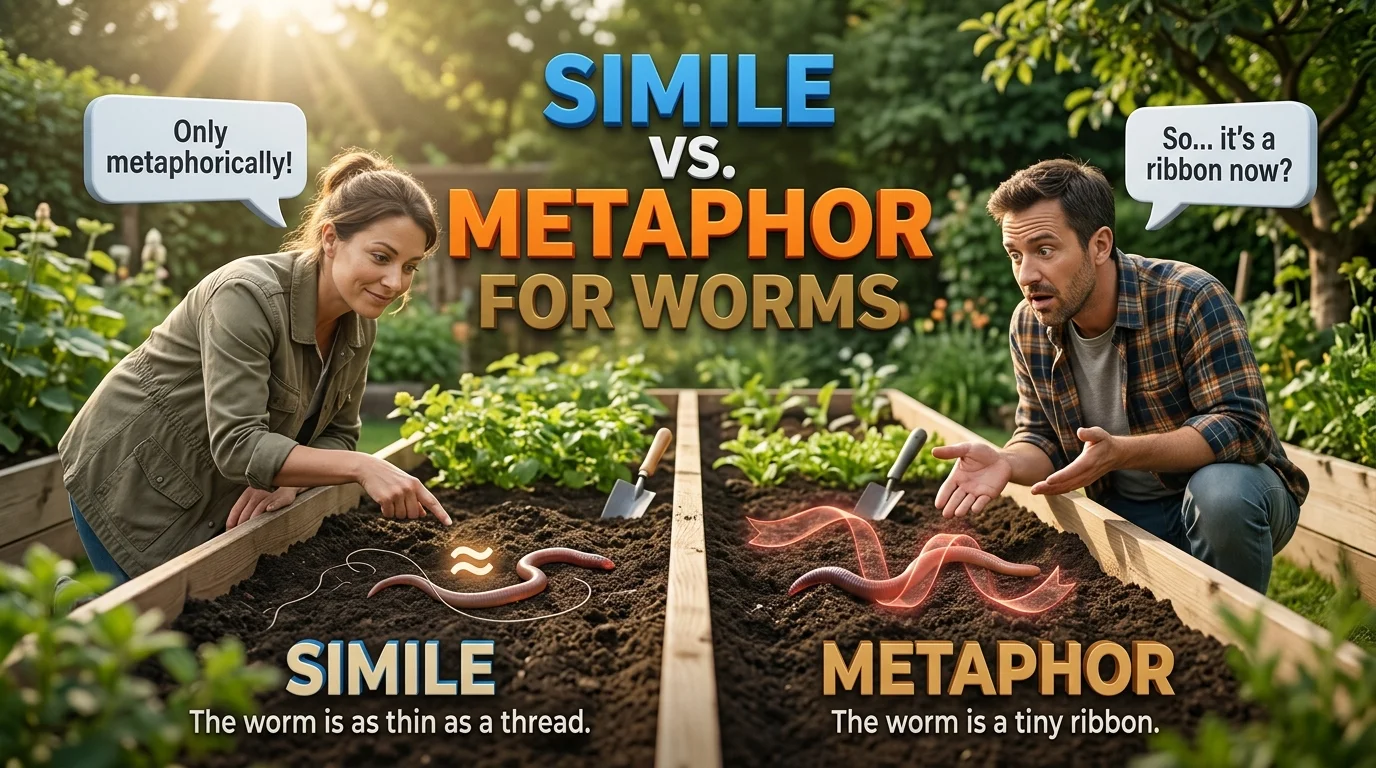
Simile vs. Metaphor for Worms
A simile makes the comparison explicit by using words such as like or as.
The worm twisted like a ribbon.
A metaphor makes the comparison directly.
The worm was a ribbon twisting through the soil.
Both devices create imagery, but the structure is different.
A simile is often useful when you want the comparison to remain clearly figurative and easy for the reader to recognize.
Quick List of Similes for Worms
Here are some of the strongest options at a glance:
- Like a tiny piece of string
- Like a ribbon in the wind
- Like a living shoelace
- Like a loose thread
- Like a wriggling noodle
- Like a piece of spaghetti
- Like a miniature rope
- Like a tiny spring
- Like a moving pencil line
- Like a thread through fabric
- Like a rubber band being stretched
- Like a ribbon dancing in the breeze
- Like a loose shoelace
- Like a flexible wire
- Like a tiny train without wheels
- Like a brown ribbon beneath the soil
- Like a dancing shoelace
- Like a string that learned to dance
- Like a noodle trying to escape
- Like a tiny rope doing gymnastics
- Like pale threads crawling from darkness
- Like restless roots
- Like a wet shoelace
- Like wet spaghetti
- Like a thread weaving through the soil