


What Is a Simile About Money?
A simile about money compares money, wealth, spending, saving, or another financial situation with something else using words such as like or as.
For example:
His savings grew like a tree watered every day.
The savings do not literally become a tree. The comparison highlights gradual growth and the regular care behind it.
Compare that with:
Money disappeared from her wallet like water through a cracked pipe.
Here, the comparison emphasizes uncontrolled loss. The image makes the financial situation easier to picture than a plain statement such as “She spent her money quickly.”
Money similes can describe very different experiences, including:
wealth and abundance
saving and gradual growth
earning and receiving income
spending and financial loss
being broke or financially stretched
debt and financial pressure
money’s influence or power
financial freedom
generosity
temptation and materialism
The key is to choose an image that matches the specific quality you want to communicate.
Why Do Writers Use Similes About Money?
Financial language often deals with ideas that are difficult to visualize: wealth, scarcity, security, debt, financial pressure, spending habits, and financial freedom.
A well-chosen simile gives one of those abstract ideas a physical shape.
Consider:
She was saving money carefully.
That tells us what she was doing, but not much about her attitude toward it.
Now consider:
She guarded every dollar like a gardener protecting a new seedling.
The comparison suggests patience, attention, and care. The reader can picture the behavior rather than simply being told about it.
A useful money simile should add at least one meaningful layer to the sentence. It might show speed, scale, emotion, control, vulnerability, growth, or consequence.
For example, saying someone has very little money gives a financial fact. Comparing their resources to a dry well also suggests emptiness and scarcity. The image earns its place because it communicates something beyond the literal statement.

Money Similes vs. Metaphors and Literal Descriptions
Similes, metaphors, and literal descriptions can communicate the same basic idea, but they create different effects.
| Form | Example | What It Does |
|---|---|---|
| Literal description | He spent his paycheck quickly. | States the situation directly. |
| Simile | He spent his paycheck like a child in a candy store. | Compares the behavior with a vivid image. |
| Metaphor | His paycheck was a melting snowball. | Treats one thing as another for effect. |
A simile openly signals that the comparison is figurative. That can make it especially useful when you want imagery without making the reader interpret a more compressed metaphor.
There is also an important distinction between what the money is doing and what the comparison means.
For example:
Money slipped through his fingers like wet sand.
The literal subject is money, but the image of wet sand communicates a secondary idea: once the spending starts, holding onto the money becomes difficult.
That is why the strongest financial comparisons are not chosen simply because they are related to money. They are chosen because the image shares a meaningful quality with the financial situation.
45+ Similes About Money for Different Situations
If you need a ready-to-use comparison, choose the category that matches the situation first. Then adjust the wording to fit the character, sentence, audience, and tone.
Similes for Having Lots of Money and Wealth
1. Rich like a king with a vault full of gold
This gives an intentionally traditional image of exceptional wealth and abundance.
Example:
After years of building his company, he was rich like a king with a vault full of gold.
2. Money stacked like bricks in a fortress
This comparison emphasizes both quantity and the sense of security that wealth can create.
3. Wealth flowing like a river after heavy rain
This works when money or income seems to arrive continuously rather than as a single windfall.
4. As wealthy as a treasure chest overflowing onto the floor
The overflowing image communicates abundance rather than merely being financially comfortable.
5. Dollars spread like autumn leaves across the ground
This is deliberately exaggerated, making it suitable for humorous or imaginative writing rather than precise financial description.
6. His fortune stood like a mountain that seemed impossible to climb
This comparison focuses on the scale of the fortune rather than simply labeling the person rich.
7. Her bank account grew like a garden in fertile soil
This works best when wealth develops gradually through continued effort.
Similes for Spending Money Too Fast or Losing It
8. Money vanished like smoke in the wind
A concise comparison for money that disappears before the person can enjoy or retain it.
Example:
My paycheck vanished like smoke in the wind after rent and bills were paid.
9. Spending money like water from a broken faucet
This suggests a continuous outflow that is difficult to stop.
10. Dollars flew out of his wallet like birds startled from a tree
The sudden movement makes the spending feel rapid and almost involuntary.
11. Her money disappeared like snow under the summer sun
This emphasizes how quickly something substantial can diminish.
12. He spent cash like a child loose in a candy store
This works when the spending is driven by excitement, temptation, or poor restraint.
13. Money slipped through his fingers like wet sand
This is especially effective when someone wants to keep their money but repeatedly finds it disappearing through spending.
14. His paycheck burned like paper in a fireplace
The image is intentionally dramatic and fits reckless spending or humorous storytelling.
15. Her savings drained like water from a bathtub with the plug pulled
Unlike comparisons about sudden spending, this one suggests a steady loss that continues until the resource is nearly gone.
Similes for Saving Money and Watching It Grow
16. Savings grew like a seed becoming a tree
This captures the progression from a small beginning to something larger.
Example:
Every small deposit felt insignificant at first, but her savings grew like a seed becoming a tree.
17. Saving money like filling a jar one coin at a time
The strength of this image is consistency. Each contribution is small, but repeated contributions eventually fill the container.
18. His nest egg grew like a garden tended with patience
This connects financial growth with regular care rather than sudden luck.
19. She protected her savings like a squirrel guarding its winter food
The animal image gives the sentence a playful tone and suggests preparation for future needs.
20. Small savings gathered like drops filling a bucket
This works particularly well when explaining why modest amounts can still matter as part of a repeated habit.
21. His emergency fund grew like a snowball rolling downhill
This suggests increasing momentum, although the comparison works best when the amount is already growing rather than describing the first small deposit.
Similes for Earning and Receiving Money
Not every money comparison needs to describe wealth or spending. Sometimes the point is to show money coming in, a reliable income, or an unexpected financial gain.
22. His earnings arrived like clockwork
This emphasizes regularity and predictability.
Example:
Her freelance payments arrived like clockwork every month.
23. Money came in like rain after a long drought
This communicates relief after a period when income was scarce.
24. New clients brought income like a steady stream
The image suggests a continuing source of income rather than one unusually large payment.
25. The unexpected bonus landed like a gift from the sky
This works when the important quality is surprise rather than the size of the payment.
Similes for Being Broke or Having No Money
26. As broke as an empty wallet
A simple, immediately understandable comparison for having little or no spending money.
27. His bank account was as bare as an empty shelf
The empty shelf creates a visual sense of having nothing left.
28. She was broke like a traveler with no coins for the road
This has a storytelling quality and works particularly well when financial hardship is part of a larger journey.
29. His pockets were as empty as a dry well
The dry-well image suggests that the resource is not merely low but completely depleted.
30. My paycheck disappeared so quickly that my wallet felt like a desert
This is more conversational and humorous, making it suitable for informal writing.
31. Her savings were as thin as a sheet of paper
This emphasizes how little financial cushion remains.
Similes for Money’s Power and Influence
Money can also be described in terms of what it does to choices, relationships, access, and behavior.
32. Money can move through a room like a powerful current
The comparison suggests that money can influence a situation even when nobody is directly talking about it.
33. Wealth can spread influence like a spotlight across a stage
This focuses on visibility and attention rather than the physical amount of money.
34. Money can pull people like a magnet
This is useful when discussing financial incentives, temptation, or material attraction.
35. His fortune carried weight like an anchor
An anchor can stabilize something, but it can also restrict movement. That makes the comparison useful when wealth has both protective and limiting effects.
36. Cash became a key that opened doors like a master key
This focuses on the access or opportunities that money can provide in a particular situation.
37. Money controlled their choices like a puppeteer’s strings
This works when financial pressure or material desire strongly influences someone’s decisions.
38. Wealth surrounded her like a high wall
Depending on the context, the image can suggest protection, separation, or isolation.
More Creative Similes for Financial Ideas
39. A dollar can feel like a drop of rain during a drought
This works when a small amount of money has unusually high importance because resources are scarce.
40. Debt can cling like a shadow
The comparison communicates persistence: the problem continues to follow the person rather than disappearing after one payment.
41. A budget can act like a map through unfamiliar territory
This is useful in educational writing because it presents a budget as a tool for direction rather than simply a list of restrictions.
42. Financial freedom can feel like a bird released from a cage
This emphasizes the emotional contrast between restriction and greater freedom.
43. A sudden expense can hit like a stone through a window
The image captures an unexpected cost that disrupts an otherwise stable situation.
44. Generosity can spread like ripples across a pond
The comparison suggests that one act of giving can affect people beyond the original recipient.
45. A tiny purchase can multiply like weeds in a garden
This works when many individually small expenses accumulate into a much larger total.
46. Debt can grow like vines around an abandoned house
The slow spread of vines creates an image of a problem becoming increasingly difficult to ignore or escape.

How to Create Your Own Similes About Money
You do not need to memorize dozens of comparisons. Once the basic process is clear, you can create original similes for almost any financial situation.
A useful formula is:
Financial situation → key quality → physical image → precise comparison
For example:
Saving money → patience → growing tree → “Her savings grew like a tree she watered every day.”
This approach helps avoid random comparisons that sound clever but do not actually explain anything.
Step 1: Identify the Emotion or Quality
First decide what you want the reader to feel or understand.
Are you describing:
abundance?
scarcity?
fear?
temptation?
freedom?
growth?
loss?
generosity?
pressure?
stability?
speed?
patience?
For example, suppose your subject is saving money.
The important quality might be patience rather than money itself.
That distinction makes it easier to find an effective image.
Step 2: Brainstorm Physical Images With the Same Quality
Now think about objects, places, animals, or natural processes that share that quality.
For patience, you might think of:
planting a tree
waiting for a harvest
building a house
filling a jar
watching a river carve through stone
You now have raw material for your comparison.
Step 3: Connect the Image Using “Like” or “As”
Turn your idea into a natural sentence.
For example:
Saving money is like planting a tree.
Or:
Her savings grew like a tree watered every morning.
The second version creates a more specific image because it shows the process rather than merely naming the comparison.
Step 4: Make the Comparison Specific and Unexpected
Generic comparisons are easy to forget.
Instead of:
He saved money like a squirrel.
Try:
He guarded every dollar like a squirrel hiding its last acorn before winter.
The added detail gives the image a situation and a reason.
You do not need to make every comparison strange or surprising. The goal is to make it specific enough to carry meaning.
Step 5: Test the Simile Aloud
Read the sentence out loud.
Ask:
Does it sound natural?
Is the comparison easy to understand?
Does the image match the intended emotion?
Is it too exaggerated for the context?
Does it add something that the literal sentence lacks?
If the comparison sounds forced, simplify it.
A good simile should feel like part of the sentence rather than something attached merely to make the writing sound creative.
Using Money Similes in Different Types of Writing
The same comparison may work beautifully in one type of writing and feel inappropriate in another. Audience and purpose should determine how much imagery you use.
Creative Writing and Fiction
Fiction gives you considerable freedom with imagery.
A character’s financial situation can reveal personality without directly explaining it.
Instead of:
Daniel was extremely careful with money.
You might write:
Daniel guarded every dollar like a sailor guarding his last match in a storm.
The image suggests that Daniel treats money as something precious and limited. It also gives the reader a clue about his circumstances without explicitly explaining them.
Poetry and Verse
Poetry often benefits from compressed imagery.
A short comparison can carry several meanings at once:
Her savings grew like morning light, slowly filling the room.
The image connects financial growth with something gradual, visible, and hopeful.
In poetry, also consider rhythm, sound, line length, and emotional tone. A technically clear simile can still feel weak if it interrupts the poem’s rhythm.
Formal Essays and Academic Writing
Money similes can be used in essays when they clarify an idea rather than replace precise explanation.
For example:
A household budget can function like a roadmap, helping families see where their income is going.
The comparison gives the reader an intuitive picture of what a budget does.
However, formal writing usually benefits from restraint. If the subject requires precise financial terminology, the comparison should support the explanation rather than substitute for it.
Speeches and Presentations
Financial imagery can make an explanation easier to remember.
For example:
Small savings are like drops filling a bucket; each one seems insignificant, but together they create something substantial.
A speaker can use this type of comparison to turn an abstract idea about repeated small contributions into a visual sequence the audience can immediately understand.
Common Mistakes When Writing Similes About Money
A simile is not automatically effective just because it contains like or as.
Overused Comparisons
Some comparisons are so familiar that they add very little imagery.
For example:
Money is like water.
The comparison can communicate the general idea of movement, but by itself it is too broad to tell the reader what kind of financial situation you mean.
A more specific version is:
Money flowed through his hands like water through a cracked pipe.
Now the comparison communicates rapid loss and poor retention.
Forced Comparisons
Do not choose an image simply because it sounds clever.
If the comparison has no meaningful connection to the financial idea, readers may stop to figure out the comparison instead of understanding the point.
Ask:
What exactly do these two things have in common?
If the answer is unclear, choose another image.
Mixing Incompatible Images
An extended comparison becomes confusing when its imagery changes halfway through.
For example, if you begin by comparing saving money to gardening, suddenly introducing ships, racing cars, and mountains can make the paragraph feel disconnected.
Choose one image system and develop it consistently.
Ignoring Cultural Context
Not every comparison works equally well for every audience.
An image involving a particular sport, holiday, animal, food, or tradition may be unfamiliar to some readers.
For a broad US audience, familiar everyday images are often easier to understand. But familiarity should not come at the expense of originality; a common object can still produce a fresh comparison when used precisely.
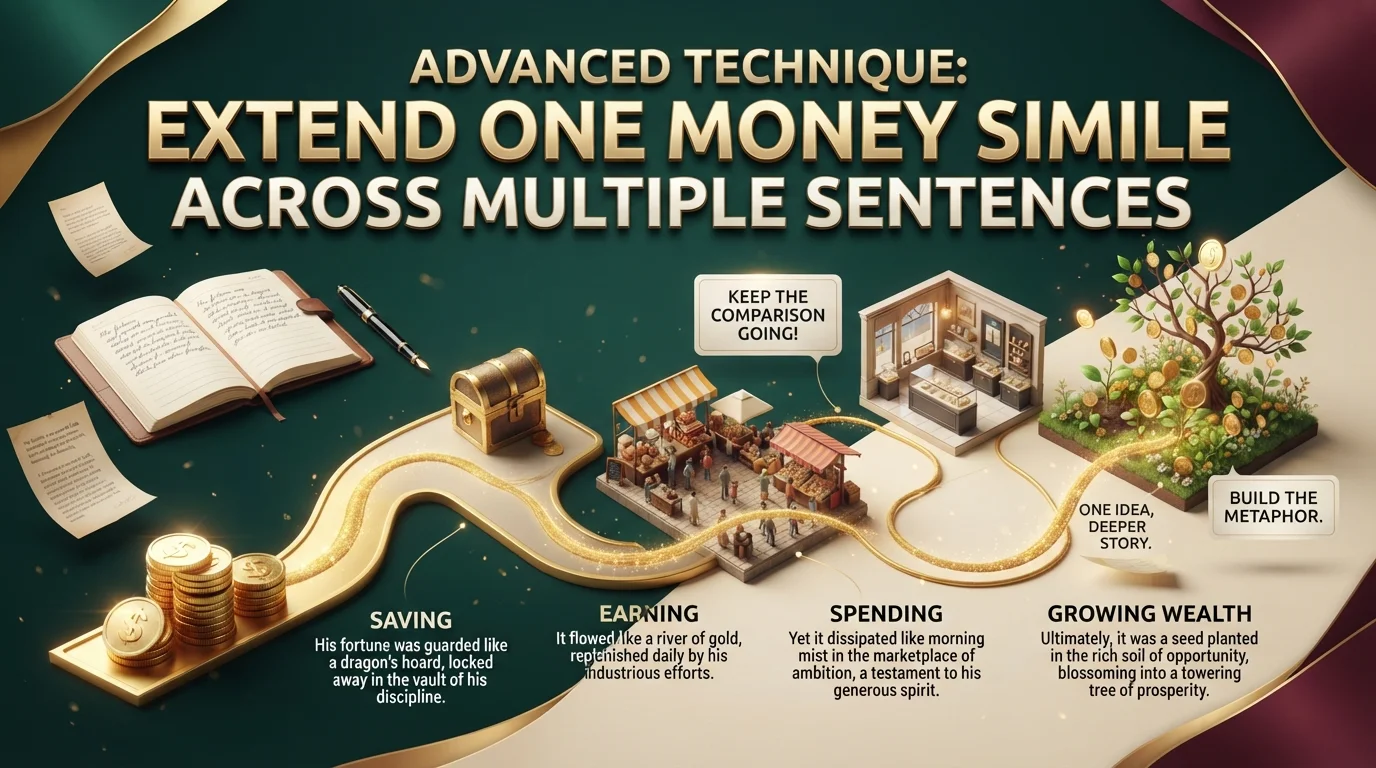
Advanced Technique: Extend One Money Simile Across Multiple Sentences
A single comparison does not always have to end after one sentence.
You can develop an image across a paragraph. This is often called an extended simile when the comparison continues through multiple sentences.
For example, imagine comparing saving money to gardening:
Saving money is like planting a garden. At first, the soil looks almost unchanged, even after you place the seeds in the ground. With regular care, however, small shoots appear. Eventually, those tiny beginnings can produce a harvest.
The financial idea becomes a process rather than a single comparison. The reader can follow the progression from small beginning → consistent care → growth → result.
This technique works especially well in:
personal essays
speeches
storytelling
educational writing
motivational writing
poetry
How to Layer Imagery Without Losing Clarity
The danger of an extended comparison is taking it too far.
If you begin with a garden, stay inside that image long enough for it to develop.
For example:
Planting → watering → growing → harvesting
Each stage reinforces the same idea.
You do not need to explain every part of the financial situation through the metaphor. Stop when the image has done its job. That keeps extended imagery vivid instead of turning it into a puzzle for the reader.
Practice Exercise: Create Three Original Similes About Money
Try this short exercise rather than simply copying an existing comparison.
Exercise 1: Describe Saving
Choose an image that represents patience.
Complete:
Saving money is like ______ because ______.
Then make the image more specific by adding one detail that a reader can visualize.
Exercise 2: Describe Spending
Choose something that disappears quickly.
Complete:
My money disappeared like ______.
Now ask whether the comparison shows speed, lack of control, or both.
Exercise 3: Describe Financial Freedom
Choose an image associated with release or independence.
Complete:
Financial freedom feels like ______.
Then remove any unnecessary words and read the sentence aloud.
The goal is not to make the simile as complicated as possible. A simple comparison that fits perfectly is usually more effective than an elaborate one that feels forced.