
What Are Similes for Attribute?
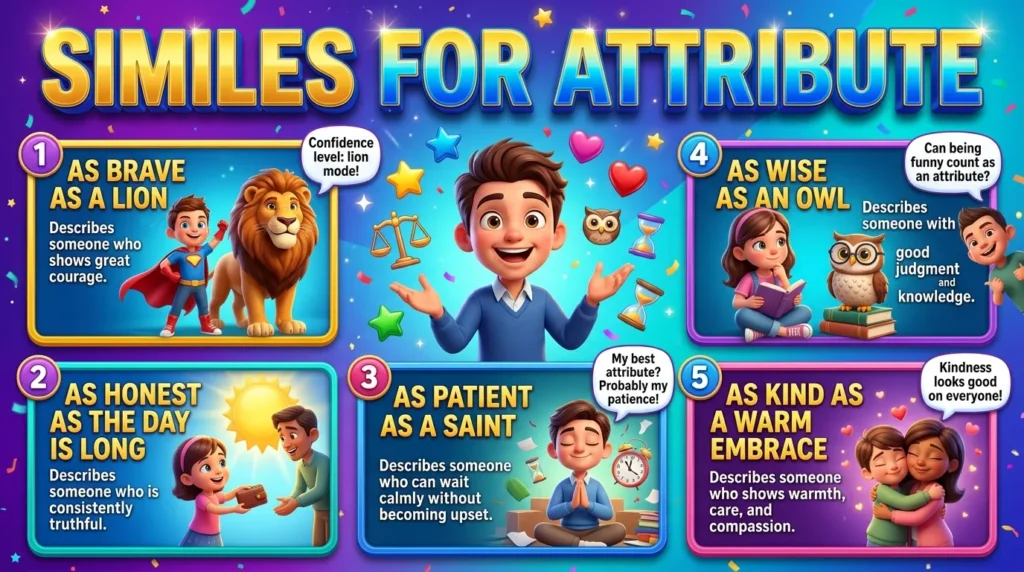
Similes for attribute are expressions that compare qualities or characteristics with something familiar. They use words like like or as to make descriptions clearer and more interesting.
According to the Cambridge Dictionary’s definition of simile, a simile compares one thing with another using these words.
For example, “as gentle as a dove” describes someone with a peaceful and caring nature.
Why Use Similes for Attribute?
Attributes help explain what makes a person or thing special. However, simply calling someone kind, brave, or honest can sometimes sound plain.
A well-chosen simile gives readers a clearer picture. It makes abstract qualities easier to understand and remember.
Here are some benefits of using similes:
Better descriptions: They make personal qualities more vivid.
Creative writing: They add personality to stories and essays.
Clear communication: They explain difficult ideas through familiar comparisons.
Stronger imagery: They help readers picture someone’s behavior.
Vocabulary development: They introduce students to expressive language.
Research published in Cambridge Core discusses how analogies help explain unfamiliar concepts. This makes comparisons useful in educational settings and everyday communication.
30 Best Similes for Attribute With Meanings and Example Sentences
Here are expressive comparisons for describing different personal qualities. Each example includes a simple meaning and sentence.
Positive Attributes and Personal Qualities
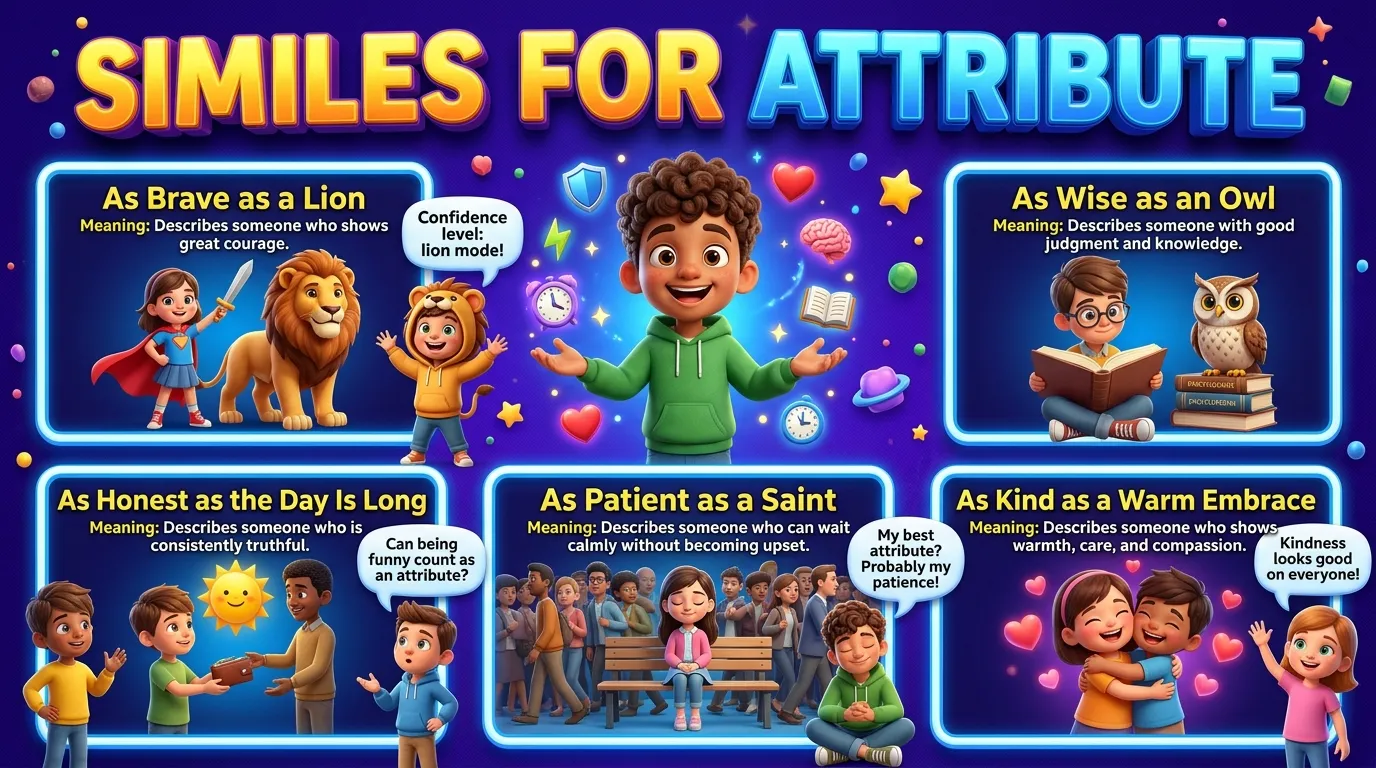
1. As brave as a lion – Meaning: Extremely courageous – Example: “She was as brave as a lion when facing her fears.”
2. As gentle as a dove – Meaning: Peaceful and kind – Example: “My grandmother is as gentle as a dove.”
3. As honest as an open book – Meaning: Completely truthful – Example: “He is as honest as an open book with his friends.”
4. Like a diamond in the sunlight – Meaning: Beautiful and valuable – Example: “Her kindness shines like a diamond in the sunlight.”
5. As patient as a saint – Meaning: Extremely patient – Example: “Our teacher is as patient as a saint.”
6. As loyal as a faithful dog – Meaning: Always supportive and dependable – Example: “He remained as loyal as a faithful dog.”
7. As wise as an owl – Meaning: Full of wisdom – Example: “My grandfather is as wise as an owl.”
8. Like sunshine on a rainy day – Meaning: Bringing happiness and hope – Example: “Her cheerful nature is like sunshine on a rainy day.”
9. As strong as an oak tree – Meaning: Emotionally or physically strong – Example: “She stayed as strong as an oak tree during difficult times.”
10. As humble as a wildflower – Meaning: Modest and unpretentious – Example: “Despite his success, he remained as humble as a wildflower.”
Similes for Intelligence, Confidence, and Creativity
11. As sharp as a razor – Meaning: Extremely intelligent – Example: “Her mind is as sharp as a razor.”
12. Like a spark lighting a fire – Meaning: Inspiring new ideas – Example: “His creativity spread like a spark lighting a fire.”
13. As confident as a king – Meaning: Very self-assured – Example: “She walked onto the stage as confident as a king.”
14. As curious as a cat – Meaning: Always eager to learn – Example: “The young student is as curious as a cat.”
15. Like a river finding its way – Meaning: Adaptable and determined – Example: “His flexible nature moves like a river finding its way.”
16. As quick as lightning – Meaning: Extremely fast at thinking or responding – Example: “Her mind is as quick as lightning during debates.”
17. As imaginative as a dream – Meaning: Full of creative ideas – Example: “His personality is as imaginative as a dream.”
Similes for Negative Attributes and Weaknesses
18. As stubborn as a mule – Meaning: Unwilling to change an opinion – Example: “He is as stubborn as a mule during arguments.”
19. As cold as ice – Meaning: Emotionally distant – Example: “His attitude was as cold as ice.”
20. Like a storm without warning – Meaning: Unpredictable and aggressive – Example: “His temper arrived like a storm without warning.”
21. As selfish as a spoiled child – Meaning: Caring only about personal needs – Example: “He acted as selfish as a spoiled child.”
22. As lazy as a sleeping cat – Meaning: Unwilling to work – Example: “He remained as lazy as a sleeping cat all afternoon.”
23. Like a shadow following someone – Meaning: Constantly dependent on another person – Example: “His insecurity followed him like a shadow.”
24. As proud as a peacock – Meaning: Overly pleased with oneself – Example: “He looked as proud as a peacock after winning.”
25. As restless as the wind – Meaning: Unable to stay calm or still – Example: “Her restless nature was as restless as the wind.”
Similes for Emotional and Social Attributes
26. As caring as a mother – Meaning: Deeply loving and supportive – Example: “She is as caring as a mother toward her friends.”
27. Like a bridge connecting two worlds – Meaning: Bringing different people together – Example: “His friendly nature works like a bridge connecting two worlds.”
28. As calm as a still lake – Meaning: Peaceful and composed – Example: “She remained as calm as a still lake during the crisis.”
29. As generous as a giving tree – Meaning: Always willing to share – Example: “My neighbor is as generous as a giving tree.”
30. Like a lighthouse in the darkness – Meaning: Guiding and inspiring others – Example: “Her leadership is like a lighthouse in the darkness.”
Attribute Synonyms and Antonyms: Words That Describe Personal Qualities
Understanding attribute synonyms and antonyms helps you describe people more accurately. Synonyms offer different ways to express qualities. Antonyms communicate opposite meanings.
What Is a Synonym for “Attributes”?
An attribute is a quality, feature, or characteristic belonging to someone or something.
Here are useful alternatives:
Characteristics: Features that describe someone.
Qualities: Personal traits or abilities.
Traits: Distinctive parts of someone’s personality.
Properties: Particular features of something.
Features: Noticeable qualities or details.
Strengths: Positive abilities or qualities.
Characteristics: Distinguishing aspects of a person.
Another Word for Attributes of a Person
When describing someone’s personality, these words work well:
Attribute | Alternative word |
|---|---|
Kindness | Compassion |
Honesty | Integrity |
Bravery | Courage |
Patience | Tolerance |
Intelligence | Wisdom |
Confidence | Self-assurance |
Loyalty | Faithfulness |
Generosity | Selflessness |
Creativity | Imagination |
Determination | Persistence |
Another Word for Attributes in an Essay
Academic writing often needs precise and professional vocabulary. Instead of repeating “attributes,” consider these alternatives:
Characteristics: For describing identifiable features.
Qualities: For discussing personal strengths.
Traits: For explaining personality.
Factors: For discussing contributing elements.
Properties: For describing objects or concepts.
Features: For highlighting important details.
For example:
Original: “The main attributes of a good leader include honesty and confidence.”
Improved: “The main characteristics of a good leader include honesty and confidence.”
Attributes Synonym Formal
If you’re writing an academic paper or professional document, consider these formal alternatives:
Formal synonym | Best use |
|---|---|
Characteristics | General descriptions |
Attributes | Specific qualities |
Properties | Technical descriptions |
Distinguishing features | Unique qualities |
Personal traits | Human personality |
Qualities | General positive features |
Capabilities | Skills and abilities |
Attribute Synonym for Kids
Children can use simple words instead of attributes. These words make descriptions easier to understand.
Traits: Things that make someone special.
Qualities: Things that describe someone.
Features: Parts or details of something.
Strengths: Things someone does well.
Skills: Things someone can do.
For example, kindness, honesty, and bravery are positive attributes.
Attribute Antonyms: What Words Mean the Opposite?
An attribute doesn’t have one perfect antonym in every situation. Its opposite depends on the quality being discussed.
Here are some useful attribute antonyms:
Positive attribute | Opposite |
|---|---|
Kindness | Cruelty |
Honesty | Dishonesty |
Bravery | Cowardice |
Patience | Impatience |
Loyalty | Betrayal |
Generosity | Selfishness |
Confidence | Insecurity |
Humility | Arrogance |
Wisdom | Foolishness |
Friendliness | Hostility |
Attribute antonym as a verb: When attribute means assigning a cause or responsibility, possible opposites include disassociate, disown, or deny, depending on context.
Attribute Examples: What Are Some Examples of Attributes?
Attributes describe people, objects, and even organizations. They can be positive, negative, physical, or personal.
Here are some everyday examples:
Personal attributes: Honesty, kindness, patience, and courage.
Physical attributes: Height, strength, appearance, and eye color.
Professional attributes: Leadership, teamwork, communication, and reliability.
Academic attributes: Curiosity, discipline, creativity, and focus.
Negative attributes: Arrogance, laziness, dishonesty, and selfishness.
These examples show how attributes help explain different characteristics.
How to Use Similes for Attribute Like a Pro
Good similes should sound natural and communicate one clear idea. Try these practical tips.
1. Choose a specific quality: Decide whether you’re describing courage, kindness, intelligence, or another attribute.
2. Find a familiar comparison: Compare the quality with something readers already understand.
3. Use like or as: These connecting words help create recognizable similes.
4. Match the comparison to the meaning: A lion suggests bravery, while a dove suggests gentleness.
5. Avoid unnecessary comparisons: One strong simile often works better than several weak ones.
Simile vs. Metaphor for Attribute
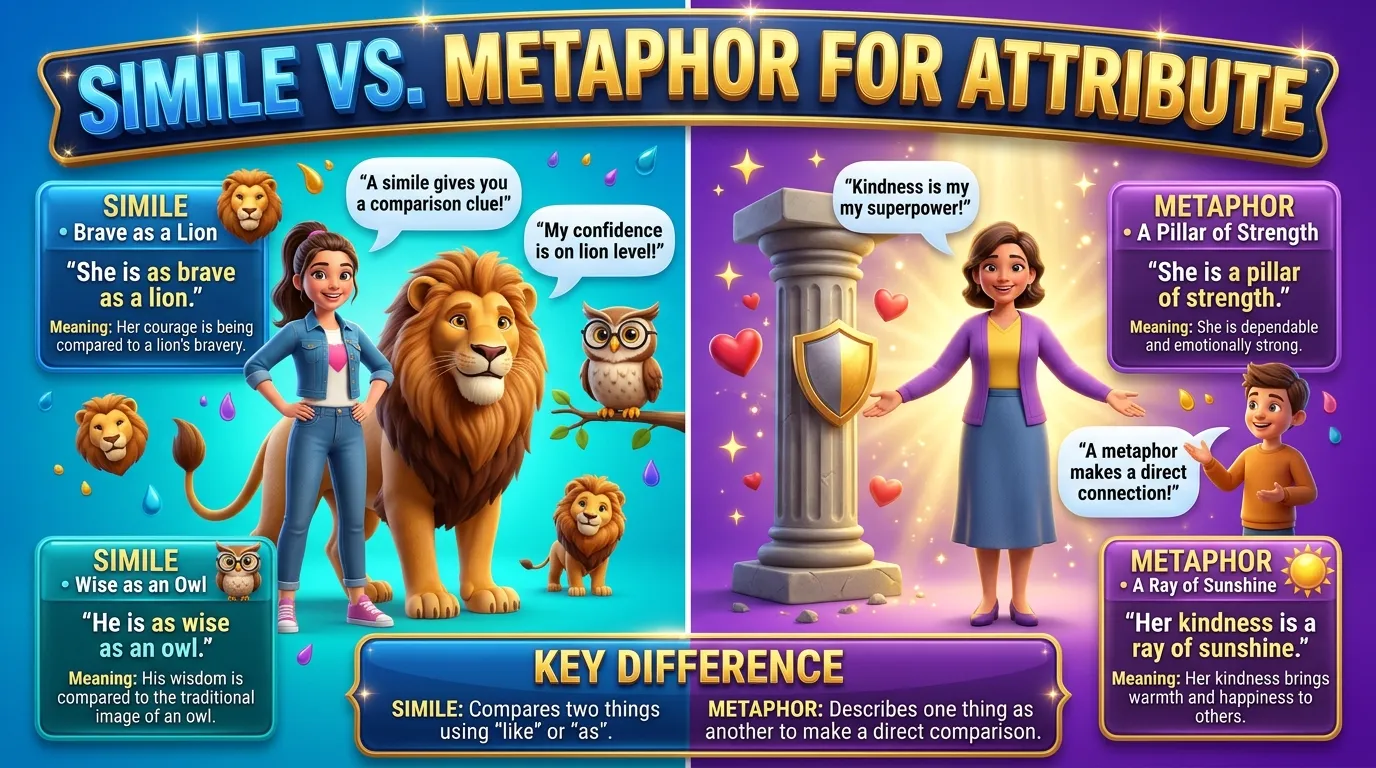
A simile compares an attribute to something using like or as. A metaphor makes a direct comparison without those words.
Simile | Metaphor |
|---|---|
She is as brave as a lion. | She is a lion. |
He is as wise as an owl. | He is an owl. |
Her kindness is like sunshine. | Her kindness is sunshine. |
His mind is as sharp as a razor. | His mind is a razor. |
Key Difference: A simile uses like or as to compare qualities, while a metaphor directly describes one thing as another.
Common Mistakes When Writing Similes for Attributes
Avoid these mistakes to make your comparisons clear and meaningful:
Using metaphors instead of similes: “He is a lion” is a metaphor. “He is as brave as a lion” is a simile.
Choosing unrelated comparisons: Make sure the comparison describes the intended attribute.
Repeating the same quality: Use different comparisons for courage, kindness, patience, and intelligence.
Confusing attributes with actions: An attribute describes a quality, while an action describes something someone does.
Using negative comparisons carelessly: Choose words that fit the tone and purpose of your writing.