

What Is a Simile for Eyes?
A simile for eyes compares someone’s eyes to another object, scene, natural element, or experience, usually using like or as.
For example:
His eyes were as bright as stars after sunset.
The comparison helps the reader visualize the eyes rather than simply receiving a factual description.
An eye simile can describe:
- Color
- Brightness
- Shape
- Size
- Expression
- Emotion
- Intensity
- Personality
- Mood
- Movement
A strong comparison usually focuses on one or two of these qualities rather than trying to describe everything at once.
75+ Similes for Eyes
1. Eyes like stars in a clear night sky
This creates an image of brightness, beauty, and liveliness.
Example:
Her eyes sparkled like stars in a clear night sky.
2. Eyes like deep blue lakes
This works well for blue eyes and suggests depth and tranquility.
Example:
His eyes were like deep blue lakes, calm but difficult to read.
3. Eyes like polished glass
This suggests clarity, brightness, or an unusually reflective appearance.
Example:
Her eyes were clear like polished glass.
4. Eyes like warm pools of honey
A useful comparison for golden, amber, or warm brown eyes.
Example:
His eyes looked like warm pools of honey in the afternoon light.
5. Eyes like two bright lanterns
This emphasizes brightness and alertness.
Example:
Her eyes shone like two bright lanterns in the darkness.
6. Eyes like the ocean beneath sunlight
This combines blue color with movement and light.
Example:
Her eyes were like the ocean beneath sunlight, shifting between blue and green.
7. Eyes like autumn leaves
This can work beautifully for hazel, amber, or brown eyes.
Example:
His eyes were like autumn leaves, flecked with gold and brown.
8. Eyes like dark coffee
A simple comparison for rich brown eyes.
Example:
Her eyes were dark like freshly brewed coffee.
9. Eyes like moonlit water
This gives eyes a mysterious, reflective quality.
Example:
His eyes shimmered like moonlit water.
10. Eyes like a summer sky
This is especially effective for bright blue eyes.
Example:
Her eyes were as blue and open as a summer sky.
11. Eyes like polished amber
This emphasizes golden or amber coloring.
Example:
The dog’s eyes were like polished amber.
12. Eyes like morning dew
This suggests freshness, brightness, and delicacy.
Example:
Her eyes were bright like morning dew.
13. Eyes like tiny mirrors
This focuses on reflection and clarity.
Example:
His eyes were like tiny mirrors, catching every movement in the room.
14. Eyes like dark windows
This creates a mysterious or difficult-to-read mood.
Example:
His eyes were like dark windows, revealing almost nothing.
15. Eyes like candles in a quiet room
This suggests warmth and a gentle glow.
Example:
Her eyes glowed like candles in a quiet room.
16. Eyes like two pools of sunlight
This is useful for bright, warm eyes.
Example:
His eyes looked like two pools of sunlight beneath his brows.
17. Eyes like sapphires
A classic comparison for vivid blue eyes.
Example:
Her eyes were bright like sapphires.
Because this is a familiar comparison, it works best when the context genuinely calls for a jewel-like image.
18. Eyes like emeralds after rain
This works particularly well for green eyes.
Example:
Her eyes were green like emeralds after rain.
19. Eyes like chocolate melting in sunlight
This creates a warm, soft image for brown eyes.
Example:
His eyes were warm like chocolate melting in sunlight.
20. Eyes like storm clouds
This suggests gray eyes or a troubled, intense expression.
Example:
His eyes were gray like storm clouds gathering over the hills.
21. Eyes like frozen lakes
This can suggest pale eyes, emotional distance, or a cold expression.
Example:
Her eyes were like frozen lakes, beautiful but distant.
22. Eyes like fireflies at dusk
This gives the eyes a lively, sparkling quality.
Example:
Her eyes flickered like fireflies at dusk.
23. Eyes like quiet rivers
This comparison suggests calmness and depth.
Example:
His eyes were like quiet rivers, steady and deep.
24. Eyes like two windows into another world
This emphasizes mystery and emotional depth.
Example:
Her eyes were like two windows into another world.
25. Eyes like bright beads
This can describe small, lively, alert eyes.
Example:
The bird watched us with eyes like bright beads.
26. Eyes like black pearls
This works for very dark eyes with a glossy appearance.
Example:
Her eyes were like black pearls beneath the soft light.
27. Eyes like glass marbles
This suggests roundness, shine, or a youthful appearance.
Example:
The child’s eyes were like glass marbles, wide with curiosity.
28. Eyes like two drops of ink
This creates a strong image for deep black or very dark brown eyes.
Example:
His eyes were like two drops of ink against his pale face.
29. Eyes like golden coins
This can describe bright amber or golden-brown eyes.
Example:
Her eyes glowed like golden coins in the evening light.
30. Eyes like candle flames
This emphasizes warmth, flickering light, or intensity.
Example:
His eyes burned like candle flames in the dim room.
31. Eyes like a clear winter sky
This suggests pale blue, clarity, and openness.
Example:
Her eyes were as clear as a winter sky.
32. Eyes like rain-soaked stones
This works well for gray eyes and a subdued mood.
Example:
His eyes were gray like rain-soaked stones.
33. Eyes like the first light of dawn
This creates an image of warmth, hope, and gentle brightness.
Example:
Her eyes glowed like the first light of dawn.
34. Eyes like hidden treasure
This suggests rarity and mystery.
Example:
His eyes were like hidden treasure, difficult to discover but impossible to forget.
35. Eyes like a quiet forest
This gives eyes an earthy, peaceful, slightly mysterious quality.
Example:
Her green eyes were like a quiet forest after rain.
Similes for Beautiful Eyes
When describing beautiful eyes, avoid relying entirely on gemstones. Beauty can come from warmth, expression, light, depth, or individuality.
Try:
- Like stars caught in glass
- Like sunlight on clear water
- Like flowers opening at dawn
- Like polished amber
- Like moonlight on a lake
- Like a clear summer sky
- Like tiny pools of light
- Like morning after a storm
- Like fireflies in a garden
- Like two windows filled with sunlight
Example
Her eyes were like sunlight resting on clear water.
The comparison suggests beauty through light and movement rather than simply naming a color.
Similes for Beautiful Blue Eyes
Blue eyes offer many possibilities beyond the familiar “like the ocean.”
- Like a cloudless summer sky
- Like deep mountain lakes
- Like sapphires beneath sunlight
- Like moonlit ocean water
- Like blue glass catching the sun
- Like winter skies after snowfall
- Like rainwater in a stone basin
- Like the horizon just before dawn
- Like a glacier reflecting the sky
- Like two pieces of clear sky
Example
Her blue eyes were like mountain lakes beneath a cloudless sky.
Similes for Brown Eyes
Brown eyes can be described through warmth, earth, wood, coffee, chocolate, autumn, and sunlight.
- Like dark coffee
- Like polished walnut
- Like warm chocolate
- Like autumn earth
- Like chestnuts in sunlight
- Like tree bark after rain
- Like amber mixed with earth
- Like roasted chestnuts
- Like warm cinnamon
- Like sunlight caught in brown glass
Example
His brown eyes were like polished walnut, dark and warm beneath the light.
Similes for Green Eyes
Green eyes can evoke forests, leaves, moss, emeralds, herbs, and spring landscapes.
- Like emeralds after rain
- Like fresh leaves in spring
- Like a forest after a storm
- Like moss beneath morning light
- Like green glass in sunlight
- Like a meadow after rain
- Like hidden leaves beneath the canopy
- Like spring grass under sunlight
- Like a quiet forest pool
- Like jade beneath clear water
Example
Her eyes were green like leaves shining after a spring rain.
Similes for Hazel Eyes
Hazel eyes are especially interesting because their appearance can shift between brown, green, gold, and amber.
Try:
- Like autumn leaves touched by sunlight
- Like honey mixed with moss
- Like a forest lit by late afternoon
- Like gold hidden beneath green leaves
- Like changing leaves in October
- Like amber floating in green glass
- Like sunlight passing through a forest
- Like a meadow at sunset
- Like polished wood flecked with gold
- Like autumn trapped in glass
Example
Her hazel eyes were like autumn leaves when the afternoon sun touched them.
Similes for Black Eyes
For very dark eyes, comparisons involving night, ink, polished stones, and dark glass can create strong imagery.
- Like two drops of ink
- Like midnight without stars
- Like polished obsidian
- Like dark glass
- Like a moonless sky
- Like black pearls
- Like shadows beneath a doorway
- Like ink beneath candlelight
- Like midnight pools
- Like polished stone after rain
Example
His eyes were like midnight pools, dark and reflective.
Similes for Gray Eyes
Gray eyes can take on qualities of clouds, silver, smoke, rain, stone, and winter skies.
- Like storm clouds before rain
- Like silver beneath moonlight
- Like rain-soaked stones
- Like a winter sky
- Like smoke drifting across a window
- Like polished silver
- Like clouds over distant mountains
- Like morning fog
- Like steel beneath soft light
- Like the sea beneath an overcast sky
Example
Her gray eyes were like storm clouds holding back the rain.
Similes for Sparkling Eyes
Sparkling eyes often suggest happiness, excitement, amusement, curiosity, or affection.
Try:
- Like stars after dark
- Like sunlight on water
- Like fireflies at dusk
- Like tiny diamonds catching light
- Like candles flickering in glass
- Like morning dew
- Like sunlight through leaves
- Like stars scattered across velvet
- Like bright coins in a fountain
- Like sparks from a small fire
Example
His eyes sparkled like sunlight dancing across a lake.
Similes for Sad Eyes
For sadness, comparisons should often focus on expression and atmosphere, not simply color.
- Like rainclouds at dusk
- Like windows after a storm
- Like flowers after a long drought
- Like a lake beneath gray skies
- Like candles running low
- Like clouds hiding the sun
- Like an empty room at twilight
- Like rain trapped behind glass
- Like winter fields beneath a pale sky
- Like a fading photograph
Example
Her eyes looked like rainclouds waiting for the storm to break.
Similes for Happy Eyes
Happy eyes can be described through brightness, movement, light, and warmth.
- Like sunlight through curtains
- Like stars suddenly appearing
- Like fireflies in summer grass
- Like morning after rain
- Like windows filled with sunlight
- Like flowers opening in spring
- Like bright coins beneath clear water
- Like candles suddenly catching flame
- Like the first light of sunrise
- Like a clear sky after a storm
Example
His eyes were bright like the first light of sunrise.
Similes for Angry Eyes
Angry eyes can communicate intensity without using graphic or exaggerated descriptions.
- Like sparks before a fire
- Like storm clouds gathering
- Like flames behind glass
- Like thunder waiting to break
- Like coals glowing beneath ash
- Like a storm trapped behind a window
- Like lightning beneath dark clouds
- Like fire reflected in polished metal
- Like a warning light in the darkness
- Like a furnace behind a closed door
Example
Her eyes flashed like sparks before a fire.
Similes for Kind Eyes
Kind eyes often benefit from warm and comforting imagery.
- Like sunlight through a window
- Like a warm lamp on a winter evening
- Like a quiet garden
- Like morning light
- Like a soft candle flame
- Like a familiar home
- Like warm tea on a cold day
- Like sunlight resting on a porch
- Like a calm lake
- Like a gentle breeze
Example
Her eyes were as warm as sunlight through a window.
Similes for Mysterious Eyes
For mystery, choose images that suggest depth, concealment, reflection, or uncertainty.
- Like dark windows
- Like an unexplored forest
- Like a locked room
- Like moonlight on deep water
- Like fog hiding a distant road
- Like a book with missing pages
- Like a midnight lake
- Like shadows behind curtains
- Like a door leading somewhere unknown
- Like stars hidden behind clouds
Example
His eyes were like a locked room, inviting curiosity but revealing nothing.
Similes for Intense Eyes
Intensity can come from focus, concentration, determination, or strong emotion.
- Like a hawk watching its surroundings
- Like flames behind glass
- Like a spotlight in darkness
- Like an arrow aimed at its target
- Like a storm about to break
- Like a blade catching sunlight
- Like a camera fixed on one point
- Like a lighthouse cutting through fog
Example
Her eyes were fixed on him like a spotlight in the darkness.
Similes for Tired Eyes
Tired eyes can be described through fading light, heavy curtains, cloudy skies, or dim lamps.
- Like lamps running out of oil
- Like windows beneath heavy curtains
- Like a sky before sunrise
- Like candles near the end of the night
- Like clouds after a long storm
- Like dim lights in an empty hallway
- Like flowers closing at dusk
- Like old photographs losing their brightness
Example
His eyes looked like lamps running out of oil after a sleepless night.
Similes for Innocent Eyes
For innocence, comparisons to clear water, open skies, and morning light work well.
- Like clear glass
- Like a cloudless sky
- Like morning dew
- Like untouched snow
- Like clear spring water
- Like an open window
- Like the first light of day
- Like fresh flowers after rain
Example
The child’s eyes were as clear as spring water.
Similes for Big or Wide Eyes
If you want to emphasize size or openness:
- Like two full moons
- Like open windows
- Like glass marbles
- Like wide circles of light
- Like saucers beneath bright light
- Like two curious moons
- Like windows thrown open
Example
Her eyes widened like two open windows when she heard the news.
Similes for Small Eyes
For small or narrow eyes, comparisons should remain respectful and descriptive.
- Like narrow windows
- Like dark commas beneath the brows
- Like slivers of moonlight
- Like small beads of polished glass
- Like tiny pools of shadow
Example
His eyes were narrow like two quiet windows beneath his brows.
Similes for Eyes That Watch Closely
When describing an observant character:
- Like a hawk scanning the horizon
- Like a camera searching for movement
- Like a lighthouse sweeping across the sea
- Like a cat watching a moving shadow
- Like a spotlight following a performer
Example
Her eyes moved across the room like a lighthouse sweeping across the sea.
Similes for Eyes in Poetry
Poetry allows more abstract comparisons because the goal may be emotional resonance rather than literal description.
For example:
Her eyes were like two pieces of night holding tiny stars.
Or:
His eyes carried the quiet of a lake before dawn.
Or:
Her gaze moved like moonlight across still water.
Or:
His eyes were windows where forgotten summers still lived.
These comparisons are less about exact physical description and more about mood, symbolism, and emotional suggestion.
How to Choose the Right Simile for Eyes
Before choosing an eye comparison, decide what you want the reader to notice.
If you want to describe color
Choose an image with a recognizable color association.
Blue → sky, ocean, sapphire, lake
Brown → coffee, walnut, chocolate, earth
Green → leaves, forest, emerald, moss
Hazel → autumn leaves, amber, sunlight through trees
Gray → clouds, silver, rain, stone
Black → ink, midnight, obsidian, dark glass
If you want to describe emotion
Focus on the atmosphere associated with the emotion.
Happiness → sunlight, stars, fireflies
Sadness → rain, clouds, fading light
Anger → sparks, flames, storms
Kindness → warm light, candles, sunshine
Mystery → shadows, locked rooms, moonlit water
If you want to describe personality
Choose an image that reflects behavior.
A curious person might have eyes like open windows.
A guarded person might have eyes like dark doors.
A focused person might have eyes like a spotlight.
A peaceful person might have eyes like still water.
The comparison becomes more meaningful when it reveals something about the character.
How to Make Eye Similes More Original
Eye descriptions are one of the easiest places for creative writing to become cliché.
Comparisons such as eyes like sapphires, eyes like stars, and eyes like oceans are familiar. They are not automatically wrong, but they may feel predictable if used without a fresh context.
Instead of asking:
What object has the same color as these eyes?
also ask:
What do these eyes make the character feel?
For example:
Instead of:
Her eyes were like stars.
Try:
Her eyes caught the last light of the room like windows facing west.
The second comparison describes light and atmosphere, not simply beauty.
How to Create Your Own Simile for Eyes
Creating a strong eye simile starts with observation.
1. Decide what you are describing
Is it:
- Color?
- Brightness?
- Expression?
- Emotion?
- Shape?
- Movement?
- Personality?
2. Find an image with the same quality
If the eyes are calm, think of still water.
If they are restless, think of flickering light.
If they are mysterious, think of fog or a locked room.
3. Make the comparison specific
Instead of:
Her eyes were like water.
Try:
Her eyes were like a quiet lake before sunrise.
The second version gives the reader much more information.
4. Match the tone
A romantic scene may welcome moonlight or warm sunlight.
A suspense scene may work better with shadows, storms, or dark glass.
A children’s story may benefit from simpler imagery.
5. Avoid forcing the comparison
If you need three sentences to explain why the eyes are “like a broken clock,” the comparison probably needs revision.
A good simile should feel natural in context.
Common Mistakes When Writing Similes for Eyes
Using only color comparisons
Not every eye description needs to be about blue, brown, green, or gray.
Eyes can communicate emotion, attention, character, age, energy, and mood.
Using the same cliché repeatedly
If every beautiful character has eyes like stars, the descriptions quickly lose impact.
Mixing incompatible images
A comparison should have a clear relationship to the quality being described.
Overloading the sentence
One strong comparison is often more effective than four weak ones.
Describing eyes without considering the character
Eye imagery becomes more powerful when it contributes to characterization.
A suspicious character might have eyes compared to locked windows, while an open and friendly character might have eyes compared to sunlight through an open door.
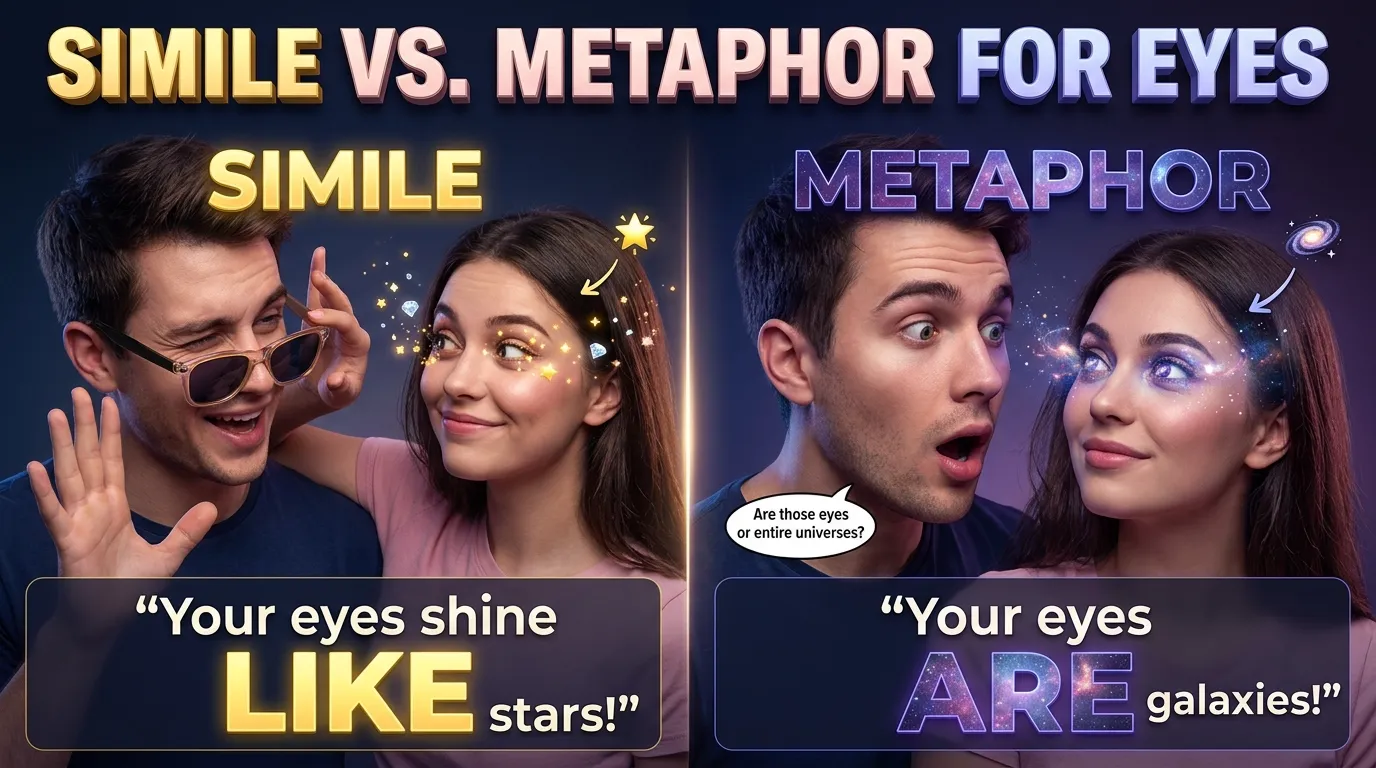
Simile vs. Metaphor for Eyes
A simile uses an explicit comparison, usually with like or as.
Her eyes were like moonlit lakes.
A metaphor makes the comparison directly.
Her eyes were moonlit lakes.
Both can create vivid imagery. The simile simply signals the comparison more clearly.
Quick List of Short Similes for Eyes
If you need short phrases for a poem, story, assignment, or caption:
- Like stars in the night
- Like deep blue lakes
- Like polished amber
- Like dark coffee
- Like emeralds after rain
- Like autumn leaves
- Like moonlit water
- Like black pearls
- Like drops of ink
- Like storm clouds
- Like fireflies at dusk
- Like morning dew
- Like candle flames
- Like sunlight on water
- Like clear glass
- Like a summer sky
- Like quiet rivers
- Like tiny mirrors
- Like golden coins
- Like windows into another world