
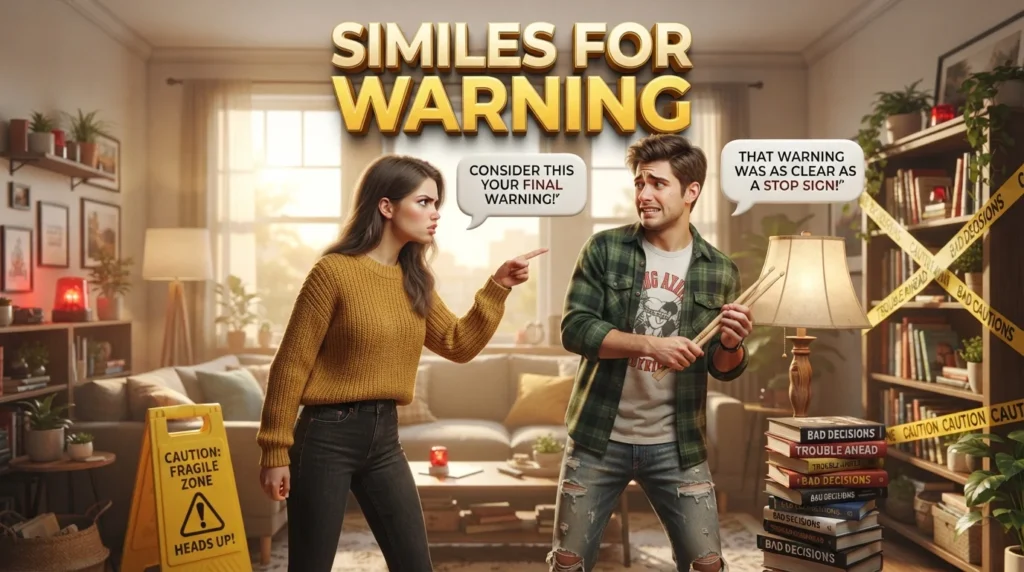
What Is a Simile for Warning?
A simile for warning is a comparison that uses “like” or “as” to describe a sign, message, feeling, sound, situation, or event that signals possible trouble.
For example:
- The dark clouds were like a warning from the sky.
- Her expression was as serious as a fire alarm.
- His silence was like a red flag.
- The distant rumble was as ominous as thunder before a storm.
- The crack in the wall was like a warning written in stone.
Warning similes can describe either the warning itself or the feeling it creates in someone who notices it.
Quick Similes for Warning
| Simile | What it suggests | Best use |
|---|---|---|
| Like a red flag | An obvious sign of trouble | Everyday writing |
| Like a storm cloud on the horizon | Trouble approaching | Foreshadowing |
| As loud as a fire alarm | Impossible to ignore | Urgent warnings |
| Like a ticking clock | Time running out | Pressure and urgency |
| As ominous as distant thunder | Trouble that may be coming | Suspense |
| Like a crack in a dam | A small sign of a larger problem | Problems developing |
| Like a shadow creeping closer | A growing but uncertain threat | Stories and suspense |
| As sharp as a warning bell | A sudden alert | Immediate attention |
| Like smoke before a fire | An early sign of danger | Foreshadowing |
| As unsettling as a stranger’s stare | Suspicion or unease | Character description |
The strongest choice depends on whether the warning is subtle, obvious, immediate, mysterious, frightening, or serious.

Similes for a Clear Warning
Some warnings are direct. There is little room for interpretation, and the comparison should communicate that clarity.
Like a red flag
A red flag is a familiar symbol of danger, concern, or something that deserves closer attention.
Example:
His sudden change in behavior was like a red flag, telling everyone that something was wrong.
This is one of the most versatile warning comparisons because it works in everyday speech as well as creative writing.
As obvious as a warning sign
This emphasizes a danger that should be easy to recognize.
Example:
The repeated errors were as obvious as a warning sign posted in the middle of the road.
Like a flashing signal
This suggests that something is actively demanding attention.
Example:
The strange noise was like a flashing signal, telling us not to go any farther.
As unmistakable as an alarm
Use this when the warning is impossible to overlook.
Example:
The sudden drop in temperature was as unmistakable as an alarm.
Similes for an Ominous Warning
An ominous warning does not necessarily tell you exactly what will happen. Instead, it creates a sense that something unpleasant may be approaching.
Like a storm cloud on the horizon
This suggests trouble that has not arrived yet but appears to be coming.
Example:
The silence between the two teams was like a storm cloud on the horizon.
As ominous as distant thunder
Distant thunder creates tension because it can signal an approaching storm without showing exactly when it will arrive.
Example:
His final words were as ominous as distant thunder.
Like a shadow creeping closer
This works well when danger grows gradually.
Example:
The rumors were like a shadow creeping closer, becoming harder to ignore each day.
Like footsteps in an empty hallway
This creates suspense around an uncertain threat.
Example:
The strange sound was like footsteps in an empty hallway, making everyone stop and listen.
As foreboding as a darkening sky
This comparison works especially well in stories and descriptive writing.
Example:
The sudden silence was as foreboding as a darkening sky before a storm.
Similes for an Urgent Warning
Some warnings require immediate action. These comparisons should feel sharp, loud, or pressing.
As loud as a fire alarm
A fire alarm is difficult to ignore, making it a natural comparison for an urgent warning.
Example:
The emergency announcement was as loud as a fire alarm, sending everyone toward the exits.
Like an alarm ringing in the night
This emphasizes sudden danger interrupting a peaceful situation.
Example:
Her phone call was like an alarm ringing in the night.
As urgent as a racing heartbeat
This connects warning with physical urgency.
Example:
The message felt as urgent as a racing heartbeat.
Like a flashing emergency light
This suggests an obvious signal demanding immediate attention.
Example:
The warning on the screen was like a flashing emergency light.
As pressing as a countdown
This comparison works when time is limited.
Example:
The deadline felt as pressing as a countdown with only seconds remaining.
Similes for a Subtle Warning
Not every warning arrives with noise. Some are small signs that something is not quite right.
Like smoke before a fire
This is useful for an early sign of a larger problem.
Example:
The small disagreement was like smoke before a fire, hinting at deeper problems.
Like a hairline crack in glass
A tiny crack may seem harmless but can indicate vulnerability.
Example:
Their broken promise was like a hairline crack in glass, small but impossible to ignore.
Like a flickering light
This can suggest instability or an uncertain problem.
Example:
The flickering light was like a warning that the old wiring was failing.
Like a whisper in the wind
This suggests a warning that is faint or difficult to understand.
Example:
The strange rumor was like a whisper in the wind, barely noticeable at first.
Like a single drop before a downpour
This suggests that a small event may precede something much larger.
Example:
The sudden silence was like a single drop before a downpour.
Similes for Danger
When the warning itself involves obvious danger, stronger imagery can create a more intense effect.
Like a ticking time bomb
This familiar comparison suggests a dangerous situation that may become explosive.
Example:
The unresolved conflict was like a ticking time bomb.
Because this expression is well known, it works best when you want immediate clarity rather than unusual imagery.
Like a loaded spring
This suggests stored energy waiting to be released.
Example:
The tense crowd was like a loaded spring, ready to erupt.
Like a trap hidden beneath leaves
This creates an image of danger that is difficult to see.
Example:
The seemingly harmless shortcut was like a trap hidden beneath leaves.
As dangerous as thin ice
This comparison emphasizes risk and the possibility of sudden consequences.
Example:
Their financial situation was as dangerous as thin ice beneath a careless step.
Like a cliff hidden by fog
This suggests danger that cannot be easily seen.
Example:
His confidence was like a cliff hidden by fog—solid-looking until someone got too close.
Similes for a Warning Voice or Tone
A warning can come through someone’s voice, expression, or choice of words.
As sharp as a whistle
This suggests a sudden sound that commands attention.
Example:
Her warning was as sharp as a whistle across a silent field.
Like a knife cutting through silence
This creates a more dramatic image.
Example:
His warning cut through the conversation like a knife through silence.
As cold as winter air
This can suggest seriousness, emotional distance, or a lack of warmth.
Example:
Her voice was as cold as winter air when she told him to stop.
Like thunder behind a quiet voice
This suggests restrained power.
Example:
There was something like thunder behind his quiet warning.
As stern as a locked door
This gives the warning a firm, unmistakable quality.
Example:
Her final words were as stern as a locked door.
Similes for a Warning Sign
Physical objects and environmental details can serve as powerful warning imagery.
Like a red flag waving in the wind
This makes the warning visually obvious.
Example:
The sudden drop in water level was like a red flag waving in the wind.
Like smoke rising from a chimney
Smoke can signal that something is happening even when the source is not visible.
Example:
The unusual smell was like smoke rising from a chimney, hinting that something had gone wrong.
Like a crack in a dam
This suggests that a small weakness may lead to a much larger failure.
Example:
The first missed payment was like a crack in a dam, exposing a much bigger problem.
Like a blinking dashboard light
This works well for modern, everyday comparisons.
Example:
His constant exhaustion was like a blinking dashboard light that everyone kept ignoring.
As noticeable as a broken streetlight
This suggests something visibly wrong in an otherwise normal environment.
Example:
The missing security guard was as noticeable as a broken streetlight on a dark road.
Similes for a Warning in a Story
Warning similes are especially useful for foreshadowing. Instead of announcing that something bad will happen, a writer can plant an image that makes readers suspicious.
For example:
The abandoned house stood at the edge of town like a warning no one had bothered to read.
Or:
The sudden silence fell over the forest like a curtain before a storm.
Or:
The broken lock was like a whisper telling them to turn around.
These comparisons do not reveal everything. They create a question in the reader’s mind:
What is about to happen?
That uncertainty is what makes warning imagery effective in suspense and storytelling.
Similes for a Warning About Trouble Ahead
When the problem has not happened yet, use comparisons that communicate approaching trouble.
- Like a storm gathering beyond the hills
- Like dark clouds building overhead
- Like thunder waiting beyond the mountains
- Like a train approaching a tunnel
- Like a tide rising toward the shore
- Like footsteps getting closer
- Like smoke drifting beneath a closed door
Example
The growing tension was like dark clouds building overhead.
The comparison tells the reader that the situation is becoming dangerous without explicitly stating what will happen.
Similes for a Mysterious Warning
A mysterious warning should create curiosity rather than explain everything.
Like a message written in disappearing ink
Example:
Her cryptic comment was like a message written in disappearing ink.
Like a bell heard from far away
Example:
The strange sound was like a bell heard from far away, impossible to place.
Like a footprint with no owner
Example:
The mark on the window was like a footprint with no owner.
Like a door left slightly open
Example:
His final sentence was like a door left slightly open, inviting questions nobody wanted to ask.
These work especially well in mysteries, thrillers, fantasy stories, and suspenseful scenes.
Similes for Warning Someone to Be Careful
Warning does not always mean danger is guaranteed. Sometimes it simply means someone should proceed carefully.
Like walking on thin ice
This suggests that one wrong move could create serious consequences.
Example:
After the argument, he felt like he was walking on thin ice around his manager.
Like carrying a glass full to the edge
This suggests a situation that could easily go wrong.
Example:
Their fragile agreement was like carrying a glass filled to the edge.
Like driving through thick fog
This communicates uncertainty and limited visibility.
Example:
Making a decision without the facts was like driving through thick fog.
Like balancing on a narrow bridge
This suggests that careful choices are necessary.
Example:
Negotiating the deal was like balancing on a narrow bridge.
Creative Similes for Warning
If you want something less predictable than the usual sirens and storm clouds, try more specific imagery.
- The warning was like a pebble dropped into still water, small but impossible not to notice.
- His silence was like a locked gate at the end of an unfamiliar road.
- The strange smell was like a fingerprint left on an otherwise clean room.
- Her hesitation was like a brake light glowing in the distance.
- The empty playground was like a smile missing its laughter.
- The sudden cold was like an unseen hand pressing against the back of my neck.
- His final glance was like a door quietly closing.
- The broken branch was like a sentence interrupted before its final word.
- The unusual quiet was like a held breath before bad news.
- The fading signal was like a lighthouse disappearing into fog.
These comparisons are particularly useful when the warning needs to feel literary, atmospheric, or understated rather than simply dramatic.
Funny Similes for Warning
Warnings can also be humorous when the situation is lighthearted.
- He treated the warning like a cat treats a bath.
- She ignored the signs like a tourist ignoring a giant map.
- His caution was as strong as a paper umbrella in a hurricane.
- The warning went past him like a joke told to someone wearing headphones.
- He approached the obvious problem like a toddler approaching a puddle in new shoes.
Humorous similes work best when the surrounding writing is already playful. They would feel out of place in a serious emergency or suspense scene.
Similes for Warning in Poetry
Poetry often benefits from warning imagery that leaves room for interpretation.
For example:
The clouds gathered like old secrets,
darkening the edge of day.
Or:
Her silence was a warning,
like thunder waiting beyond the hills.
Or:
A single bird fled the trees,
like a message no one could read.
The goal is not always to explain the warning. Sometimes the image itself creates the feeling.
How to Choose the Right Simile for Warning
Before choosing a comparison, ask what kind of warning you are describing.
For an obvious warning
Use clear imagery:
- red flag
- alarm
- flashing signal
- warning sign
For an approaching threat
Use imagery involving:
- storms
- shadows
- distant thunder
- rising tides
- approaching footsteps
For a hidden danger
Use comparisons involving:
- traps
- cracks
- fog
- concealed objects
- unstable structures
For suspense
Choose images that create uncertainty:
- unexplained sounds
- half-open doors
- fading lights
- distant signals
- unexplained footprints
For urgency
Use comparisons associated with:
- alarms
- countdowns
- racing hearts
- emergency signals
- rapidly changing conditions
This makes the simile serve the writing rather than simply decorate it.
How to Create Your Own Warning Similes
Creating an original warning simile becomes easier when you first identify what kind of warning you want to communicate.
1. Identify the warning
Ask what the reader should understand:
- Something is dangerous.
- Trouble is approaching.
- A situation is becoming unstable.
- Someone should be careful.
- Something feels suspicious.
- Time is running out.
2. Find a physical image
Look for something that behaves in a similar way.
For example:
Idea: Trouble is approaching
Image: A storm moving toward town
3. Connect them
The growing conflict was like a storm moving toward town.
4. Adjust the intensity
A quiet warning might need:
like a distant rumble
A severe warning might need:
like an alarm screaming through the night
5. Check the tone
A mystery, children’s story, poem, essay, and thriller may all need different kinds of warning imagery.
The strongest simile is not necessarily the most dramatic one. It is the one that fits the scene.

Warning Simile vs. Metaphor
A simile makes a comparison using words such as like or as.
The warning was like a storm cloud.
A metaphor makes the comparison directly.
The warning was a storm cloud.
Both create imagery, but the simile keeps the comparison explicit.
If you want to teach students the difference, a simple rule is:
Simile = comparison using “like” or “as.”
Metaphor = direct comparison without “like” or “as.”
Common Mistakes When Using Warning Similes
Making every warning sound catastrophic
Not every warning needs death, destruction, or disaster.
A missing detail in a story might be better described as:
a small crack in an otherwise smooth surface
rather than:
the end of the world.
Using too many familiar clichés
Expressions such as “ticking time bomb” and “red flag” are clear, but they are also familiar.
Use them when clarity is more important than originality. In creative writing, consider developing a more specific image.
Making the comparison unclear
A creative simile should still be understandable.
If readers have to stop and decode the comparison, it may distract from the warning itself.
Ignoring intensity
A whispered warning and a life-threatening warning should not sound identical.
Match the imagery to the stakes.
Adding too many similes
One strong comparison can have more impact than five competing images.
Choose the image that best communicates the moment.
Quick List: Warning Similes by Mood
Subtle
- Like smoke before a fire
- Like a shadow creeping closer
- Like a whisper in the wind
- Like a single drop before a downpour
Ominous
- As ominous as distant thunder
- Like a storm cloud on the horizon
- Like footsteps in an empty hallway
- Like a darkening sky
Urgent
- As loud as a fire alarm
- Like an emergency signal
- Like a flashing warning light
- As urgent as a racing heartbeat
Dangerous
- Like a ticking time bomb
- Like a hidden trap
- As dangerous as thin ice
- Like a loaded spring
Mysterious
- Like a message written in disappearing ink
- Like a bell heard from far away
- Like a footprint with no owner
- Like a door left slightly open
Cautious
- Like walking on thin ice
- Like driving through thick fog
- Like balancing on a narrow bridge
- Like carrying a glass filled to the edge