
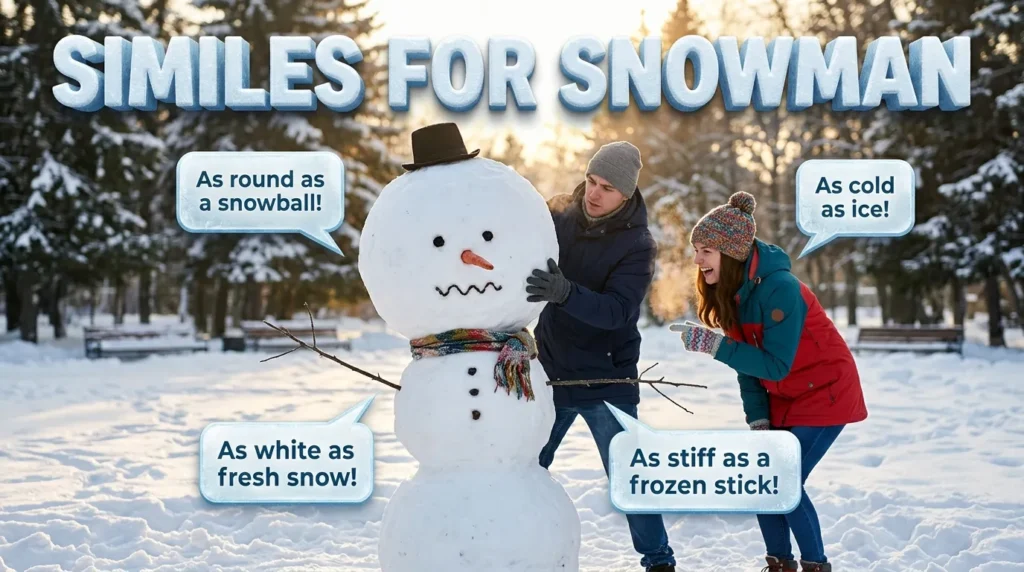
What Is a Simile for a Snowman?
A simile for a snowman compares the snowman or one of its characteristics with something else using like or as.
For example:
The snowman stood as white as a winter cloud.
The comparison emphasizes its bright, snowy appearance.
Another example:
His coal eyes were black like buttons against a white shirt.
This creates a strong contrast between the dark eyes and snowy face.
80+ Similes for a Snowman
Similes for a Snowman’s Appearance
- The snowman was as white as freshly fallen snow.
- The snowman stood like a snowy statue in the yard.
- His round body looked like three giant snowballs stacked together.
- The snowman was as bright as a field beneath the winter sun.
- He looked like a giant made entirely of snow.
- His snowy body shone like polished ivory.
- The snowman stood as tall as a small tree.
- His round shape looked like a stack of white moons.
- The snowman looked as soft as a pile of winter clouds.
- His body gleamed like a sculpture carved from snow.
- He stood like a cheerful guard outside the house.
- The snowman looked like a giant snow-covered toy.
- His snowy shape was as round as a collection of giant pearls.
- The snowman appeared like a white giant against the dark trees.
- His body was as pale as moonlight on fresh snow.
Similes for a Snowman’s Round Body
A snowman’s shape is one of its easiest characteristics to visualize.
- His body was round like a giant snowball.
- His middle section was as round as a full moon.
- The snowman’s belly looked like a huge white balloon.
- His body was stacked like three giant pearls.
- The snowballs were as round as oversized oranges.
- His belly bulged like a soft white hill.
- The snowman’s body looked like a tower of marshmallows.
- His round shape resembled a stack of white pumpkins.
- The snowman was as plump as a winter cloud.
- His body curved like three giant white bubbles.
Similes for a Snowman’s Face
A few simple comparisons can bring a snowman’s face to life.
- His face was as white as untouched snow.
- His coal eyes were black like pieces of charcoal.
- His eyes looked like two dark buttons sewn onto a white coat.
- His carrot nose was orange like a ripe pumpkin.
- His smile curved like a crescent moon.
- His coal eyes glittered like black beads.
- His face looked as blank as a fresh sheet of paper.
- His smile stretched like a crooked line across the snow.
- His nose stood out like an orange flag against the white snow.
- His eyes were as dark as midnight.
- His face looked like a blank canvas waiting for a smile.
- His carrot nose pointed outward like a tiny orange arrow.
- His grin was as wide as a crescent moon.
- His features looked like colorful buttons scattered across a white canvas.
- His face seemed as cheerful as a child’s drawing.
Similes for a Snowman’s Carrot Nose
The carrot nose can provide color and humor.
- His carrot nose was orange like a bright autumn pumpkin.
- The carrot stuck out like a little orange arrow.
- His nose looked like a tiny traffic cone.
- The orange carrot stood out like a flame against the snow.
- His nose was as bright as a winter sunset.
- The carrot pointed forward like a small orange beak.
- His nose looked like a carrot-shaped flag.
- The orange nose glowed like a tiny ember against his white face.
- His carrot nose was as noticeable as a bright orange flower in snow.
- The carrot stuck from his face like an orange sail.
Similes for a Snowman’s Eyes
- His coal eyes were as black as midnight.
- His eyes looked like two buttons on a white coat.
- The coal eyes stood out like black stars against the snow.
- His eyes were dark like pebbles on a beach.
- The little coal pieces looked like black beads.
- His eyes were as dark as winter shadows.
- The coal eyes appeared like two tiny windows in his snowy face.
- His eyes looked like drops of ink on white paper.
- The black eyes contrasted like dark berries against snow.
- His eyes were as round as marbles.
Similes for a Snowman’s Smile
- His smile curved like a crescent moon.
- The snowman’s grin was as wide as a rainbow.
- His crooked smile looked like a line drawn by a playful child.
- His smile stretched across his face like a tiny black ribbon.
- His grin looked as cheerful as a child’s Christmas card.
- The smile curved like a banana across his snowy face.
- His mouth looked like a dark crescent on a white canvas.
- His grin was as playful as a child’s joke.
- His smile appeared like a little crescent moon beneath his carrot nose.
- His crooked grin looked like a secret he was trying not to tell.
Similes for a Snowman’s Hat and Scarf
- His black hat sat on his head like a crown.
- The hat looked as dark as the winter night.
- His scarf wrapped around his neck like a colorful ribbon.
- The scarf fluttered like a flag in the winter wind.
- His hat tilted like a crooked crown.
- The bright scarf stood out like a rainbow against the snow.
- His scarf hung like a colorful waterfall.
- The hat rested on his head like a lid on a jar.
- His scarf was as bright as a Christmas decoration.
- The wind pulled at his scarf like an impatient child.
Similes for a Snowman’s Stick Arms
- His stick arms stretched out like tree branches.
- His arms reached toward the sky like bare winter branches.
- The branches looked like long wooden fingers.
- His stick arms pointed outward like the hands of a clock.
- The branches spread like the limbs of a small tree.
- His arms were as thin as twigs.
- The snowman’s branches looked like wooden wings.
- His arms reached sideways like a child asking for a hug.
- The sticks poked from his body like crooked fingers.
- His arms stretched wide like the branches of an old tree.
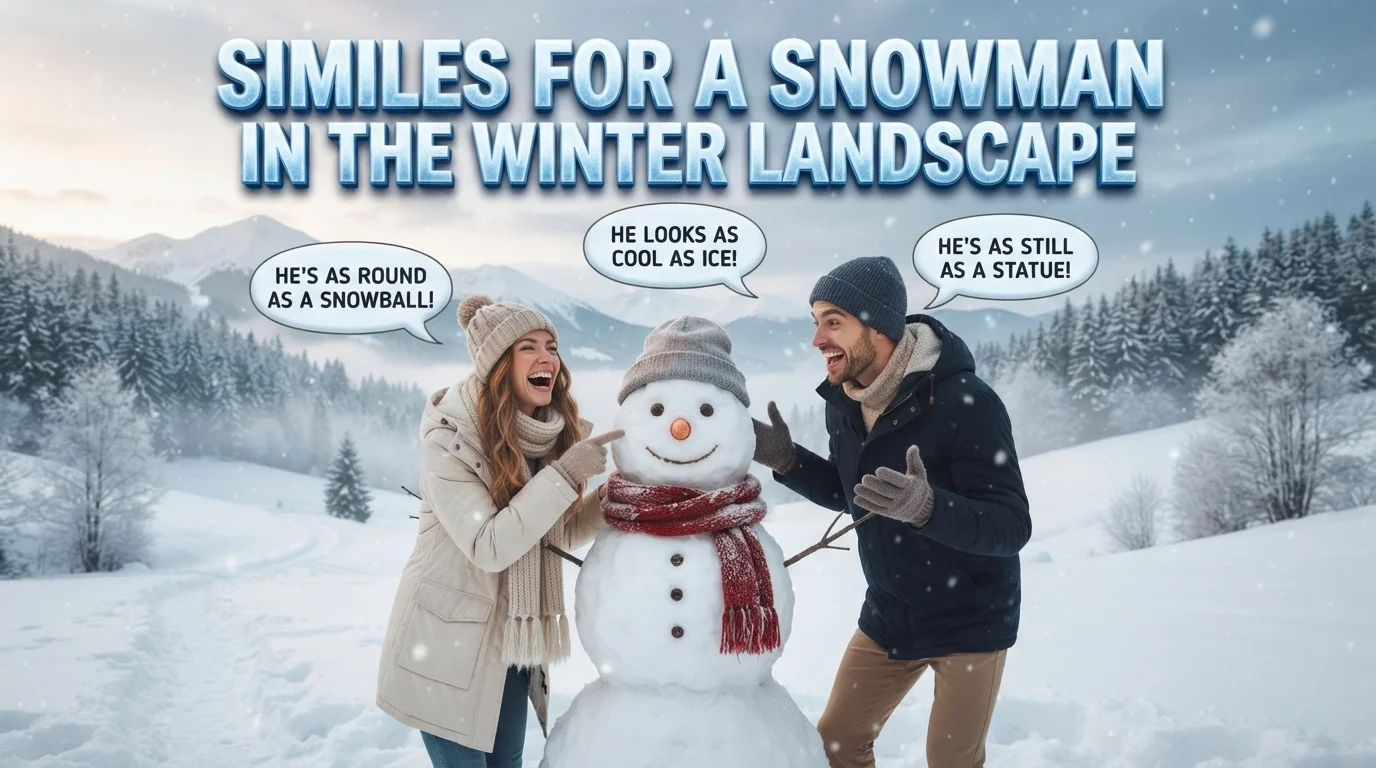
Similes for a Snowman in the Winter Landscape
- The snowman stood like a white statue in the snowy yard.
- He looked like a lone guardian in the winter garden.
- The snowman stood as bright as a lantern against the gray sky.
- He appeared like a white giant among the bare trees.
- The snowman looked like a character from a winter storybook.
- He stood in the yard like a cheerful visitor who had arrived overnight.
- The snowman looked as peaceful as a sleeping mountain.
- He stood like a silent watchman beneath the falling snow.
- The snowman blended into the landscape like a cloud that had landed on Earth.
- He looked like winter itself had taken shape in the yard.
Similes for a Snowman by Mood
The comparison you choose can change how the snowman feels to the reader.
| Mood | Simile | Effect |
|---|---|---|
| Cheerful | Like a child with a big smile | Playful |
| Funny | Like a giant snowball wearing a hat | Humorous |
| Magical | Like a character from a winter storybook | Whimsical |
| Peaceful | Like a sleeping mountain | Calm |
| Mysterious | Like a silent figure in the fog | Mysterious |
| Friendly | Like a neighbor waiting at the door | Welcoming |
| Imposing | Like a white giant | Powerful |
| Lonely | Like a lone statue in the yard | Solitary |
| Playful | Like a child dressed for winter | Lighthearted |
| Majestic | Like a snowy mountain | Grand |
The same snowman can feel funny, mysterious, cheerful, or lonely depending on the surrounding context.
Similes for Snowmen for Kids
Simple comparisons are especially useful for young writers.
- The snowman was as white as snow.
- His eyes were black like buttons.
- His nose was orange like a carrot.
- His body was round like a ball.
- His smile curved like a moon.
- His arms stretched like tree branches.
- His hat sat like a crown.
- His scarf fluttered like a flag.
- The snowman stood like a statue.
- His body looked like three giant snowballs.
- His eyes were as dark as night.
- He stood like a friendly guard.
Similes for a Snowman in School Writing
Rather than using several comparisons that all describe the snowman’s whiteness, combine different characteristics.
For example:
A tall snowman stood in the yard like a cheerful guard. His body was as round as three giant snowballs stacked together. Two coal eyes looked like black buttons against his white face, while an orange carrot pointed outward like a tiny arrow. His red scarf fluttered like a flag in the winter wind.
This description gives the reader several distinct details:
- cheerful guard → personality
- giant snowballs → body shape
- black buttons → eyes
- tiny arrow → nose
- flag → scarf movement
Each comparison has a separate job.
Similes for a Snowman in Stories
A snowman can be more than an object in the background. In a story, the comparison can help create personality or atmosphere.
Cheerful
The snowman stood like a friendly neighbor waiting to greet everyone who passed.
Mysterious
In the moonlight, the snowman stood like a silent stranger at the edge of the yard.
Funny
The snowman looked like a giant marshmallow wearing a hat two sizes too small.
Lonely
The snowman stood alone like a forgotten statue beneath the gray sky.
Magical
Under the moonlight, the snowman looked like a winter character who had stepped out of a storybook.
The comparison changes how the reader interprets the same basic figure.
Similes for a Snowman in Poetry
Snowmen can work particularly well in poems because their temporary nature can evoke winter, childhood, imagination, play, and passing time.
For example:
A snowman stands
like a white moon
beneath the winter sky,
with coal-black eyes
and a crooked smile
like a crescent.
Or:
His scarf dances
like a flag in the wind,
while snowflakes fall
like feathers
around his silent feet.
These comparisons add movement and atmosphere without needing lengthy explanations.
How to Create Your Own Snowman Similes
Creating an original simile becomes easier when you focus on one characteristic at a time.
1. Choose a feature
For example:
Snowman’s round body
2. Identify its quality
It’s:
- round
- large
- soft-looking
- white
- stacked
3. Brainstorm similar shapes
Think about:
- moons
- balloons
- pearls
- marshmallows
- pumpkins
- bubbles
4. Choose the image that fits
For a playful description:
The snowman’s body looked like three giant marshmallows stacked together.
For a more poetic description:
His round body looked like three pale moons stacked beneath the winter sky.
5. Put it into context
His round body looked like three pale moons stacked beneath the winter sky, while his scarf fluttered in the cold wind.
Now the comparison contributes to the entire scene.
How to Make Snowman Similes More Original
Some comparisons are naturally familiar:
The snowman was as white as snow.
There’s nothing wrong with a familiar simile when you want clarity.
But creative writing can become more distinctive by focusing on unexpected but understandable images.
Instead of:
His body was round like a ball.
You could write:
His body rose like a stack of oversized pearls in the snowy yard.
Instead of:
His scarf moved in the wind.
Try:
His scarf fluttered like a bright flag announcing winter’s arrival.
Originality doesn’t mean making a comparison difficult. The image should remain clear, natural, and relevant.
Common Mistakes When Using Snowman Similes
1. Comparing everything to snow
Snow is the obvious reference point, but snowmen have many other features worth describing.
Try exploring:
- shape
- color
- texture
- facial expression
- clothing
- movement
- surroundings
- personality
2. Using only appearance
A snowman can be described through the way it interacts with its surroundings.
For example:
His scarf fluttered like a flag in the wind.
This creates movement.
3. Repeating “as white as snow”
It’s useful once, but repeating the same comparison quickly becomes dull.
4. Making every snowman cheerful
A snowman can be funny, lonely, mysterious, peaceful, magical, or imposing depending on the story.
5. Overloading a paragraph with comparisons
A few purposeful similes usually create stronger imagery than a simile in every sentence.
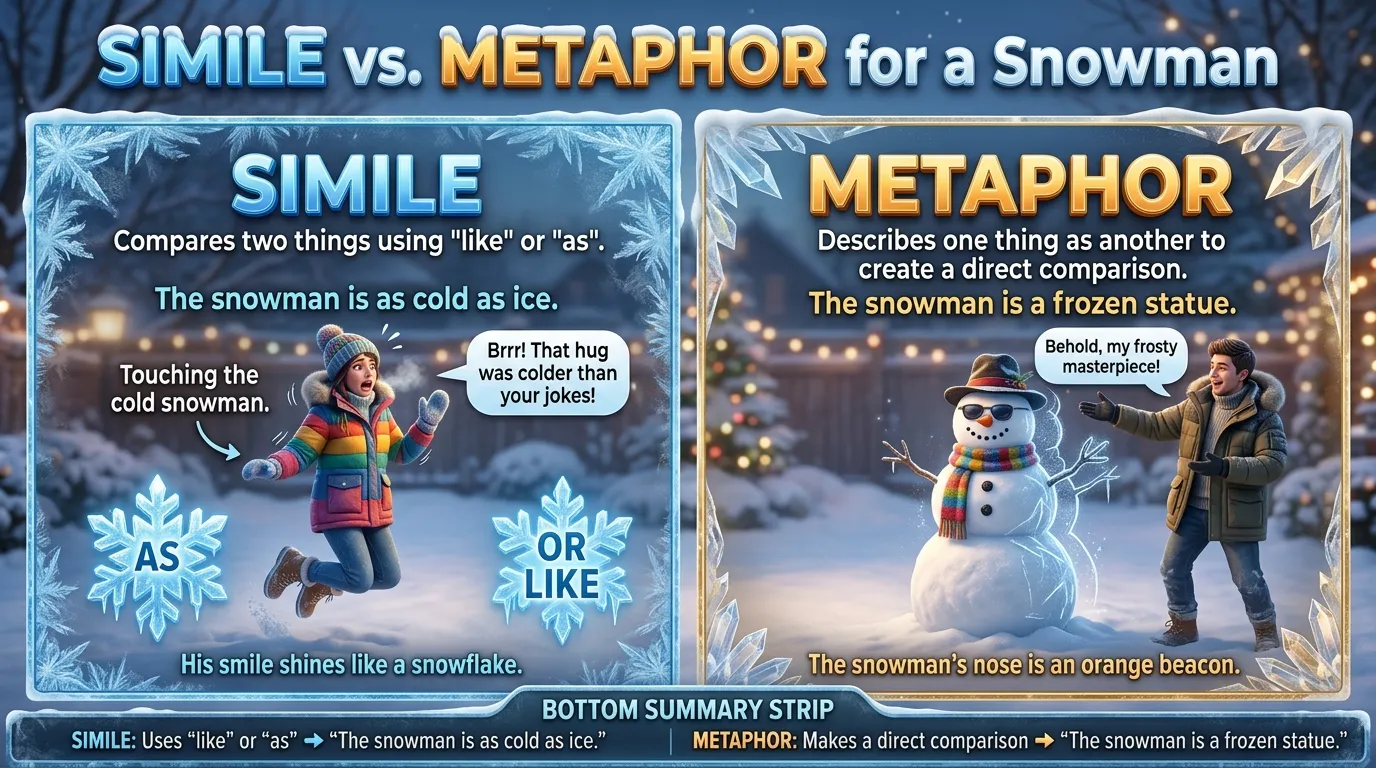
Simile vs. Metaphor for a Snowman
A simile uses like or as:
The snowman stood like a white statue.
A metaphor makes the comparison directly:
The snowman was a white statue in the yard.
Both are forms of figurative language.
The simplest distinction is:
Simile → like/as
Metaphor → direct comparison
25 Short Similes for a Snowman
For quick reference:
- The snowman was as white as fresh snow.
- His body was round like a giant ball.
- His eyes were black like buttons.
- His nose pointed out like an orange arrow.
- His smile curved like a crescent moon.
- His hat sat like a crown.
- His scarf fluttered like a flag.
- His arms stretched like tree branches.
- He stood like a snowy statue.
- His body looked like three giant snowballs.
- His cheeks were as pale as moonlight.
- His coal eyes were as dark as midnight.
- His body looked like a stack of pearls.
- His nose was as bright as a winter sunset.
- His scarf was like a colorful ribbon.
- He stood like a silent watchman.
- His arms reached outward like wooden wings.
- His body was as round as a full moon.
- He looked like a giant made of snow.
- His grin was as wide as a crescent moon.
- His coal eyes looked like drops of ink.
- His snow-covered body gleamed like ivory.
- He looked like a character from a winter storybook.
- He stood like a friendly guard.
- He looked like winter itself had taken shape.