
What Is a Simile for Winter?
A winter simile is a comparison that uses like or as to describe something connected with winter.
For example:
The snow was as white as freshly fallen flour.
The snow isn’t actually flour. The comparison gives the reader a familiar image of its color and softness.
Another example:
The winter wind howled like a wild animal outside the window.
The wind isn’t literally an animal, but the comparison emphasizes its loud, restless sound.
Similes are a form of figurative language that make descriptions more vivid by connecting one thing to another recognizable image.
100+ Similes for Winter
Similes for Snow
Snow is one of winter’s most recognizable images, but it can be described in many different ways depending on whether you’re focusing on its color, texture, movement, sound, or effect on the landscape.
- The snow was as white as freshly washed cotton.
- Snow covered the ground like a soft white blanket.
- The snow sparkled like thousands of tiny diamonds.
- Snowflakes drifted like feathers from the sky.
- The snow fell like white confetti.
- The landscape looked like a blank sheet of paper.
- The snow glittered like powdered glass beneath the sunlight.
- The snow was as soft as a feather pillow.
- Snow covered the rooftops like frosting on a cake.
- The fields looked like white oceans frozen beneath the sky.
- The snow settled over the trees like a layer of powdered sugar.
- The flakes floated like tiny dancers through the air.
- The snow glowed like silver beneath the moonlight.
- The road disappeared beneath the snow like a trail beneath a curtain.
- Fresh snow looked as clean as an untouched canvas.
Similes for Snowflakes
Individual snowflakes can inspire more delicate comparisons.
- Snowflakes floated like tiny feathers.
- Each snowflake was as delicate as a piece of lace.
- The flakes danced like miniature ballerinas.
- Snowflakes twirled like confetti caught in the wind.
- The crystals sparkled like tiny stars.
- The flakes fell as softly as whispers.
- Snowflakes drifted like white butterflies.
- Each crystal looked like a miniature piece of glass.
- The flakes swirled like dancers on a frozen stage.
- Snowflakes gathered on the window like tiny white flowers.
Similes for Cold Weather
Cold can be difficult to describe because it is something the reader needs to feel rather than see.
- The air was as cold as an open freezer.
- The morning was cold like a metal chair left outside overnight.
- The wind felt like icy fingers against my face.
- The cold wrapped around me like a wet blanket.
- The temperature was as harsh as a slap.
- The air bit like tiny needles against my skin.
- The cold crept through my coat like a thief.
- My fingers were as numb as stones.
- The winter air felt like ice against my cheeks.
- The cold settled over the town like a heavy curtain.
- My breath came out like smoke from a chimney.
- The chill moved through the house like a ghost.
- The freezing air stung like thousands of tiny pins.
- The morning felt as cold as a forgotten cellar.
- The wind cut through my jacket like a knife.
Not every cold-weather simile needs to be dramatic. A quiet winter morning might call for a gentler comparison than a blizzard.
Similes for Winter Wind
Wind can transform a peaceful winter scene into something energetic or threatening.
- The winter wind howled like a wolf.
- The wind rushed through the trees like an angry river.
- The icy breeze slipped through my clothes like a needle.
- The wind rattled the windows like impatient fingers.
- The gusts roared like distant thunder.
- The wind whipped around the house like a restless animal.
- The breeze whispered through the bare branches like a secret.
- The winter wind struck my face like a splash of cold water.
- The gusts twisted through the streets like invisible dancers.
- The wind screamed around the chimney like a creature in the dark.
Similes for Ice
Ice can be described through its appearance, hardness, transparency, slipperiness, or sound.
- The pond was as smooth as a sheet of glass.
- The ice glittered like polished crystal.
- The frozen lake looked like a giant mirror.
- The ice was as clear as a window.
- Frost covered the pond like a thin layer of sugar.
- The frozen surface cracked like breaking glass beneath the pressure.
- The ice shone like silver beneath the morning sun.
- The sidewalk was as slippery as a wet tile floor.
- The frozen puddles looked like little mirrors scattered across the road.
- The lake lay beneath the snow like a sleeping giant.
Similes for Frost
Frost can transform ordinary objects into something delicate and unusual.
- Frost covered the window like white lace.
- The grass glittered like tiny crystals beneath the morning sun.
- The frozen leaves were as delicate as paper cutouts.
- Frost decorated the branches like sugar crystals on a cake.
- The window looked like it had been painted with silver feathers.
- The rooftops sparkled like they had been dusted with diamonds.
- The frost clung to the grass like tiny beads of glass.
- The morning fields looked like they had been sprinkled with powdered sugar.
Similes for Icicles
- The icicles hung from the roof like rows of glass teeth.
- The icicles glittered like crystal swords in the sunlight.
- They hung from the eaves like frozen fingers.
- The icicles were as clear as glass.
- The roof was decorated with icicles like a frozen chandelier.
- The long icicles looked like silver needles pointing toward the ground.
- Sunlight made the icicles sparkle like diamonds.
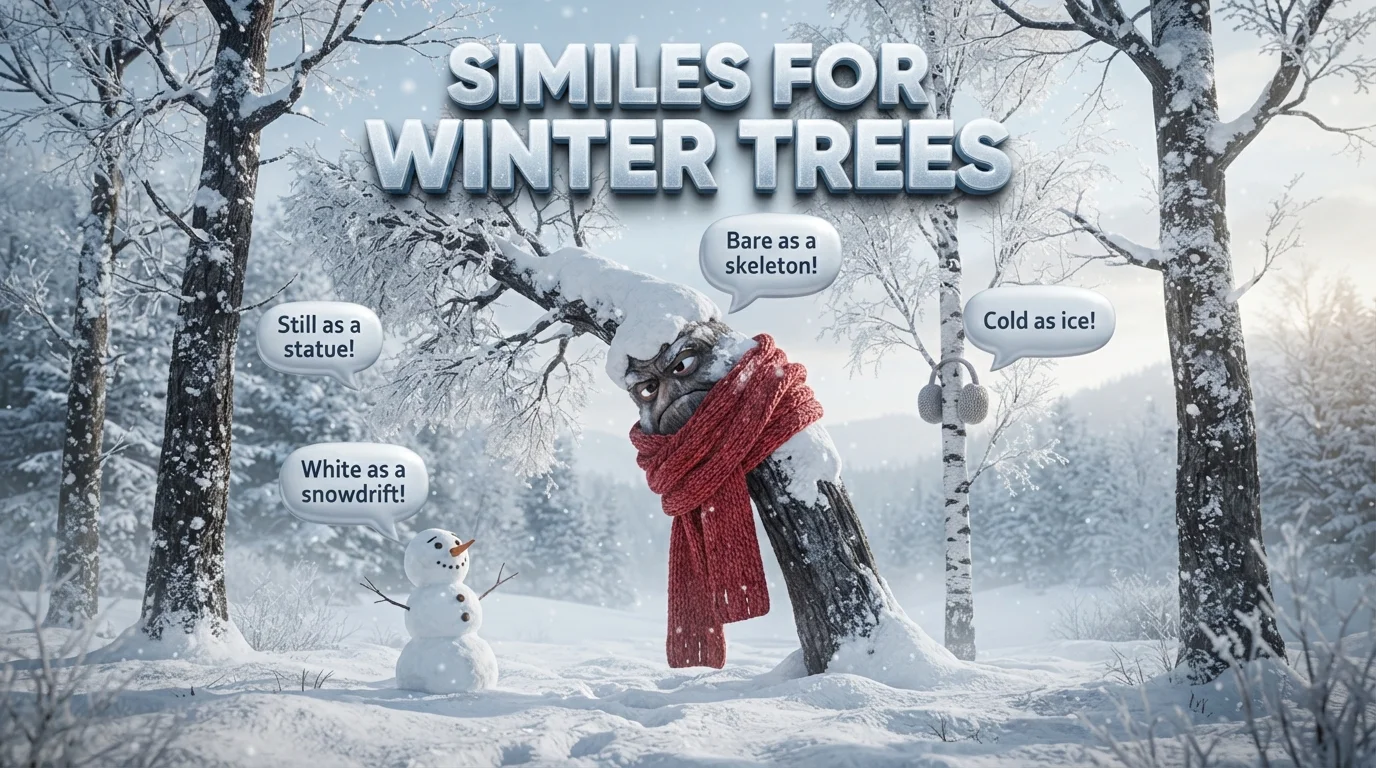
Similes for Winter Trees
Winter trees have a very different appearance from trees in spring and summer.
- The bare branches stretched like skeletal fingers toward the sky.
- The trees stood as still as statues.
- The branches looked like dark lines drawn across the pale sky.
- Snow covered the branches like white frosting.
- The trees stood like silent guards along the road.
- The bare forest looked like a collection of sleeping giants.
- The branches swayed like thin arms in the wind.
- The snow-covered trees looked like giant candles dusted with sugar.
Similes for a Winter Morning
A winter morning can feel peaceful, harsh, mysterious, or beautiful.
- The winter morning was as quiet as an empty church.
- The sunrise looked like a ribbon of fire across the horizon.
- The morning sky was as pale as watered-down paint.
- The rooftops glittered like diamonds in the early light.
- The frost-covered streets looked like silver pathways.
- The sun rose like a pale coin above the horizon.
- The morning air was as crisp as a freshly opened apple.
- The world looked like it had been wrapped in white paper.
- The town woke slowly like an animal emerging from hibernation.
Similes for a Winter Night
Winter nights often create stronger contrasts between darkness and light.
- The winter sky was as dark as ink.
- The moon hung like a silver lantern above the snow.
- The stars glittered like scattered diamonds.
- The snowy fields glowed like pale blankets beneath the moon.
- The night was as silent as an empty forest.
- The fireplace glowed like a small sun in the darkness.
- The windows shone like warm golden eyes against the night.
- The moonlight spread across the snow like spilled silver.
Cozy Winter Similes
Winter writing doesn’t always have to focus on freezing temperatures. The contrast between the cold outdoors and a warm interior can create some of the strongest imagery.
Try comparisons such as:
- The fireplace was like a little sun inside the room.
- The blanket was as warm as a hug.
- The hot chocolate steamed like a tiny cloud.
- The cabin felt as cozy as a nest.
- The fire crackled like a quiet conversation.
- The room glowed like a lantern in the winter darkness.
- The wool sweater was as soft as a cloud.
- The warm kitchen felt like a shelter from the storm.
- The mug warmed my hands like a small portable fireplace.
- The cabin looked like a safe harbor in the snow.
This contrast is useful in creative writing because it lets you move between harsh winter conditions and human comfort.
Winter Similes for Kids
For younger writers, simple comparisons are usually easiest to understand and use.
- The snow was as white as cotton.
- The snowflakes fell like feathers.
- The wind howled like a wolf.
- The ice was as smooth as glass.
- The trees stood like statues.
- The snow sparkled like diamonds.
- The moon was like a silver ball.
- The fireplace was as warm as the sun.
- My hands were as cold as ice.
- The snow covered the ground like a blanket.
- The winter sky was as gray as a cloud.
- The icicles hung like frozen fingers.
- The snowflakes danced like ballerinas.
- The stars shone like tiny lights.
- The winter wind sounded like a roaring animal.
These can easily be expanded into descriptive paragraphs.

Winter Similes for School Writing
If you’re writing a winter paragraph, avoid placing a simile in every sentence. Instead, choose comparisons that describe different aspects of the scene.
For example:
Snow covered the town like a soft white blanket. The bare trees stood like silent guards beside the road, while the winter wind howled like a wolf beyond the houses. Inside, the fireplace glowed like a small sun, giving the room a warm refuge from the freezing air outside.
Notice how each comparison has a different purpose:
- blanket → coverage and softness
- guards → shape and stillness
- wolf → sound and intensity
- small sun → warmth and light
That creates a fuller picture than simply describing everything as “cold” or “white.”
Winter Similes by Sense
One of the easiest ways to improve winter descriptions is to deliberately use different senses.
| Sense | Example | What it describes |
|---|---|---|
| Sight | Snow glittered like diamonds | Appearance |
| Touch | Air felt like icy needles | Cold |
| Sound | Wind howled like a wolf | Noise |
| Smell | Pine scent drifted like a forest breeze | Aroma |
| Taste | Cocoa tasted like melted chocolate comfort | Flavor |
| Movement | Snowflakes danced like ballerinas | Motion |
Sensory variety keeps winter writing from becoming visually repetitive.
Winter Similes by Mood
The same winter landscape can feel completely different depending on the comparison.
Peaceful
The snow fell as softly as whispers.
Magical
The snow-covered forest looked like an enchanted kingdom.
Frightening
The winter wind howled like a creature outside the door.
Lonely
The empty road stretched like a gray ribbon into the distance.
Cozy
The fireplace glowed like a little sun.
Playful
The children raced through the snow like excited puppies.
Mysterious
The fog curled through the trees like a ghost.
This is an important part of choosing a good simile: the image should match the mood you want to create.
Funny Winter Similes
Winter descriptions can also be humorous.
- My fingers were as useless as frozen sticks.
- I walked across the ice like a penguin learning to dance.
- The winter wind hit me like an unexpected bucket of ice water.
- I wore so many layers that I looked like a walking sleeping bag.
- The snow piled up like laundry nobody wanted to fold.
- My frozen toes felt like tiny blocks of wood.
- The snowball flew like a badly aimed baseball.
- I slipped across the ice like a cartoon character.
- The scarf wrapped around my neck like an overprotective parent.
- My winter coat was as bulky as a camping tent.
Humorous similes can work especially well in personal narratives, children’s stories, captions, and casual writing.
Winter Similes for Poetry
Winter imagery naturally fits poetry because it can represent silence, change, loneliness, beauty, stillness, or renewal.
For example:
Snow falls
like quiet feathers,
covering the sleeping earth
beneath a sky
as pale as old paper.
Or:
The bare trees reach
like tired hands
toward the winter sky,
while moonlight spills
like silver
across the frozen field.
These comparisons aren’t merely describing weather. They can help establish a particular emotional atmosphere.
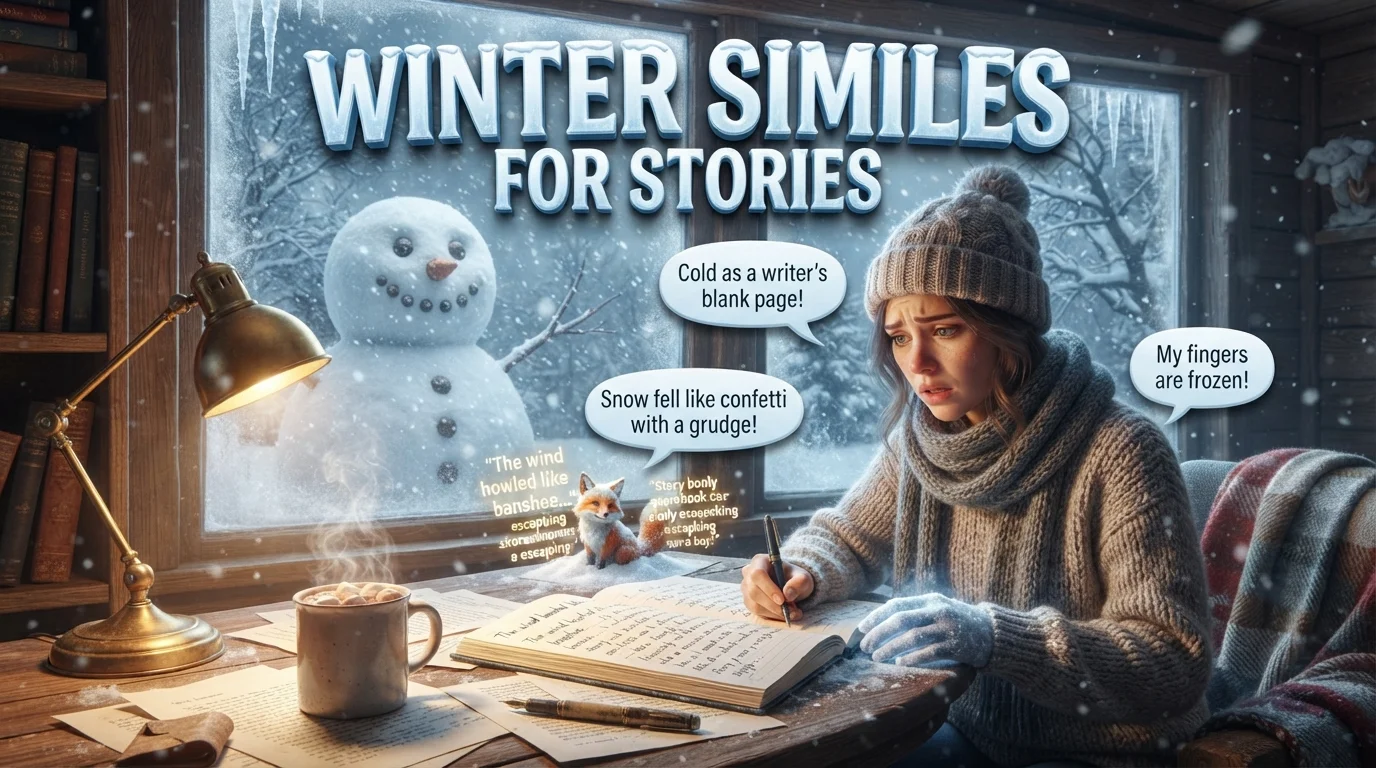
Winter Similes for Stories
In fiction, a winter simile can reveal more than scenery.
Consider:
The children raced through the snow like excited puppies.
This communicates their energy.
Compare it with:
He walked through the snow like a tired traveler crossing a desert.
The winter setting remains the same, but the emotional experience is completely different.
You can also use similes to develop a character:
She held the steaming mug like it was a small treasure.
The comparison suggests that warmth and comfort matter to her in that moment.
How to Create Your Own Winter Similes
You don’t need to copy a list to create effective winter imagery.
1. Choose a winter subject
For example:
Snow
2. Decide what you want to communicate
Maybe the snow is:
- soft
- bright
- quiet
- heavy
- endless
- delicate
- cold
Choose one.
Let’s use quiet.
3. Find something else that is quiet
Think of:
- whispers
- sleeping animals
- empty churches
- still lakes
- closed libraries
4. Build the comparison
The snow fell as quietly as a whisper.
5. Make it fit your scene
Snow fell as quietly as a whisper, covering the empty street before dawn.
Now the simile contributes to the atmosphere instead of existing as an isolated phrase.
How to Make Winter Similes More Original
Many winter comparisons are familiar:
- snow like a blanket
- stars like diamonds
- wind like a wolf
- ice like glass
These aren’t necessarily bad. Familiar comparisons can be useful when the audience needs something simple and immediately understandable.
But if you’re writing creatively, you can look for less predictable connections.
Instead of:
The snow was like a blanket.
Try:
Snow tucked itself into every corner of the sleeping town like a quiet guest who had decided to stay.
The second comparison gives the snow a sense of movement and personality.
Another approach is to compare winter with an experience rather than another physical object:
The first snowfall felt like the world had pressed a pause button.
That creates a different kind of imagery.
Common Mistakes When Using Winter Similes
1. Using “cold” without showing it
Instead of:
It was very cold.
Try:
The air stung my face like tiny needles.
The reader can now imagine the sensation.
2. Comparing everything to snow
Winter contains more than snow.
Explore:
- ice
- wind
- frost
- darkness
- bare trees
- fireplaces
- clothing
- sunlight
- frozen water
- winter animals
- indoor warmth
3. Using too many clichés
Some familiar comparisons work well, especially for younger readers. But creative writing benefits from occasional unexpected imagery.
4. Ignoring the mood
A peaceful snow scene and a dangerous blizzard shouldn’t necessarily use the same kind of comparisons.
5. Adding a simile to every sentence
Too many comparisons can make writing feel artificial.
Use them where they add something meaningful.
Simile vs. Metaphor in Winter Writing
A simile makes a comparison using like or as:
The snow was like a white blanket.
A metaphor makes the comparison directly:
The snow was a white blanket.
Both are forms of figurative language.
The easiest distinction to remember is:
Simile → like/as
Metaphor → direct comparison
25 Short Winter Similes for Quick Reference
- Snow as white as cotton.
- Snowflakes like feathers.
- Ice as smooth as glass.
- Wind like a wolf.
- Frost like white lace.
- Snow like a blanket.
- Stars like diamonds.
- Moon like a silver lantern.
- Trees like silent guards.
- Cold like icy needles.
- Snow like powdered sugar.
- Icicles like frozen fingers.
- Fireplace like a little sun.
- Snowflakes like dancers.
- Winter sky as dark as ink.
- Frozen pond like a mirror.
- Snow as soft as feathers.
- Wind like a roaring river.
- Frost like tiny crystals.
- Winter morning as quiet as a whisper.
- Snow-covered trees like sleeping giants.
- Breath like chimney smoke.
- Snow like white confetti.
- Winter night like a dark blanket.
- Moonlight like spilled silver.