

What Is a Simile for Worried?
A simile for being worried compares worry, anxious thoughts, nervous behavior, or emotional tension to something familiar, usually using like or as.
For example:
He was as restless as a bird trapped indoors.
The comparison gives the reader a clearer picture of his emotional state.
Worry can be expressed through imagery involving:
- Knots
- Storms
- Shadows
- Clocks
- Trapped animals
- Waves
- Heavy weights
- Tight strings
- Racing thoughts
- Uncertainty
85+ Similes for Worried
1. As worried as a bird in a cage
This suggests restlessness and an inability to escape concern.
Example:
He was as worried as a bird trapped in a cage.
2. Like a knot in the stomach
A familiar image for physical anxiety.
Example:
Worry sat in her stomach like a tight knot.
3. Like a storm gathering overhead
This suggests growing concern.
Example:
His worry hung over him like a storm gathering overhead.
4. Like a shadow that would not leave
A useful comparison for persistent worry.
Example:
The thought followed her like a shadow that refused to disappear.
5. Like a clock ticking in an empty room
This conveys tension and anticipation.
Example:
His worry sounded like a clock ticking in an empty room.
6. Like a trapped fly
This works especially well for restless thoughts.
Example:
Her thoughts buzzed like a trapped fly.
7. Like a weight on his chest
A physical image for emotional pressure.
Example:
The uncertainty felt like a weight pressing against his chest.
8. Like a storm inside her head
This suggests racing and conflicting thoughts.
Example:
Questions spun through her mind like a storm inside her head.
9. Like walking on thin ice
This conveys uncertainty and fear of making a mistake.
Example:
He felt worried, like he was walking on thin ice.
10. Like a fire alarm that would not stop ringing
This suggests persistent internal warning.
Example:
The concern in her mind was like a fire alarm that would not stop ringing.
11. Like a shadow creeping closer
This works for gradually increasing worry.
Example:
Fear approached like a shadow creeping closer.
12. Like waves crashing against a shore
This suggests repeated thoughts returning again and again.
Example:
Worry hit him like waves crashing against the shore.
13. Like a tightly wound spring
This conveys nervous tension.
Example:
She sat there like a tightly wound spring.
14. Like a storm trapped in a bottle
This suggests intense emotion being held inside.
Example:
His worry felt like a storm trapped inside a bottle.
15. Like a door left slightly open
This can represent uncertainty.
Example:
The unanswered question lingered like a door left slightly open.
16. Like a dark cloud
A classic comparison for persistent concern.
Example:
A dark cloud of worry followed her throughout the day.
17. Like a restless animal
This emphasizes agitation.
Example:
He paced around the room like a restless animal.
18. Like a needle scratching a record
This can describe a thought that keeps interrupting the mind.
Example:
The same concern returned like a needle scratching across a record.
19. Like a drum beating too fast
This works particularly well for nervous anticipation.
Example:
Her heart raced like a drum beating too fast.
20. Like a cage around his thoughts
This suggests feeling mentally trapped.
Example:
The uncertainty felt like a cage around his thoughts.
Similes for Mild Worry
Not every concern is overwhelming. For mild worry, softer imagery works better.
- Like a small cloud passing overhead
- Like a pebble in a shoe
- Like a low hum in the background
- Like a loose thread
- Like a fly buzzing nearby
- Like a distant rumble
- Like a question left unanswered
- Like a wrinkle in an otherwise smooth page
- Like a tiny stone in his pocket
- Like a faint shadow
Example
The upcoming interview sat in her mind like a small cloud that would not quite drift away.
Similes for Deep Worry
For intense concern, use images that communicate pressure or emotional weight.
- Like a heavy stone on the chest
- Like a storm trapped inside
- Like drowning beneath waves
- Like a rope tightening around the heart
- Like a mountain pressing down
- Like a dark cloud covering the sky
- Like an alarm that never stops
- Like a fire burning behind closed doors
- Like a cage closing around the mind
- Like an ocean with no shore
Example
His worry felt like a heavy stone pressing against his chest.
Similes for Nervous Worry
Nervousness often appears through physical movement.
- Like a bird trapped indoors
- Like a rabbit sensing danger
- Like a spring ready to snap
- Like a horse waiting at the starting gate
- Like a leaf trembling in the wind
- Like a wire pulled too tight
- Like a clock racing toward midnight
- Like a drum beating too quickly
- Like a kettle about to whistle
- Like a restless bee
Example
She felt like a rabbit listening for danger in the grass.
Similes for Worried Thoughts
Worry often involves repetitive or racing thoughts.
- Like bees trapped inside a jar
- Like a carousel spinning too fast
- Like waves returning to shore
- Like birds flying in every direction
- Like papers scattered by the wind
- Like a radio changing stations
- Like a hamster running on a wheel
- Like a storm tossing leaves through the air
- Like a scratched record repeating the same line
- Like a river rushing downhill
Example
His thoughts raced like birds startled from a tree.
Similes for Worry About Someone
When a character is worried about another person, the imagery can focus on waiting, uncertainty, and attachment.
- Like waiting for a door to open
- Like watching a storm approach
- Like holding a fragile glass
- Like waiting beside a silent phone
- Like a parent listening for footsteps
- Like a candle burning down
- Like standing at the edge of a cliff
- Like waiting for an uncertain answer
- Like a cloud covering the sun
- Like a rope pulled tight
Example
She waited for the phone to ring like someone standing at the edge of a cliff.
Similes for Worried About the Future
Uncertainty about what comes next often creates a different kind of worry.
- Like walking into thick fog
- Like sailing without a map
- Like standing at an unopened door
- Like walking across thin ice
- Like watching dark clouds gather
- Like stepping onto an unfamiliar road
- Like waiting for a storm
- Like reading a book with the next page missing
- Like looking through a window covered in mist
- Like sailing toward a hidden shore
Example
The future stretched before him like a road disappearing into fog.
Similes for a Worried Face
Instead of repeatedly saying someone “looked worried,” describe the visible signs.
- His forehead was furrowed like a folded map.
- Her eyebrows drew together like two lines pulled by a string.
- His face looked tense like a rope stretched tight.
- Her eyes darted like birds startled from a branch.
- His expression was as troubled as a sky before a storm.
- Her lips tightened like a knot being pulled closed.
- His eyes looked restless like water disturbed by wind.
- Her face was pale like a cloud-covered moon.
These comparisons work particularly well in character descriptions.
Similes for a Worried Person
A worried character often behaves differently before they ever say they are concerned.
They might:
- Pace like a caged animal.
- Fidget like a bird on a branch.
- Watch the clock like someone waiting for bad news.
- Bite their lip like a child trying not to speak.
- Move as cautiously as someone walking on thin ice.
- Check their phone like a person waiting for an urgent message.
- Sit stiffly like a statue under pressure.
- Look around like someone expecting something to go wrong.
Example
He paced around the room like a caged animal waiting for the door to open.
Similes for Worried and Scared
Worry and fear overlap, but they are not identical. Worry often focuses on what might happen, while fear can involve a more immediate sense of danger.
For a worried character who is also frightened:
- Like a rabbit sensing a predator
- Like a traveler lost in a dark forest
- Like a child hearing footsteps upstairs
- Like a bird hearing thunder before a storm
- Like someone standing on the edge of a cliff
- Like a swimmer caught in rough water
- Like a person hearing an alarm in the dark
- Like a shadow moving behind you
Example
She felt like a rabbit hearing footsteps in the grass.
Similes for Worried in a Story
When writing fiction, choose a comparison that reveals the character’s personality.
A cautious character might:
Study every detail like a detective expecting a hidden clue.
A restless character might:
Pace like a caged animal.
A hopeful but worried character might:
Watch the door like a traveler waiting for the last train.
A deeply troubled character might:
Carry the uncertainty like a stone tied to the heart.
A nervous student might:
Wait for the test results like someone listening for thunder.
The comparison becomes part of the characterization rather than simply decorating the sentence.
How to Choose the Right Simile for Worried
Start by asking what kind of worry you are describing.
Mild concern
Use images such as:
small clouds, loose threads, distant rumbles, pebbles
Nervous anticipation
Use:
clocks, springs, birds, drums, thin ice
Persistent worry
Use:
shadows, buzzing insects, dark clouds, repeating sounds
Deep emotional pressure
Use:
weights, storms, cages, waves, tightening ropes
Worry about uncertainty
Use:
fog, unopened doors, missing maps, unknown roads
The comparison should reflect the intensity rather than making every worried character sound terrified.
How to Create Your Own Simile for Worry
1. Identify the source of the worry
Is the character worried about:
- A loved one?
- An exam?
- A decision?
- An uncertain future?
- A conversation?
- A mistake?
- A possible danger?
2. Identify the emotional behavior
Does the worry make the person:
- Pace?
- Fidget?
- Overthink?
- Lose sleep?
- Check the clock?
- Become quiet?
- Feel physically tense?
3. Find something that behaves similarly
If thoughts keep repeating, consider:
a scratched record, a looping track, or waves returning to shore.
If the person feels trapped, consider:
a cage, locked room, or tangled thread.
If the worry keeps growing, consider:
a storm gathering or a shadow getting closer.
4. Connect the ideas naturally
For example:
The unanswered question hovered over him like a storm cloud.
5. Match the tone
A children’s story might use a comparison such as:
Her worries buzzed like tiny bees.
A serious novel might use:
The uncertainty sat on his chest like a stone.
Common Mistakes When Writing Similes for Worried
Making every worry sound extreme
A minor concern does not need to feel like a disaster.
Confusing worry with fear
Worry often involves anticipation and uncertainty, while fear can suggest immediate danger.
Using clichés without purpose
Expressions such as “a dark cloud” can work, but fresher imagery may create a stronger voice when the scene allows it.
Describing only the emotion
Instead of:
She was extremely worried.
Show the behavior:
She checked the clock for the fifth time, her fingers tapping against the table.
A simile can strengthen that description.
Choosing imagery that does not fit the character
A playful comparison may weaken a serious scene. Context determines whether an image feels appropriate.
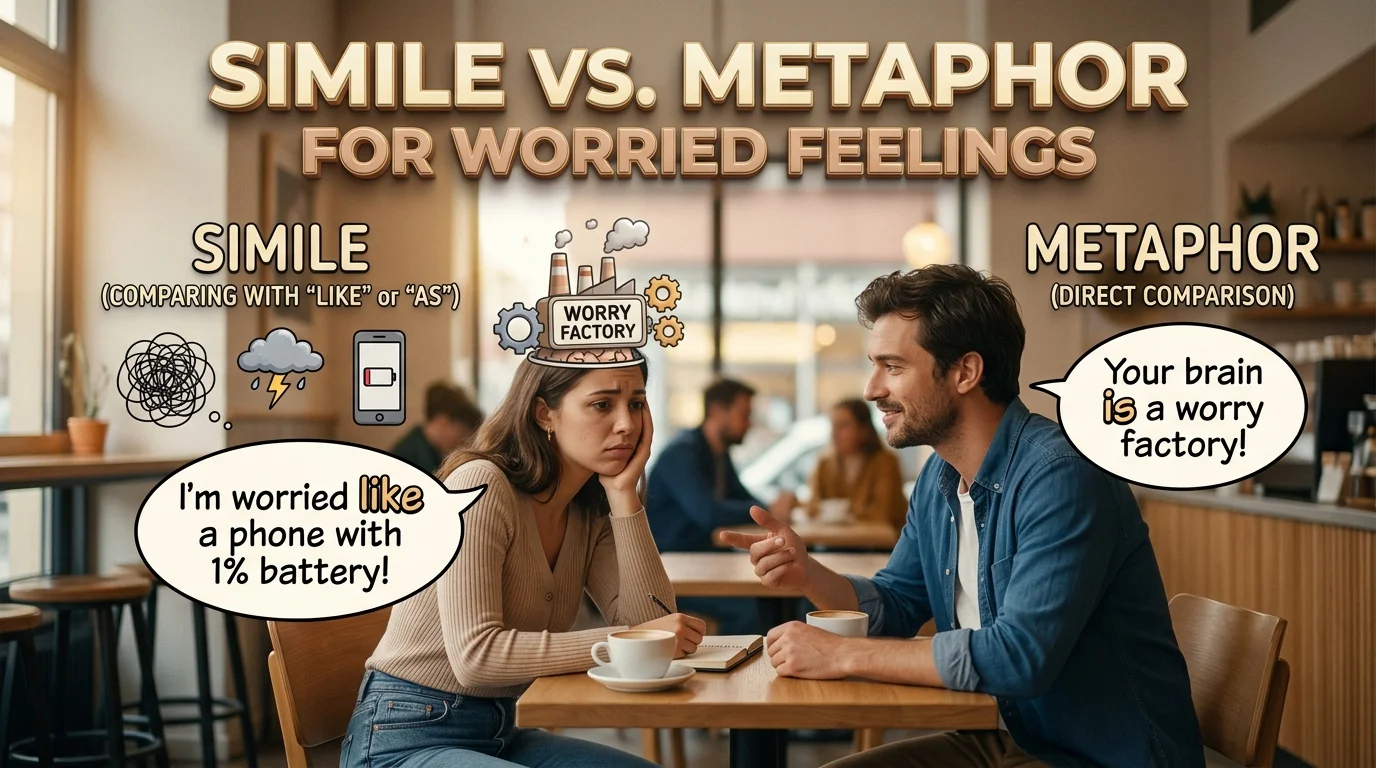
Simile vs. Metaphor for Worried Feelings
A simile makes the comparison explicit:
His worry was like a storm gathering overhead.
A metaphor makes the comparison directly:
His worry was a storm gathering overhead.
Both can communicate emotional pressure, but the simile signals the comparison with like or as.
Quick List of Similes for Worried
- Like a bird trapped in a cage
- Like a knot in the stomach
- Like a storm gathering overhead
- Like a shadow that will not leave
- Like a clock ticking in an empty room
- Like a trapped fly
- Like a weight on the chest
- Like a storm inside the head
- Like walking on thin ice
- Like a fire alarm that will not stop
- Like a shadow creeping closer
- Like waves crashing against the shore
- Like a tightly wound spring
- Like a storm trapped in a bottle
- Like a door left slightly open
- Like a dark cloud
- Like a restless animal
- Like a scratched record
- Like a drum beating too fast
- Like a cage around the mind
- Like walking through fog
- Like sailing without a map
- Like a rope pulled tight
- Like a kettle about to whistle
- Like a leaf trembling in the wind