
What Is a Simile for Anger?
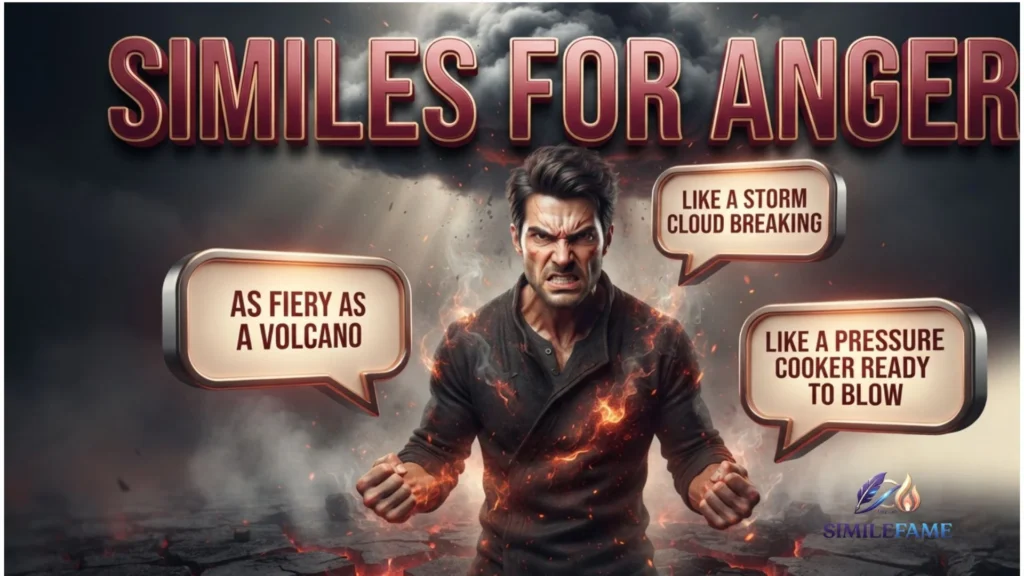
A simile for anger compares an angry emotion, reaction, or person with something familiar. Most similes use “like” or “as” to make the comparison clear.
For example:
Her anger burned like a wildfire.
Anger is not literally a wildfire. The comparison helps readers imagine its heat, intensity, speed, and destructive potential.
A good simile can make emotional writing more:
- vivid
- memorable
- descriptive
- expressive
- emotionally engaging
The important part is choosing an image that matches the exact kind of anger you’re describing.
50 Similes for Anger
The examples below cover different emotional states, from mild irritation to intense rage. Each one can be adapted to fit a particular character, audience, or writing situation.

Powerful Similes for Anger
1. His anger burned like a raging fire.
This creates a strong image of heat and intensity.
His anger burned like a raging fire, but he forced himself to remain seated.
Best for: dramatic fiction, novels, emotional essays, and serious storytelling.
2. Her fury crashed like a storm against the shore.
The repeated crashing suggests anger that keeps returning rather than disappearing immediately.
Her fury crashed like a storm against the shore when she finally confronted him.
Emotional effect: forceful, turbulent, and difficult to contain.
3. His temper flashed like lightning.
This is particularly effective for sudden anger.
His temper flashed like lightning. One moment he was laughing; the next, his voice had changed completely.
Best for: dialogue, scripts, action scenes, and fast-paced stories.
4. Her anger burned like hot coals.
Unlike a sudden flame, hot coals suggest anger that continues beneath the surface.
Her anger burned like hot coals long after the argument ended.
Best for: lingering anger and resentment.
5. He was as furious as a volcano ready to erupt.
The comparison creates anticipation because the reader expects a release.
Everyone could tell he was as furious as a volcano ready to erupt.
Writer’s Insight: Volcano imagery works best when anger has been building. If the character becomes angry instantly, lightning or a spark may create a more precise image.
6. His rage roared like a wildfire through dry grass.
This suggests anger spreading rapidly.
His rage roared like a wildfire through dry grass once the accusations began.
Best for: extreme conflict and dramatic scenes.
7. She shook with anger like a tree in a violent storm.
This comparison focuses on a physical reaction.
She shook with anger like a tree in a violent storm.
Best for: showing anger rather than simply naming it.
8. His fury was like thunder trapped inside a room.
The comparison combines sound, force, and confinement.
His fury was like thunder trapped inside a room, making every word feel heavier.
Emotional effect: overwhelming and claustrophobic.
9. Her temper was as fierce as a lightning strike.
The comparison emphasizes sudden intensity.
Her temper was as fierce as a lightning strike when she heard the accusation.
10. He glared like a predator ready to attack.
This focuses on the angry person’s behavior rather than anger itself.
He glared like a predator ready to attack, his jaw tightly clenched.
Best for: character descriptions and tense scenes.
Similes for Intense Anger
11. His anger boiled like water in a kettle.
This suggests emotional pressure steadily increasing.
His anger boiled like water in a kettle as the meeting dragged on.
12. She was as furious as a volcano bursting through its crater.
This creates dramatic imagery for overwhelming anger.
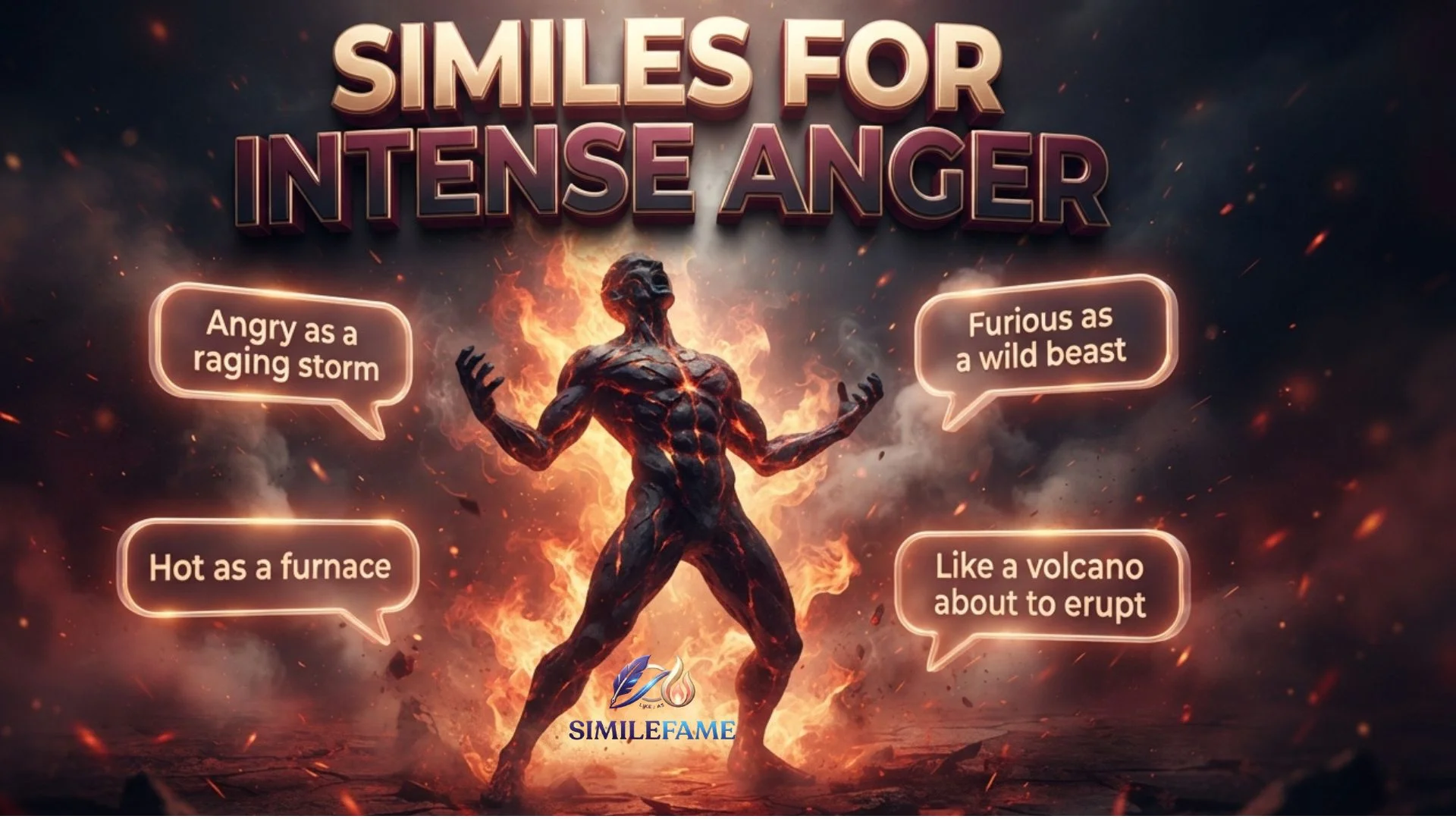
13. His rage burned like a furnace.
A furnace suggests sustained, intense heat.
His rage burned like a furnace beneath his calm expression.
14. Her anger hit like a sudden wave.
This works when anger arrives with unexpected force.
Her anger hit like a sudden wave when she realized what had happened.
15. He was as angry as a storm cloud ready to break.
The image suggests that emotional release is approaching.
16. His fury surged like a river after heavy rain.
This works well when anger grows quickly and becomes difficult to control.
17. She burned with anger like a flame fed with oil.
The image suggests that something is making the emotion stronger.
Every new accusation fed her anger like oil poured onto a flame.
18. His temper snapped like a dry branch.
The comparison suggests a breaking point.
His temper snapped like a dry branch when the insult was repeated.
19. Her rage was as powerful as a hurricane.
This creates an image of overwhelming force.
20. He looked like a pressure cooker ready to explode.
The pressure-cooker image is useful when anger has been restrained for a long time.
He looked like a pressure cooker ready to explode, but he still said nothing.
Similes for Silent and Hidden Anger
Not every angry person shouts. Some characters become quieter, colder, or more controlled.
21. His anger simmered like soup left on a low flame.
This suggests anger that remains active without becoming an obvious outburst.
22. She was as cold as ice, but anger burned underneath.
The contrast between coldness and heat makes the emotion more complex.
23. His resentment sat like a stone in his chest.
This creates a feeling of emotional weight.
His resentment sat like a stone in his chest whenever he thought about the betrayal.
24. Her silence was like a locked door hiding a storm.
The image suggests that powerful feelings are being deliberately concealed.
25. His anger lurked like a shadow behind his smile.
This works particularly well for characters who pretend everything is fine.
26. She held her fury like a spark beneath dry leaves.
A tiny spark can become something much larger, creating a sense of danger.
27. His frustration was like steam trapped inside a sealed container.
This emphasizes pressure without requiring an actual outburst.
28. Her anger remained buried like an ember beneath ashes.
The ember suggests that the emotion has not disappeared.
29. He was quiet as still water, but his anger ran deep.
This works when outward calm contrasts with strong internal emotion.
30. Her resentment grew like roots beneath the ground.
Roots suggest slow, hidden development over time.
Writer’s Insight: For hidden anger, avoid automatically using explosions or hurricanes. Images of weight, pressure, buried heat, shadows, and confinement often communicate restrained emotion more effectively.
Similes for Bottled-Up Anger
31. His anger was like a balloon stretched to its limit.
This creates a sense that one more trigger could cause a release.
32. She held her frustration like water behind a dam.
The dam represents emotional restraint.
She held her frustration like water behind a dam, afraid that one more question would break her control.
33. His rage was like a volcano sealed beneath the earth.
This combines hidden anger with the expectation of eventual release.
34. Her anger pressed against her like steam inside a pressure cooker.
This emphasizes internal pressure.
35. He kept his fury bottled up like a storm trapped in a jar.
The contradiction creates a memorable image of something powerful being confined.
36. Her temper was like a rubber band pulled too far.
This is particularly useful for showing emotional strain.
37. His resentment piled up like dry wood waiting for a spark.
The comparison suggests that past frustrations are accumulating.
38. She carried her anger like a heavy stone in her pocket.
This communicates an emotion that follows someone throughout the day.
Similes for Sudden Anger
39. His anger flashed like lightning.
Short and direct, this comparison emphasizes speed.
40. She became furious like a match catching fire.
The image suggests a rapid emotional change.
41. His temper erupted like a shaken bottle suddenly opened.
This works when anger has been contained before suddenly escaping.
42. Her rage struck like a thunderclap.
The comparison emphasizes shock and suddenness.
43. He snapped like a rubber band pulled too far.
This suggests a breaking point after prolonged tension.
44. Her anger burst out like water breaking through a dam.
This combines buildup with sudden release.
Similes for Extreme Rage
45. His rage was like a wildfire consuming everything in its path.
This suggests anger that seems to spread without restraint.
46. She was as furious as a hurricane tearing through a coastline.
The comparison communicates enormous force.
47. His anger exploded like a volcano releasing years of pressure.
This is particularly suitable when resentment has accumulated over time.
48. Her fury thundered through the room like a violent storm.
This connects anger with sound and atmosphere.
49. He burned with rage like a furnace running at full heat.
This emphasizes sustained intensity.
50. His temper was like a dam collapsing under enormous pressure.
The image works especially well when a calm character finally loses control.
Similes for an Angry Person
Sometimes you want to describe the person’s behavior, not simply the emotion.
Physical and Behavioral Comparisons
| Simile | What the reader imagines |
|---|---|
| He paced like a caged tiger. | Restlessness and aggression |
| She glared like a hawk watching its prey. | Intense focus |
| He stood as rigid as a statue. | Controlled anger |
| She trembled like a leaf in a strong wind. | Overwhelming emotion |
| He stormed around like a bull in a field. | Uncontrolled movement |
| She was as tense as a bow pulled tight. | Restrained pressure |
A Story Example
Maya paced like a caged tiger, stopping only long enough to glare at the locked door.
The simile does more than tell us Maya is angry. It reveals how she responds to anger.
A character who paces, for example, feels different from one who becomes completely silent.
Similes for Frustration and Irritation
Anger exists on a spectrum. Irritation may be mild, while frustration often comes from being blocked or unable to solve a problem.
Everyday Comparisons
- His frustration was like a locked door he could not open.
- Her annoyance buzzed like a mosquito near her ear.
- His patience wore thin like an old piece of fabric.
- She was as irritated as someone listening to a dripping faucet.
- He felt as restless as a bird trapped indoors.
- Her frustration was like a traffic jam with no visible exit.
Mini Scenario
Situation: A student has tried to solve the same math problem several times.
Possible simile:
The problem frustrated him like a locked door that refused to open.
Why it fits: The comparison captures the feeling of trying repeatedly without making progress.
Quick Challenge: Think of a frustrating everyday experience—slow internet, traffic, a broken appliance, or a missed appointment. What physical object could represent that frustration?
How to Describe Anger With a Simile
Start by identifying the kind of anger rather than immediately searching for a comparison.
For Mild Anger
Use familiar, slightly irritating images.
She was as annoyed as someone listening to a dripping faucet.
For Growing Anger
Choose something that gradually increases.
His anger rose like dark clouds before a storm.
For Hidden Anger
Choose an image that looks quiet but contains something underneath.
Her resentment smoldered like an ember beneath ashes.
For Sudden Anger
Use something that happens quickly.
His temper flashed like lightning.
For Explosive Anger
Choose an image involving release or destruction.
His anger erupted like a volcano.
Writer’s Insight: Don’t ask, “What is another word for angry?” Ask, “What does this anger feel like?” Is it hot, heavy, trapped, sharp, fast, restless, or slow-burning? That question usually leads to better imagery.
Similes for Anger in Writing
A simile becomes useful when it contributes something to the surrounding sentence.
Compare:
Marcus was angry with his brother.
with:
Marcus’s anger boiled like water in a forgotten kettle as he stared across the room.
The second sentence gives the emotion heat and movement.
You can strengthen it further by adding physical behavior:
His anger burned like a furnace, and his clenched fists trembled at his sides.
The simile handles the imagery while the physical detail gives the reader evidence of the emotion.
A Useful Rule
Don’t add a simile simply because a sentence feels plain.
Add one when it helps you:
- reveal character
- create atmosphere
- increase tension
- establish mood
- visualize an emotion
- make a moment memorable
Storytelling Applications
Similes can strengthen several elements of fiction and storytelling.
Character Development
She guarded her resentment like a secret diary.
The comparison suggests a person who keeps emotional pain private.
Dialogue
“Don’t ask me again,” he said, his voice as sharp as broken glass.
The comparison makes the dialogue feel tense without adding a long explanation.
Setting
Anger filled the room like smoke.
Now the emotion becomes part of the atmosphere.
Action
He slammed the door like a storm breaking through a window.
The comparison gives the physical action more energy.
Conflict
Her frustration built like water behind a dam as the argument continued.
The reader can sense that the confrontation is moving toward a breaking point.
Fiction and Novel Writing
Novels give writers room to develop emotional imagery over several sentences.
Sarah sat silently at the table. Her anger was like water behind a dam, rising with every question. She knew she could stay quiet only for so long.
The simile introduces pressure, while the surrounding sentences create anticipation.
For a more physical character:
He crossed the room like a storm given human form, knocking the chair aside as he went.
Writer’s Insight
Don’t place a simile in every sentence of a novel. Constant figurative language can make emotional scenes feel artificial.
Use your strongest comparisons at moments where the emotion changes, peaks, or reveals something important about the character.
Poetry Applications
Poetry can use similes to compress emotion into a small amount of language.
Creating Imagery
My anger burns
like a coal beneath the snow,
quiet to the eye,
alive underneath.
The coal and snow create a contrast between an apparently cold surface and hidden heat.
Creating Rhythm
His words struck
like stones against glass.
The short structure gives the line a sharp, quick rhythm.
Creating Emotional Depth
My resentment grows
like roots beneath the ground,
unseen,
but reaching everywhere.
The comparison suggests that resentment can become deeply embedded over time.
Poetry Tip
Read your simile aloud. A comparison that looks beautiful on the page may sound awkward when spoken.
In poetry, sometimes the most effective simile is the shortest one.
Children’s Writing
Children usually respond well to comparisons involving familiar objects, animals, food, and everyday experiences.
Examples
Sam was as angry as a bear whose picnic basket had disappeared.
Lily’s frustration buzzed like a bee inside her head.
He stomped around like a dinosaur looking for lunch.
These comparisons are easier for younger readers to visualize.
Writer’s Tip
For children’s writing, favor clear images over complicated vocabulary. The simile should make the emotion easier to understand, not harder.
Essays and School Assignments
Similes can make descriptive writing more engaging, particularly in personal narratives and creative assignments.
Plain Version
The crowd became angry after the decision.
With Figurative Language
The crowd’s frustration grew like pressure behind a dam after the announcement.
The comparison gives the emotional change a sense of buildup.
For academic writing, however, use figurative language selectively. A strong comparison is usually more effective than five unrelated ones.
Speeches and Presentations
A short simile can help an audience understand an abstract emotional experience.
Frustration can feel like pushing against a locked door: the harder you try, the more trapped you feel.
This works because the audience does not have to imagine an abstract definition of frustration. They can visualize the physical experience.
Speechwriting Tip
Choose comparisons that can be understood immediately when heard aloud. Avoid complicated images that require several sentences to explain.
Scripts and Screenwriting
Screenwriting often relies on visible behavior rather than lengthy emotional descriptions.
Instead of:
John is extremely angry.
You could write:
John paces like a caged tiger. His fists tighten.
The actor can then communicate the emotion through movement and performance.
Screenwriting Tip
Keep the action clear. A simile should support the scene rather than distract from what the character is doing.
Social Media Caption Ideas
A well-chosen simile can make a short caption more relatable.
Instagram Caption
Trying to stay calm while my coffee order disappears: as irritated as a cat staring at an empty bowl.
TikTok Caption
When someone says “calm down” while you’re already mad: my patience vanished like Wi-Fi during a storm.
Facebook Caption
Some days, frustration builds like traffic on a Friday afternoon.
Pinterest Description
Writing an angry character? Try: “Her resentment smoldered like an ember beneath ash.”
Social Media Tip
One memorable comparison usually works better than filling a short caption with several similes.
How to Create Your Own Similes for Anger
You don’t need an unusual vocabulary to create original imagery.
Step 1: Identify the Emotion
Decide whether you’re describing:
- irritation
- frustration
- annoyance
- resentment
- anger
- fury
- rage
Step 2: Identify Its Physical Quality
Ask what the emotion feels like.
Hot? Think about furnaces, boiling water, heated metal, or sunlight.
Heavy? Think about stones, weights, or loaded bags.
Fast? Think about lightning, sparks, racing animals, or falling objects.
Trapped? Think about cages, locked doors, dams, or sealed containers.
Sharp? Think about broken glass, needles, or blades.
Step 3: Choose an Unexpected Image
Suppose the emotion feels trapped.
A familiar comparison might be:
My anger was like water behind a dam.
Now try something more personal:
My anger was like a sentence stuck behind my teeth.
The second image connects the emotion with speech and restraint, which may fit a character who desperately wants to say something but stays silent.
Step 4: Test the Comparison
Ask:
- Can the reader picture it?
- Does it match the intensity?
- Does it sound natural?
- Does it add something to the sentence?
- Does it fit the character and audience?
If the answer is yes, the simile is doing useful work.
A Simple Formula for Original Similes
A practical starting formula is:
Emotion + like/as + physical image + emotional connection
For example:
Her frustration + was like + a door that refused to open.
You can also reverse the structure:
Like a storm trapped behind glass, his anger had nowhere to go.
Changing sentence structure helps prevent your writing from sounding repetitive.
How to Avoid Cliché Similes
Classic images such as fire, volcanoes, storms, and lightning remain useful because readers understand them immediately.
The problem comes when every angry character sounds exactly the same.
Instead of:
His anger was like a volcano.
Try making the comparison specific:
His anger was like a pressure gauge climbing toward the red line.
Now the image suggests buildup and approaching danger.
Or:
Her resentment was like a splinter buried too deep to remove.
This creates a quieter, more personal feeling.
Cliché-Control Test
Before using a familiar simile, ask:
Could this comparison describe almost any angry character?
If the answer is yes, look for something connected to the character’s environment, personality, occupation, memories, or immediate situation.
That is often where original imagery comes from.
Match the Simile to the Tone
The same emotion can require very different language depending on the audience.
| Writing situation | Useful approach |
|---|---|
| Children’s story | Simple and playful |
| School assignment | Clear and easy to understand |
| Novel | Character-specific imagery |
| Poetry | Concise and evocative |
| Comedy | Unexpected or exaggerated |
| Speech | Short and memorable |
| Social media | Relatable and modern |
| Serious fiction | Controlled and emotionally precise |
A funny comparison can weaken a tragic scene. A highly dramatic comparison can feel excessive when describing a minor annoyance.
Weak vs. Strong Similes
Weak
He was angry like a fire.
The comparison is understandable, but the structure sounds unnatural.
Better
His anger burned like fire.
This is smoother and more direct.
Stronger
His anger burned like a fire starved of oxygen, growing hotter with every word.
The additional detail connects the image to emotional buildup.
Writer’s Insight
A stronger simile isn’t necessarily a longer simile. It is usually a more precise comparison.
Practice Your Own Similes
Now turn the ideas above into writing practice.
Exercise 1: Complete the Simile
Finish these:
- Her anger was like __________.
- His frustration felt as heavy as __________.
- Her resentment smoldered like __________.
- His temper flashed like __________.
- Their rage moved through the room like __________.
Try to avoid fire, volcano, and storm in at least three answers.
Exercise 2: Rewrite a Plain Sentence
Start with:
James was angry when he heard the news.
Rewrite it four ways:
- mild anger
- hidden anger
- intense anger
- explosive anger
The event stays the same. Only the emotional expression changes.
Exercise 3: Improve a Cliché
Start with:
Her anger was like a volcano.
Make the comparison specific to her personality.
If she has spent years hiding her feelings, perhaps your image involves buried heat, a sealed container, or pressure underground.
Exercise 4: Use the Five Senses
Create an anger simile based on:
- something you can see
- something you can hear
- something you can touch
- something you can smell
- something you can physically feel
This encourages you to move beyond visual imagery.
Quick Writing Challenge
Imagine this situation:
A friend promises to attend an important event but doesn’t show up. Three hours later, they arrive without an explanation.
Create four different comparisons:
Irritation:
Frustration:
Resentment:
Rage:
The situation stays the same, but the emotional intensity changes.
That exercise teaches an important writing skill: imagery should follow the emotion rather than the other way around.
Quick Reference: Choosing an Anger Image
For Heat
Think about:
- fire
- furnace
- boiling water
- hot metal
For Pressure
Think about:
- dam
- balloon
- pressure cooker
- tightened wire
For Suddenness
Think about:
- lightning
- spark
- snap
- thunderclap
For Hidden Anger
Think about:
- ember
- buried root
- locked room
- shadow
For Persistent Irritation
Think about:
- mosquito
- dripping faucet
- buzzing insect
- creeping rust
For Extreme Rage
Think about:
- wildfire
- hurricane
- eruption
- collapsing dam
Use these as creative starting points, not as a checklist to copy. The strongest image may come from something unique to your character or situation.
Final Tips for Using Similes for Anger
The best similes for anger don’t simply tell readers that someone is mad. They show what the anger feels like and how it behaves.
Use:
- fire when heat and intensity matter
- lightning for sudden anger
- a dam for emotional pressure
- an ember for hidden resentment
- a buzzing insect for persistent irritation
- a storm for turbulent emotion
- weight when anger feels emotionally heavy
Most importantly, match the comparison to the scene.
A character who is mildly irritated doesn’t need to sound like a volcano. A character hiding years of resentment may be better represented by an ember than an explosion.
When creating your own similes, start with the emotion, identify its physical quality, choose an image that shares that quality, and then ask whether the comparison adds something meaningful.
A good simile doesn’t merely tell readers that a character is angry.
It gives their anger a shape, sound, temperature, movement, or weight they can imagine.