

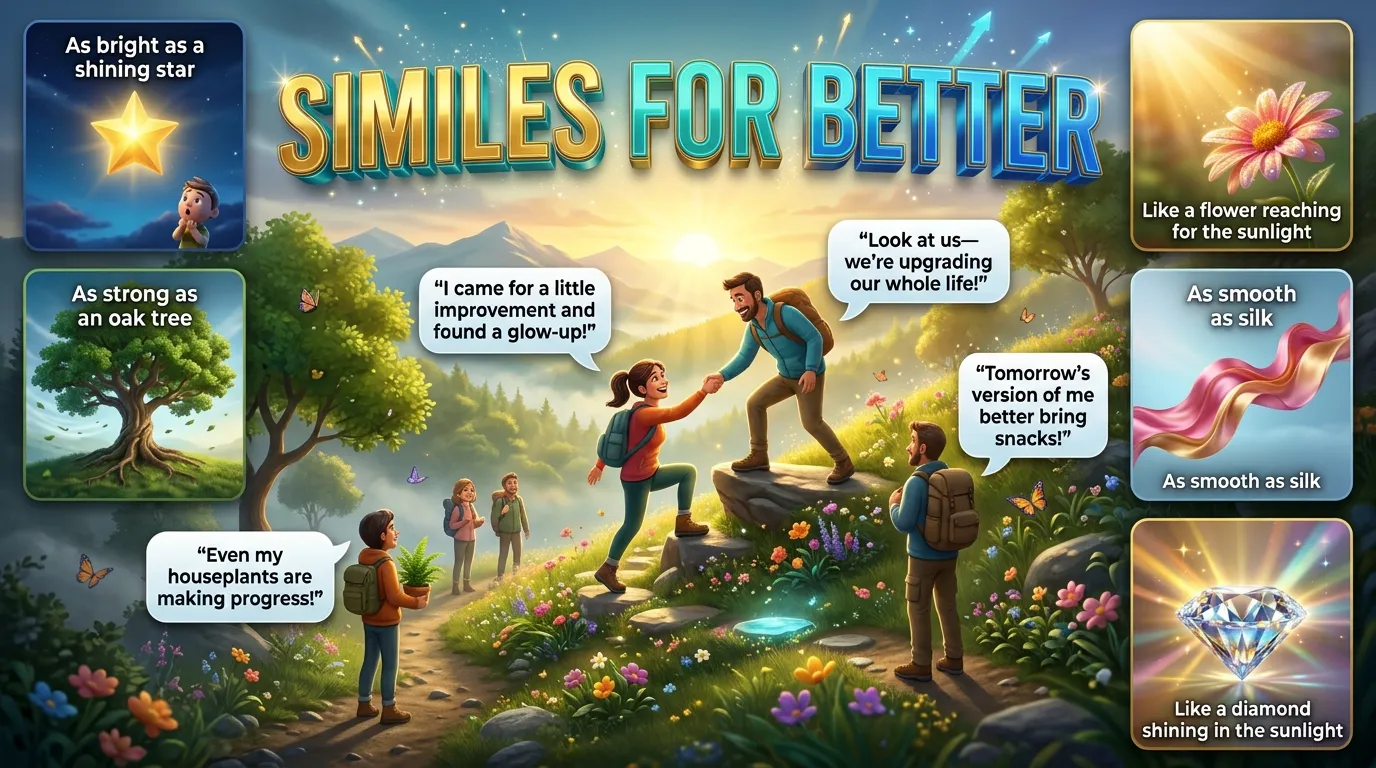
What Is a Simile for Better?
A simile for better compares improvement or a positive change to something familiar using like or as. It helps readers picture how a person, situation, feeling, or experience has improved.
For example, “Her confidence grew like a tree reaching toward the sunlight” compares personal growth to a tree becoming stronger.
The word better can describe different kinds of improvement:
Feeling better: Becoming happier, calmer, or healthier.
Getting better at something: Developing a skill through practice.
Making things better: Improving a situation or solving a problem.
Moving toward better days: Finding hope after difficult experiences.
Becoming a better person: Learning, growing, and treating others more thoughtfully.
Best Similes for Better With Meanings
These similes describe improvement, progress, and positive change in different situations.
Simile | Meaning |
|---|---|
Like a flower blooming after rain | Becoming stronger or happier after a difficult time |
As bright as the morning sun | Feeling more cheerful and hopeful |
Like a road becoming smoother | Experiencing fewer problems over time |
As fresh as a cool breeze | Feeling refreshed and renewed |
Like a seed growing into a tree | Developing gradually into something stronger |
As clear as a cloudless sky | Becoming easier to understand |
Like a lamp growing brighter | Improving in a noticeable way |
As steady as a river finding its course | Making consistent progress |
Like a garden coming back to life | Recovering after a difficult period |
As strong as an oak tree | Becoming more resilient |
Like a door opening to sunlight | Discovering new opportunities |
As smooth as freshly polished glass | Becoming more refined or effective |
Like a puzzle falling into place | Making progress as problems become clearer |
As warm as sunshine after winter | Feeling comfort and relief after hardship |
Like a path opening through a forest | Finding a clearer way forward |
Similes for Getting Better at Something
Improving a skill takes practice, patience, and effort. These similes help describe progress in sports, school, work, music, art, and other activities.
Like a seed growing into a strong tree: Developing gradually with time and care.
As sharp as a freshly sharpened pencil: Becoming more skilled and precise.
Like a musician finding the rhythm: Learning to perform with greater confidence.
As smooth as a well-rehearsed dance: Performing a task with ease and coordination.
Like a puzzle coming together piece by piece: Understanding more as you learn.
As quick as a practiced runner: Performing a familiar task efficiently.
Like a rough stone becoming polished: Improving through repeated effort.
As steady as a train on its tracks: Making consistent progress toward a goal.
Example: “After weeks of practice, Maya played the piano as smoothly as a well-rehearsed dance.”
Similes for Feeling Better
Sometimes, feeling better means finding emotional relief, regaining confidence, or experiencing a little peace after a stressful period.
As light as a feather: Feeling relieved after a burden disappears.
Like sunshine breaking through dark clouds: Feeling happier after sadness.
As calm as a lake at dawn: Feeling peaceful after stress.
Like a cool breeze on a summer day: Feeling refreshed and comforted.
As warm as a blanket on a cold night: Feeling safe and cared for.
Like rain washing dust from the leaves: Feeling renewed after a difficult experience.
As bright as a window opening to the morning: Feeling more optimistic.
Like a deep breath after a long run: Experiencing relief after pressure.
Example: “After talking with her best friend, she felt as light as a feather.”
Similes for Making Things Better
These comparisons are useful when describing solutions, improvements, teamwork, and efforts to create a more positive situation.
Like oil smoothing a squeaky hinge: Making a difficult situation easier.
As clear as freshly cleaned glass: Making confusing information easier to understand.
Like a bridge connecting two distant shores: Bringing people or ideas together.
As helpful as a map on an unfamiliar road: Making a challenging task easier to manage.
Like a missing puzzle piece completing the picture: Providing what a situation needs.
As organized as books on a carefully arranged shelf: Improving order and efficiency.
Like fresh paint on an old fence: Giving something a renewed appearance.
As balanced as scales holding equal weights: Making a situation fairer or more stable.
Example: “The new schedule worked like oil smoothing a squeaky hinge, making the entire morning easier.”
Similes for Better Days Ahead
When someone has faced disappointment or hardship, comparisons can help express hope for a more positive future.
Like sunrise after a long night: Suggesting that a difficult period is ending.
As hopeful as a seed waiting for spring: Believing that good changes may come.
Like a rainbow appearing after rain: Finding beauty after a difficult experience.
As promising as a clear road ahead: Looking forward to new opportunities.
Like a window opening in a stuffy room: Discovering fresh possibilities.
As bright as stars in a dark sky: Finding hope during uncertain times.
Like winter giving way to spring: Moving from a difficult season into a better one.
As refreshing as rain on dry ground: Welcoming relief after a long struggle.
Example: “After months of setbacks, the new opportunity felt like sunrise after a long night.”
Similes for Becoming a Better Person
Personal growth often involves learning from mistakes, showing kindness, and becoming more thoughtful. These similes can help describe that process.
Like a tree growing stronger through changing seasons: Developing resilience through experience.
As gentle as a breeze through tall grass: Becoming more considerate and calm.
Like a mirror becoming clear after cleaning: Seeing yourself and your choices more honestly.
As patient as a gardener tending young plants: Learning to give yourself and others time.
Like a candle lighting another candle: Helping others while spreading kindness.
As open as a window on a spring morning: Becoming more receptive to new ideas.
Like a rough diamond slowly being polished: Developing qualities that become clearer over time.
As steady as a compass pointing north: Becoming more consistent in your values.
Example: “He became more patient like a gardener tending young plants, learning that personal growth takes time.”
Funny Similes for Better
Humorous similes can make improvement feel relatable, especially when progress is small, unexpected, or delightfully dramatic.
Like a sleepy cat finally finding a sunny spot: Getting comfortable after a rough start.
As happy as a phone at 100% battery: Feeling ready to take on the day.
Like a computer restarting after a stubborn glitch: Working properly after a frustrating problem.
As smooth as butter on a warm pancake: Becoming surprisingly easy or effortless.
Like a plant finally getting watered: Perking up after being neglected.
As organized as a sock drawer after a miracle: Becoming neat in an unexpected way.
Like a Wi-Fi signal returning during a video call: Improving just when it is needed most.
As cheerful as a dog hearing the word “walk”: Becoming noticeably happier.
Like a burnt toast finally getting a second chance: Recovering from a small disaster.
As confident as a penguin in a tuxedo: Looking ready for an important occasion.
Example: “After a good night’s sleep, I felt like a computer restarting after a stubborn glitch.”
Short Similes for Better
Short comparisons work well in captions, poems, dialogue, and concise descriptions.
Like sunshine after rain
As fresh as a breeze
Like a flower in bloom
As bright as dawn
Like a road cleared of stones
As strong as an oak
Like a puzzle completed
As calm as still water
Like spring after winter
As smooth as silk
Like a lamp growing brighter
As light as a feather
Like a seedling reaching upward
As clear as blue sky
Like a door opening wide
Choose the phrase that matches the type of improvement you want to describe. For example, “like spring after winter” suggests recovery, while “like a lamp growing brighter” emphasizes gradual progress.
Similes for Better in Different Situations
The best simile depends on what is improving and how that change feels.
Situation | Simile | Meaning |
|---|---|---|
Improving a skill | Like a rough stone becoming polished | Developing through practice |
Feeling happier | Like sunshine breaking through clouds | Moving from sadness to happiness |
Recovering after hardship | Like a garden coming back to life | Regaining strength and hope |
Solving a problem | Like a puzzle falling into place | Finding clarity |
Building confidence | Like a lamp growing brighter | Becoming more self-assured |
Improving teamwork | Like gears turning smoothly | Working together more effectively |
Making a fresh start | Like a window opening to spring air | Welcoming new possibilities |
Learning from mistakes | Like a path becoming clearer with every step | Gaining understanding |
Finding peace | As calm as a lake at dawn | Feeling relaxed and settled |
Hoping for the future | Like sunrise after a long night | Expecting better circumstances |
How to Use Similes for Better in a Sentence
A strong simile should explain the kind of improvement taking place. Use these steps to create comparisons that fit your writing.
1. Identify What Is Improving
Decide whether you are describing a feeling, skill, relationship, situation, or personal quality.
For example, a student improving at math may need a different comparison from someone recovering after a difficult week.
2. Choose an Image That Shows Change
Think of familiar things that become stronger, brighter, smoother, calmer, or healthier.
Examples include a growing plant, a clearing sky, a polished stone, or a road becoming easier to travel.
3. Connect the Image to the Improvement
Make sure the comparison expresses the intended change.
Basic: “My writing improved.”
More vivid: “My writing improved like a rough stone becoming polished.”
The second sentence gives readers a clearer picture of gradual development.
4. Use Like or As
A simile directly compares two things using like or as.
For example: “Her mood lifted like a kite catching the wind.”
5. Keep the Comparison Natural
Avoid adding imagery that distracts from your meaning. A simple, relevant comparison often communicates improvement better than an elaborate one.
Common Mistakes When Writing Similes for Better
Avoid these common problems when creating or selecting similes.
Using an unclear comparison: Readers should understand how the image relates to improvement.
Repeating the same imagery: Too many flowers, sunrises, and rainbows can make writing predictable.
Confusing similes with metaphors: “Progress is a staircase” is a metaphor. “Progress is like a staircase” is a simile.
Using comparisons that do not fit the tone: A funny simile may not suit a serious reflection on personal growth.
Making unsupported promises: A hopeful comparison should express possibility rather than guarantee a positive outcome.
Forcing the word “better”: Use the exact word when it fits, but allow the comparison to communicate improvement naturally.
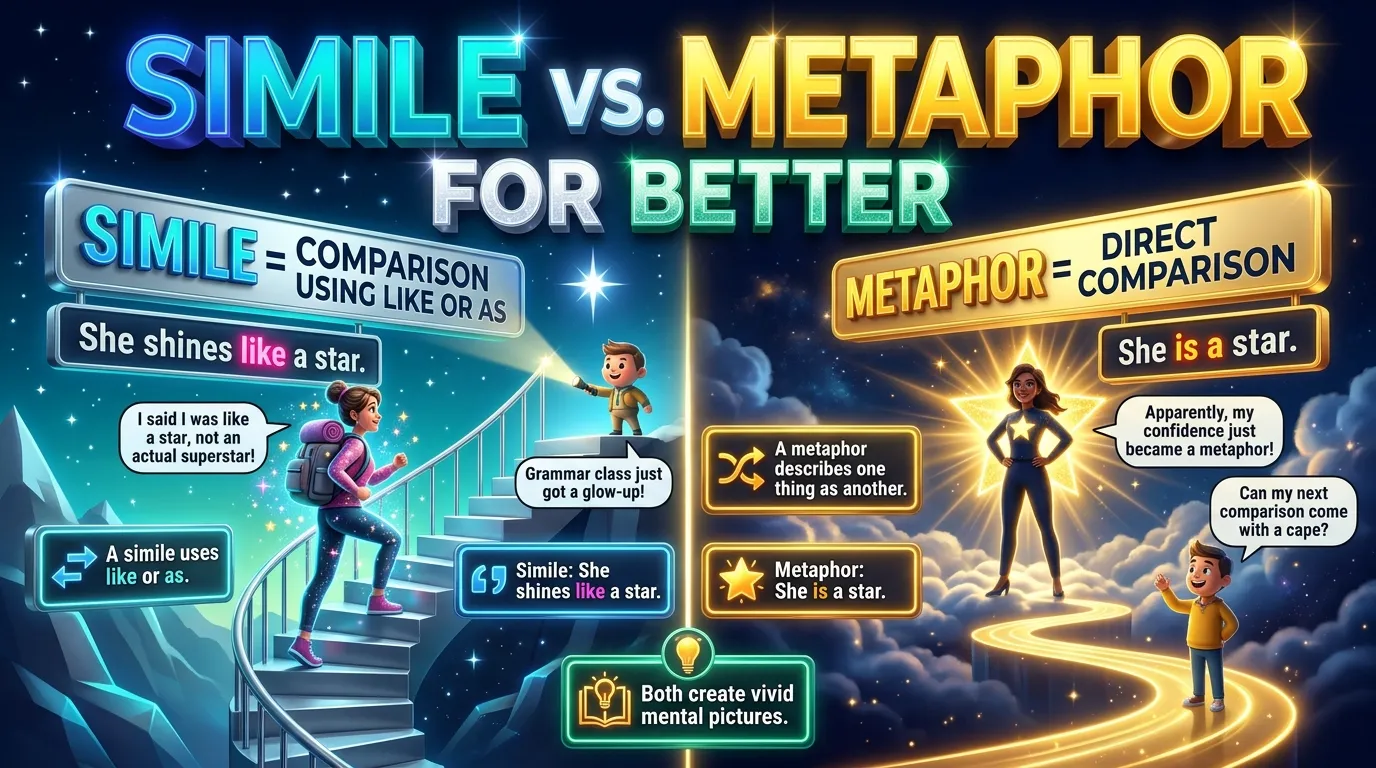
Simile vs. Metaphor for Better
Similes and metaphors both create comparisons, but they use different structures.
Feature | Simile | Metaphor |
|---|---|---|
Structure | Uses like or as | Describes one thing as another |
Example | Her confidence grew like a tree. | Her confidence was a tree. |
Effect | Makes the comparison explicit | Makes the comparison more direct |
Common use | Clear descriptions and accessible imagery | Strong, compact imagery |
Both can describe improvement effectively. Choose a simile when you want to make the relationship between two ideas clear.