
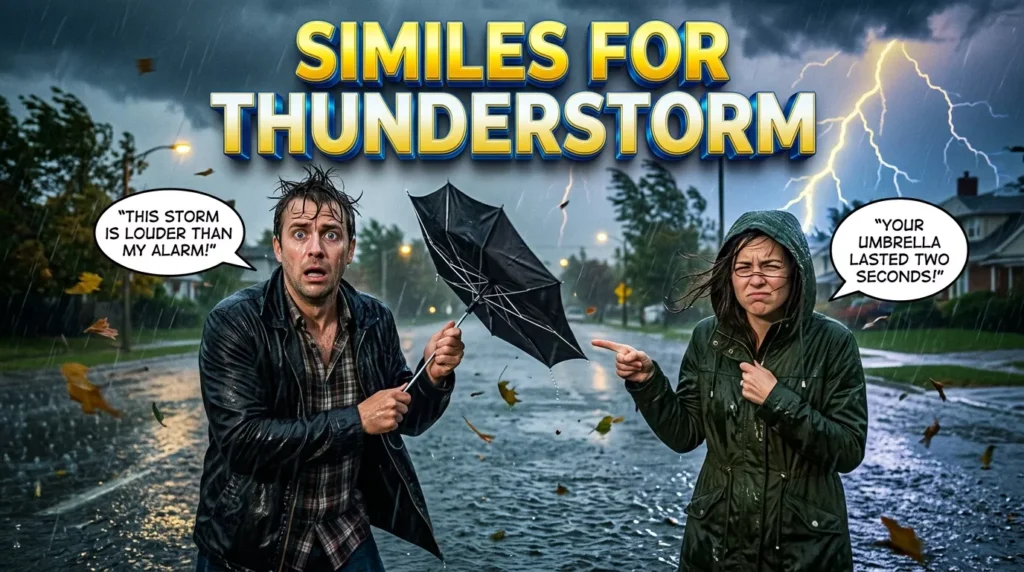
What Is a Thunderstorm?
A thunderstorm is a weather event associated with lightning and thunder. It often brings heavy rain and may also produce strong winds, hail, or other hazardous conditions.
Thunderstorms can create a range of sensory experiences:
Sound: Deep rumbles, sudden cracks, and booming thunder.
Sight: Dark clouds, brilliant lightning, and sheets of rain.
Movement: Gusting winds, falling rain, and fast-changing clouds.
Atmosphere: Tension, excitement, fear, or the relief that follows a storm.
Similes help express these details by comparing unfamiliar or dramatic sensations with experiences readers already understand.

Best Similes for Thunderstorm
Here are some vivid comparisons for describing the different parts of a thunderstorm.
Simile | Meaning |
|---|---|
Like an angry giant pounding on the sky | Loud, forceful thunder |
Like fireworks exploding in the darkness | Sudden, brilliant lightning |
Like a waterfall pouring from the heavens | Extremely heavy rain |
Like a drumline marching across the clouds | Repeated rolls of thunder |
Like a black blanket covering the sun | Dark storm clouds |
Like a lion roaring above the rooftops | Deep, powerful thunder |
Like silver knives slicing through the sky | Sharp flashes of lightning |
Like a thousand fingers tapping on the roof | Raindrops striking a surface |
Like a wild horse racing across the plains | Strong, rushing wind |
Like a giant shaking the windows | Powerful thunder that rattles a house |
Like a curtain falling across the landscape | Rain obscuring the view |
Like a warning bell ringing in the distance | Distant thunder announcing an approaching storm |
Similes for Thunder With Meanings and Examples
Thunder can sound like a deep rumble, a sudden crack, or a long rolling boom. These comparisons help distinguish between the different sounds of a storm.
1. Like an Angry Giant Pounding on the Sky
This simile makes thunder sound powerful and threatening, as though an enormous creature were striking the heavens.
Example: Thunder boomed like an angry giant pounding on the sky, shaking the windows of the old farmhouse.
2. Like a Lion Roaring Above the Rooftops
A lion’s roar is deep, powerful, and intimidating. This comparison works well when thunder sounds loud enough to dominate the surrounding landscape.
Example: The thunder rolled like a lion roaring above the rooftops, drowning out the voices on the porch.
3. Like a Drumline Marching Across the Clouds
This simile describes repeated rumbles that seem to travel across the sky, creating a rhythmic succession of sounds.
Example: Thunder echoed like a drumline marching across the clouds as the storm moved toward the valley.
4. Like a Giant Rolling Barrels Down a Staircase
This imaginative comparison suggests a series of heavy, uneven rumbles that grow louder and fade away.
Example: The thunder sounded like a giant rolling barrels down a staircase, rumbling long after the lightning disappeared.
5. Like a Cannon Exploding in the Distance
A cannon blast suggests a sudden, forceful crack of thunder that interrupts the quiet.
Example: A sharp clap of thunder burst like a cannon exploding in the distance, startling everyone in the garden.
6. Like Furniture Dragging Across the Heavens
This simile is especially effective for low, prolonged thunder that seems to scrape and rumble overhead.
Example: Thunder groaned like furniture dragging across the heavens, making the quiet house feel unusually small.
7. Like a Giant Slamming a Door
This comparison emphasizes an abrupt, startling burst of sound.
Example: Thunder cracked like a giant slamming a door, and the children jumped in their seats.
Similes for Lightning During a Thunderstorm
Lightning transforms a dark sky with sudden flashes of brilliant light. These similes emphasize its brightness, speed, shape, and dramatic effect.
Similes That Describe Bright Lightning
Like a camera flash in a pitch-black room: A sudden burst of bright light.
Like fireworks bursting behind a curtain: Bright flashes illuminating the clouds.
Like a white-hot blade cutting through the sky: A sharp, striking bolt of lightning.
Like a silver ribbon unrolling across the clouds: A long, branching streak of light.
Like a match struck against the darkness: A brief but brilliant flash.
Like a giant’s flashlight sweeping across the earth: Lightning illuminating a wide area.
Example: Lightning flashed like a camera flash in a pitch-black room, revealing the twisted branches of the old oak tree.
Similes That Describe Sudden Lightning
Like a whip cracking across the sky: A quick, sharp streak.
Like a spark jumping from a live wire: A brief, energetic flash.
Like a white arrow racing through the clouds: A fast, narrow bolt.
Like a zipper opening the night: A jagged flash that seems to split the darkness.
Example: A bolt of lightning shot downward like a white arrow racing through the clouds, illuminating the fields for an instant.
Similes for Heavy Rain During a Thunderstorm
Thunderstorms often bring intense rainfall that splashes against windows, floods gutters, and reduces visibility. These similes help readers imagine the amount, speed, and sound of the rain.
Like a waterfall spilling from the sky: Rain falling in a heavy, continuous sheet.
Like a thousand fingers drumming on the roof: The rapid tapping sound of raindrops.
Like buckets being emptied over the earth: An overwhelming downpour.
Like beads racing down a glass window: Raindrops streaming across a surface.
Like a curtain of water hiding the street: Rain obscuring buildings and roads.
Like a river tumbling over rocks: Fast-moving water rushing along the ground.
Like a million tiny stones striking the pavement: Heavy drops hitting a hard surface.
Like a shower of silver threads: Rain streaking through the light.
Example: Rain hammered the roof like a thousand fingers drumming on a giant wooden table.
Similes for Dark Thunderstorm Clouds
Dark clouds can make the landscape feel mysterious, tense, or ominous before the storm arrives.
Like a black blanket pulled across the sky: Thick clouds blocking sunlight.
Like mountains gathering on the horizon: Large, imposing cloud formations.
Like bruises spreading across the heavens: Dark patches expanding through the sky.
Like a curtain closing over the afternoon: Clouds making the day grow dim.
Like a fleet of dark ships sailing overhead: Heavy clouds moving across the sky.
Like ink spilling across a sheet of paper: Darkness spreading rapidly.
Like a giant shadow swallowing the sun: Clouds covering the sunlight.
Example: Dark clouds gathered like a fleet of enormous ships sailing toward the coast, turning the bright afternoon gray.
Similes for Strong Winds During a Thunderstorm
Wind can whip through trees, rattle shutters, and push loose objects across the ground. These similes communicate its force and movement.
Like a wild horse charging through an open field: Fast, forceful gusts.
Like an invisible hand shaking every tree: Wind making branches sway violently.
Like a wolf howling through a narrow canyon: Wind producing a hollow, eerie sound.
Like a giant sweeping crumbs from a table: Wind scattering leaves and loose objects.
Like a restless animal clawing at the windows: Gusts rattling doors and shutters.
Like a rushing river flowing through the streets: Wind moving continuously through an area.
Example: The wind howled like a wolf trapped in a narrow canyon, rattling the shutters of the empty house.
Similes for a Thunderstorm at Night
A nighttime thunderstorm can feel especially mysterious because darkness makes each flash of lightning and crash of thunder more dramatic.
Like a monster waking in the darkness: The sudden arrival of loud thunder.
Like a giant lantern flashing behind a curtain: Lightning illuminating the clouds.
Like a thousand drums beating in a cave: Thunder echoing through the night.
Like a black ocean swallowing the stars: Thick clouds hiding the night sky.
Like a silver crack spreading across black velvet: Lightning splitting a dark sky.
Like footsteps approaching through an empty hallway: Distant thunder gradually growing louder.
Example: The night sky flickered like a giant lantern flashing behind a curtain as lightning illuminated the bedroom walls.
Similes for a Frightening Thunderstorm
Writers often use thunderstorms to create suspense, fear, or an atmosphere of danger. These similes emphasize the emotional effect of the weather.
Like a warning from an unseen giant: Thunder suggesting an approaching threat.
Like a nightmare spilling into the real world: A frightening, overwhelming storm.
Like a beast growling beyond the window: Deep thunder creating a sense of danger.
Like a thousand ghosts whispering through the trees: Wind and rain producing eerie sounds.
Like a battlefield exploding overhead: Repeated crashes of thunder and flashes of lightning.
Like a dark curtain hiding an unknown world: Heavy rain obscuring the landscape.
Example: The thunderstorm sounded like a battlefield exploding overhead, and every flash of lightning made the empty road look more frightening.
Similes for a Thunderstorm in Creative Writing
The most effective storm descriptions do more than list sounds and sights. They help establish a mood, reveal a character’s emotions, or move a story forward.
For a Dramatic Story
The thunder rolled like a giant dragging chains across the sky, while lightning flashed like a blade drawn from a silver sheath.
This combination builds tension by pairing a prolonged, threatening sound with a sudden visual image.
For a Poem
Rain fell like silver strings, and thunder beat like drums beneath the clouds.
This comparison uses rhythm and visual imagery to create a musical description of the storm.
For a Children’s Story
The thunder grumbled like a sleepy giant, and the rain danced on the roof like a hundred tiny feet.
These playful comparisons make the storm vivid without making it too frightening.
For a Descriptive Essay
Dark clouds spread like a black blanket over the neighborhood, and rain poured like a waterfall from the heavens.
This version describes the weather clearly while creating a strong visual impression.
Short Similes for Thunderstorm
Use these concise comparisons in poems, captions, or short descriptive passages.
Like a roaring lion.
Like drums in the sky.
Like fireworks in darkness.
Like a black blanket overhead.
Like a waterfall from heaven.
Like a giant slamming a door.
Like silver knives in the clouds.
Like a wolf howling in the wind.
Like a curtain of rain.
Like a camera flashing at midnight.
Like a cannon in the distance.
Like a wild horse in the wind.
Like ink spreading across the sky.
Like a monster waking at night.
Like a river falling from the clouds.
Similes for Thunderstorm in Sentences
Here are complete sentences showing how storm-related similes can work in different contexts.
Thunder: Thunder boomed like an angry giant pounding on the sky.
Lightning: Lightning flashed like a white blade slicing through the darkness.
Rain: Rain fell like a waterfall spilling from the heavens.
Wind: The wind rushed through the trees like a wild horse across the plains.
Clouds: Dark clouds gathered like a black blanket over the town.
Night: The storm flickered like a giant lantern hidden behind a curtain.
Fear: The thunder roared like a monster growling outside the window.
Heavy rainfall: Water streamed down the windows like beads racing across glass.
Distant thunder: A low rumble rolled across the valley like barrels tumbling down a staircase.
Storm’s arrival: The sky darkened like a curtain closing over the afternoon.
How to Choose the Right Simile for a Thunderstorm
A good simile should match the particular part of the storm you want to describe. Thunder, lightning, wind, rain, and clouds create different sensory experiences, so they work best with different comparisons.
Match the Simile to the Weather
For loud thunder: Choose a roaring lion or an angry giant.
For sudden lightning: Choose a camera flash or a blade cutting through darkness.
For heavy rain: Choose a waterfall or buckets pouring from the sky.
For strong wind: Choose a wild horse or a wolf howling.
For dark clouds: Choose a black blanket or ink spreading across the sky.
For an eerie atmosphere: Choose a monster waking in darkness or ghosts whispering through trees.
Match the Simile to the Mood
For a frightening story, use sharp sounds, dark shadows, and threatening creatures. For a peaceful nature poem, describe rain as silver threads or clouds as ships sailing overhead. For children’s writing, use playful images that make the storm seem lively rather than dangerous.
Make Familiar Comparisons More Original
Common comparisons can be effective, but a specific detail makes a description more memorable.
Instead of:
Thunder sounded like a drum.
Try:
Thunder rolled like a giant drum echoing through an empty mountain valley.
The setting helps readers imagine how the sound travels and feels. Add details that serve the scene rather than crowding the sentence with too many comparisons.

What Is the Difference Between a Simile and a Metaphor for a Thunderstorm?
A simile compares two things using words such as like or as. A metaphor describes one thing as another without explicitly stating the comparison.
Figurative device | Example |
|---|---|
Simile | The thunderstorm was like a roaring giant. |
Metaphor | The thunderstorm was a roaring giant. |
Literal description | The thunderstorm brought thunder, lightning, and heavy rain. |
The simile makes the comparison explicit, while the metaphor presents the image more directly. Both can make storm descriptions more vivid.