
What Is a Simile?
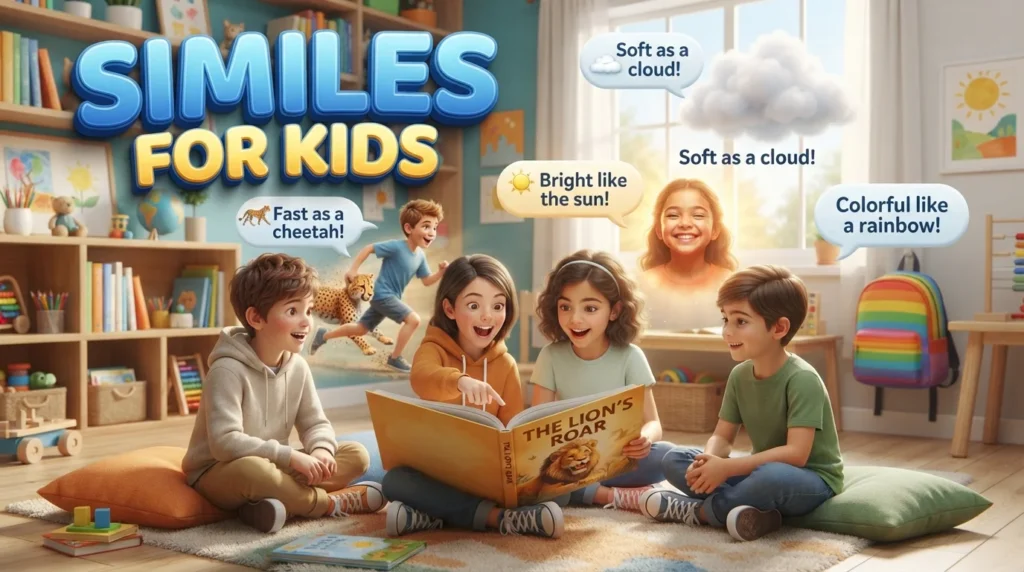
A simile is a comparison between two different things that share a particular quality. Similes commonly use words such as “like” or “as.”
For example:
The puppy was as playful as a bouncing ball.
The puppy is not actually a ball. The writer compares the puppy’s playful movement to a bouncing ball to give the reader a clearer picture.
A simple way to remember it is:
Simile = comparison + imagery
Similes are part of figurative language, a broad category of language that helps writers express ideas in vivid or imaginative ways.
How Does a Simile Work?
A useful simile connects two things through a quality they have in common.
For example:
The snow was as white as cotton.
Snow and cotton are different things, but both can be very white. The comparison gives the reader a familiar image instead of simply stating:
The snow was white.
The second sentence tells the reader a fact. The simile helps the reader picture it.
What Words Signal a Simile?
Common similes use:
- like
- as
- as … as
Examples:
The clouds looked like fluffy pillows.
He ran like a cheetah.
She was as quiet as a mouse.
One useful reminder: seeing “like” or “as” does not automatically make a sentence a simile. The sentence needs to make a comparison.
Why Do Kids Use Similes?
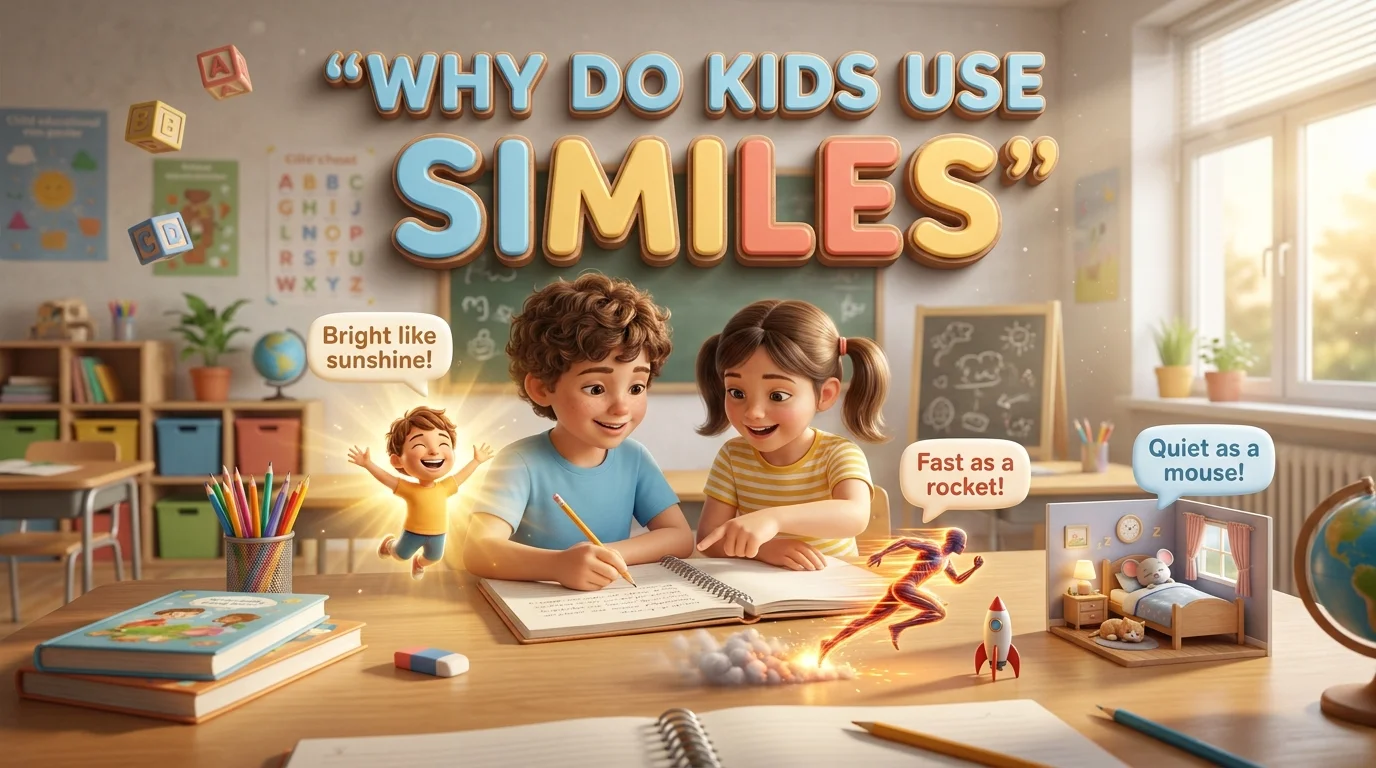
A plain sentence can tell readers something. A well-chosen simile can help them see, hear, feel, or imagine it.
Compare:
The girl was nervous.
with:
The girl was as nervous as a rabbit hiding in the grass.
The second sentence gives the feeling a visual image. Instead of simply naming nervousness, it shows the reader how that nervousness might look or feel.
Similes can help kids:
- Make stories more descriptive
- Describe characters and settings
- Express emotions
- Create stronger imagery
- Make poems more memorable
- Add personality to school assignments
- Help readers visualize an action or scene
- Develop creative writing skills
Writer’s Insight
A good simile does not have to be complicated. For younger readers, a familiar comparison is often more effective because the image is understood immediately.
The goal is not to make a sentence sound fancy. The goal is to make the idea clearer, more vivid, or more memorable.
Best Similes for Kids
The examples below are organized by common writing situations so kids can see not only what a simile looks like, but when it might be useful.
Easy Similes for Kids
These are simple starting points for younger writers.
As happy as a kid on a birthday
This describes strong excitement and happiness.
Mia was as happy as a kid on a birthday when she opened the surprise gift.
It works because a birthday is a familiar situation associated with excitement and anticipation.
As quiet as a mouse
Use this when someone or something makes very little noise.
The students became as quiet as mice when the teacher entered the room.
This is especially useful when writing about a sudden change from noise to silence.
As busy as a bee
This describes someone with many tasks to complete.
Dad was as busy as a bee getting everything ready for the party.
As light as a feather
This suggests that something weighs very little.
The tiny paper airplane was as light as a feather.
As cold as ice
This describes something extremely cold.
The water was as cold as ice when I dipped my toes into the pool.
As fast as a rocket
This creates an image of very quick movement.
The little boy ran as fast as a rocket toward the playground.
As strong as an ox
This traditional comparison describes someone who is very strong.
The athlete was as strong as an ox when he lifted the heavy box.
As slow as a snail
Use this to describe very slow movement.
The old computer was as slow as a snail.
As bright as the sun
This can describe something that shines strongly or someone who looks especially cheerful.
Her smile was as bright as the sun.
As brave as a lion
This describes someone showing courage.
The young firefighter was as brave as a lion.
Similes for Kids About Animals
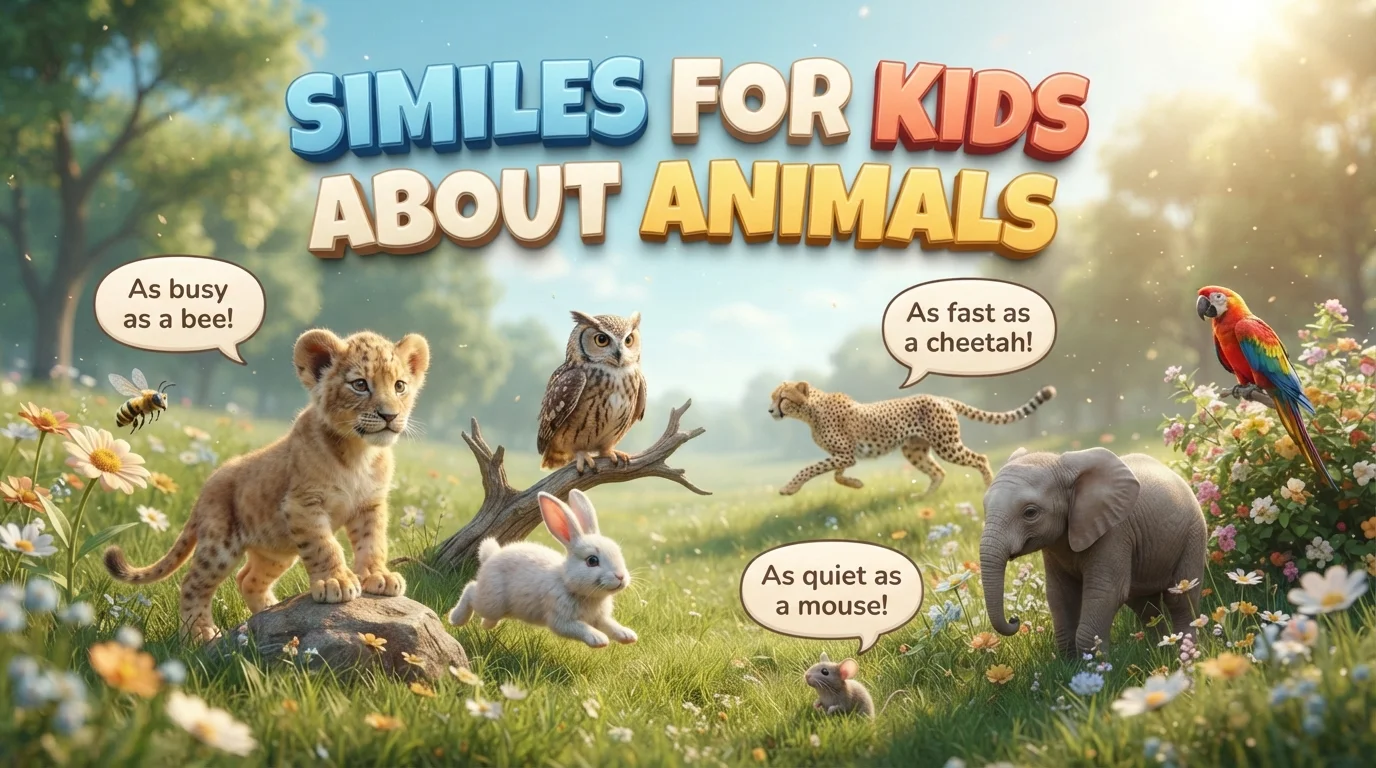
Animals are useful comparisons because children can easily picture how different animals move and behave.
Fast Animal Similes
He ran like a cheetah.
A cheetah creates an immediate image of speed.
The horse moved like the wind.
This suggests quick, smooth movement and a sense of freedom.
The rabbit darted like an arrow.
Here, the arrow comparison emphasizes sudden, direct movement.
Quiet Animal Similes
She crept as quietly as a cat.
This works well when a character is trying not to be noticed.
The mouse was as quiet as a shadow.
This is a more imaginative comparison. It focuses on almost complete silence rather than using a traditional animal expression.
Brave Animal Similes
The little boy stood as brave as a lion.
The comparison connects the character with courage and strength.
She faced the challenge like a fearless eagle.
This creates a more adventurous image.
Quick Challenge
Choose an animal you know well.
Ask:
How does it move?
What does it sound like?
What is it known for?
Now use one of those qualities to create a new comparison.
For example, instead of copying “fast like a cheetah,” you might describe a quick rabbit as:
The rabbit zipped across the garden like a tiny arrow.
Similes for Kids About Feelings and Emotions
Feelings can be difficult to describe because you cannot always see them directly. Similes give those feelings an image.
Happiness
She was as happy as a bird singing in the morning.
The comparison creates a cheerful, lively mood.
His excitement bubbled like soda.
This makes the excitement feel energetic and difficult to contain.
Sadness
He felt as lonely as a cloud drifting across an empty sky.
The image emphasizes distance and loneliness.
Her tears fell like rain.
This familiar comparison connects something emotional with something visible.
Anger
He was as angry as a storm.
The storm creates an image of force and intensity.
Her anger flashed like lightning.
This suggests an emotion that appears suddenly and powerfully.
Nervousness
My stomach felt like a washing machine before the test.
This playful comparison gives nervousness a physical feeling.
He shook like a leaf in the wind.
The movement of a leaf makes the character’s nervousness easier to picture.
Writer’s Insight
When writing about an emotion, don’t always settle for naming it.
Instead of:
I was scared.
ask:
What does fear feel like? What might it look or move like?
That question can lead to a much more memorable comparison.
Similes for Kids About Nature
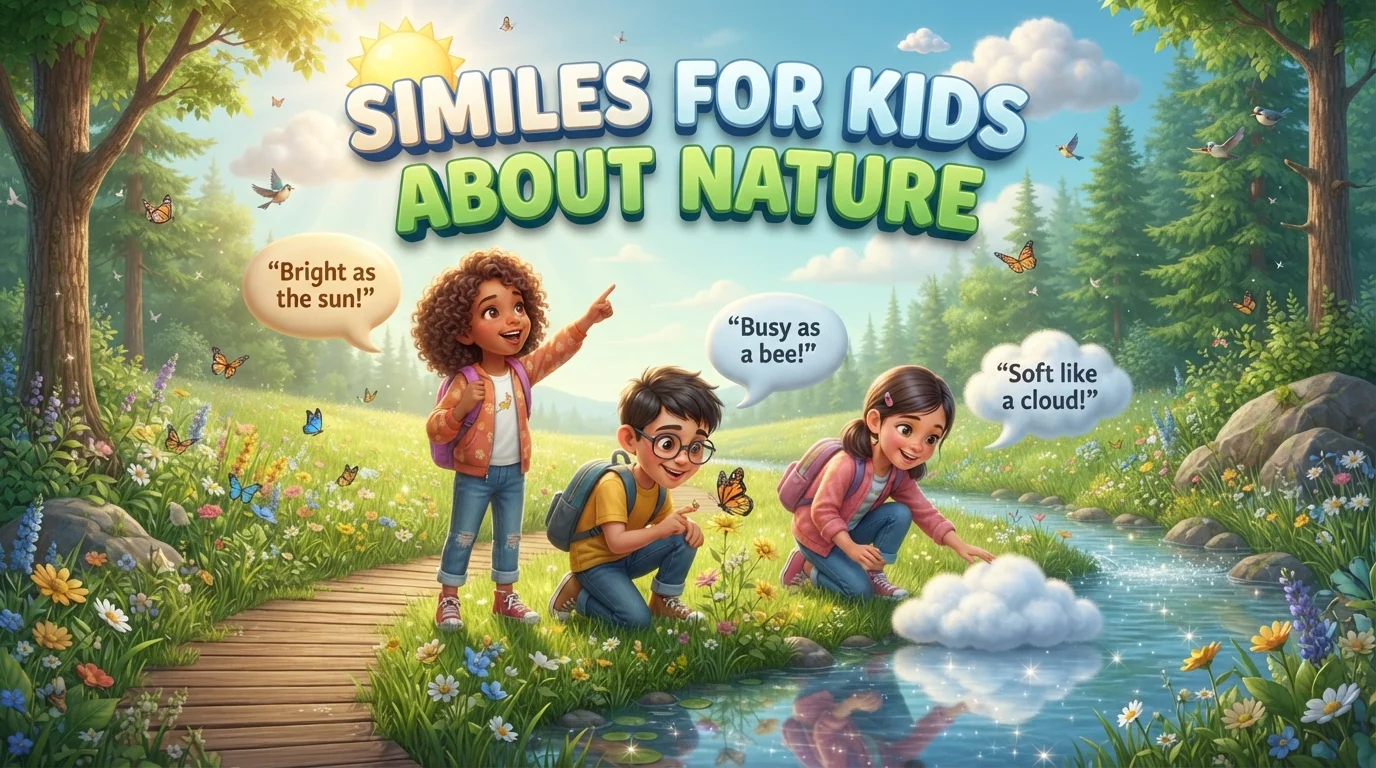
Nature gives young writers plenty of familiar images to work with.
Clouds
The clouds were like giant pillows floating across the sky.
The comparison creates a soft, dreamy picture.
Stars
The stars twinkled like tiny diamonds.
This emphasizes their brightness.
Wind
The wind raced through the trees like a playful child.
The comparison gives the wind a lively personality.
Rain
The rain tapped on the roof like tiny drums.
This works particularly well because it describes the sound of rain.
Moon
The moon hung in the sky like a silver lantern.
The lantern comparison creates a calm, glowing nighttime image.
Trees
The trees stood like tall guards around the forest.
This can make the setting feel protected, mysterious, or imposing.
Funny Similes for Kids
Funny similes often work because the comparison creates an unexpected picture.
He ate like a vacuum cleaner.
This exaggerates how quickly he ate.
My little brother bounced around like popcorn in a hot pan.
The comparison suggests nonstop movement and energy.
The puppy raced around the house like a tiny tornado.
This creates a humorous picture of energetic chaos.
My backpack felt as heavy as a bag of bricks.
The exaggeration makes a complaint about a heavy backpack more playful.
Writer’s Insight
A funny simile does not need a joke attached to it. The comparison itself can create the humor.
Try comparing an ordinary situation with something surprisingly different. The key is making sure the shared quality is still clear.
Powerful Similes for Kids
Some similes are useful when a scene needs more energy or intensity.
The thunder crashed like a giant drum.
The comparison emphasizes the storm’s loud sound.
The runner moved like an arrow.
An arrow suggests speed and direct movement.
The waves rose like giant walls.
This makes the ocean seem powerful and intimidating.
Her voice was as clear as a bell.
The comparison emphasizes clarity.
These examples show why a simile can be more useful than simply adding an adjective such as loud, fast, or clear.
Short Similes for Kids
Sometimes a short comparison is all a sentence needs.
- As cold as ice
- As white as snow
- As busy as a bee
- As quiet as a mouse
- As light as a feather
- As fast as lightning
- Like a rocket
- Like a star
- Like a bird
- Like a whisper
Short similes are particularly helpful when children are first learning how comparisons work.
The next step is learning how to choose a comparison that adds something specific rather than simply filling a sentence.
Similes for Students
Students can use similes in descriptive paragraphs, stories, poems, and other school assignments.
For Descriptive Writing
Plain:
The classroom was noisy.
With a simile:
The classroom was as noisy as a busy train station.
The comparison gives the reader a clearer idea of just how loud the classroom feels.
For Character Description
Plain:
The girl was very kind.
With a simile:
The girl was as gentle as a warm summer breeze.
The comparison creates a softer emotional impression.
For Setting Description
Plain:
The forest was dark.
With a simile:
The forest was as dark as a cave.
The cave gives the reader a familiar image of darkness.
Student Writing Tip
Don’t add a simile simply because an assignment asks for figurative language.
First decide what you want the reader to picture. Then choose a comparison that helps create that picture.
One purposeful simile can be more effective than several forced ones.
Similes for Creative Writing
Similes can strengthen a story when they reveal something about a character, action, emotion, or setting.
Character Description
Jake was as nervous as a bird trapped inside a room.
The comparison shows that Jake feels restless and uncomfortable.
Action
The ball flew through the air like a rocket.
The comparison makes the movement feel fast and energetic.
Setting
The abandoned house stood like a giant skeleton against the night sky.
The image creates an eerie mood.
Dialogue
A character might say:
“I was running like a cheetah!”
This can make dialogue feel more expressive and show the character’s personality.
Writer’s Insight
Choose a comparison that sounds as though it belongs in the story.
A playful character might use a funny simile. A serious narrator might use a quieter image. The best comparison does more than describe something—it also supports the tone of the scene.
Similes in Poetry for Kids
Poetry gives similes room to create imagery, rhythm, and emotion.
Consider:
The moon is like a lantern,
Glowing softly through the night.
The comparison gives the moon a familiar image while helping create a calm mood.
Another example:
The rain falls like silver strings,
And dances softly on the roof.
The comparison adds movement and gives the rain a more poetic image.
Why Similes Work Well in Poems
They can:
- Create vivid imagery
- Express emotion
- Strengthen descriptions
- Contribute to rhythm
- Make abstract ideas easier to picture
- Give readers memorable images
Poetry Challenge
Choose one:
moon — rain — wind — friendship — school
Write one simile about it.
Then turn your comparison into two lines of poetry.

Similes in Everyday Conversation
Similes aren’t limited to school assignments.
Kids may use comparisons while talking with friends or family:
“I’m hungry like a wolf.”
“The test was as easy as tying my shoes.”
“He was running like crazy.”
Some everyday comparisons are informal or exaggerated. That is part of what makes spoken language expressive.
The important skill is knowing when a comparison sounds natural and when it feels forced.
Similes for Children’s Stories
A children’s story becomes more engaging when comparisons help readers picture characters and scenes.
Character
Lily was as curious as a kitten.
The reader can imagine a child who wants to investigate everything.
Setting
The garden looked like a secret green kingdom.
The comparison gives the setting a sense of wonder.
Action
The little dog raced across the yard like a tiny rocket.
The reader can picture the dog’s speed and energy.
Storytelling Tip
Don’t describe everything with a simile.
Use one when you want to draw attention to an important character, emotion, setting, or action. Let the surrounding sentences provide ordinary details so the comparison has room to stand out.
How to Create Your Own Similes
Creating an original simile becomes easier when you separate the process into a few simple steps.
Step 1: Choose What You Want to Describe
Pick a person, object, place, feeling, sound, or action.
For example:
The classroom
Step 2: Choose One Important Quality
Ask what you want the reader to notice.
Maybe the classroom is:
- noisy
- bright
- crowded
- messy
- calm
Suppose you choose:
Noisy
Step 3: Think of Something Else That Is Noisy
Possible ideas include:
- a stadium
- a train station
- a thunderstorm
- a playground
Step 4: Connect the Ideas
The classroom was as noisy as a busy train station.
Now the reader has a stronger image.
Step 5: Test the Comparison
Ask:
- Does the comparison make sense?
- Is the shared quality clear?
- Does it fit the audience?
- Does it sound natural?
- Does it make the sentence more vivid?
If yes, you have a useful simile.
What Makes a Good Simile?
A good simile does more than connect two random things. It gives the comparison a purpose.
A strong simile is usually:
- Easy to understand
- Relevant to the subject
- Vivid
- Appropriate for the audience
- Connected by a clear quality
- Useful to the sentence
For example:
The puppy was as playful as a bouncing ball.
The comparison works because both suggest energetic movement.
A weaker comparison is one where the connection is difficult to understand.
Writer’s Insight
Before keeping a simile, ask:
“What exactly are these two things sharing?”
If you cannot answer that question, the comparison probably needs another look.
Common Simile Mistakes Kids Make
Using a Comparison That Doesn’t Fit
Weak:
The girl was as quiet as a thunderstorm.
A thunderstorm is associated with loud sound, so the comparison sends the opposite message.
Better:
The girl was as quiet as a mouse.
Making Every Sentence Figurative
A paragraph filled with comparisons can become tiring.
For example, if every sentence contains like or as, the reader may start noticing the writing technique instead of the story.
Use similes where they add a useful image.
Choosing a Comparison That Is Too Complicated
Young readers don’t need comparisons that require a long explanation.
If the reader has to stop and figure out what the comparison means, a simpler image may work better.
Using a Familiar Simile Without Thinking About Meaning
Traditional expressions are useful, but they still need to fit the situation.
As busy as a bee
works when someone is doing many things.
It would not make much sense for a character who is sitting quietly doing nothing.
How to Make Similes More Creative
Once you understand simple comparisons, experiment with fresher images.
Instead of:
The classroom was noisy.
You could write:
The classroom buzzed like a beehive before lunch.
Instead of:
The boy was nervous.
Try:
His thoughts jumped like popcorn in a hot pan.
Instead of:
The rain was heavy.
Try:
The rain poured like a curtain falling from the sky.
These examples work because the comparisons focus on something specific: sound, restless thoughts, or the appearance of falling rain.
Avoiding Clichés
Classic similes are useful when learning, but original comparisons can help young writers develop their own voice.
Ask:
What unusual thing behaves in a similar way?
For example, instead of automatically comparing something fast to a cheetah, think about other things that move quickly:
The skateboard shot down the hill like a marble racing across a table.
The comparison feels different while still giving the reader a clear sense of movement.
Real-Life Simile Scenarios
Sometimes a situation makes the purpose of a simile easier to understand.
A Student Gets Great Exam Results
Plain sentence:
Sara was very happy.
Simile:
Sara was as happy as a kid opening a birthday present.
Why it fits:
The comparison communicates excitement and gives the reader a familiar situation to picture.
A Runner Starts a Race
Plain sentence:
The runner moved quickly.
Simile:
The runner shot forward like an arrow.
Why it fits:
An arrow suggests fast, direct movement.
A Child Walks Through a Dark Forest
Plain sentence:
The forest looked frightening.
Simile:
The forest looked as dark as a cave.
Why it fits:
The cave gives the reader an immediate image of darkness and makes the setting feel more intimidating.
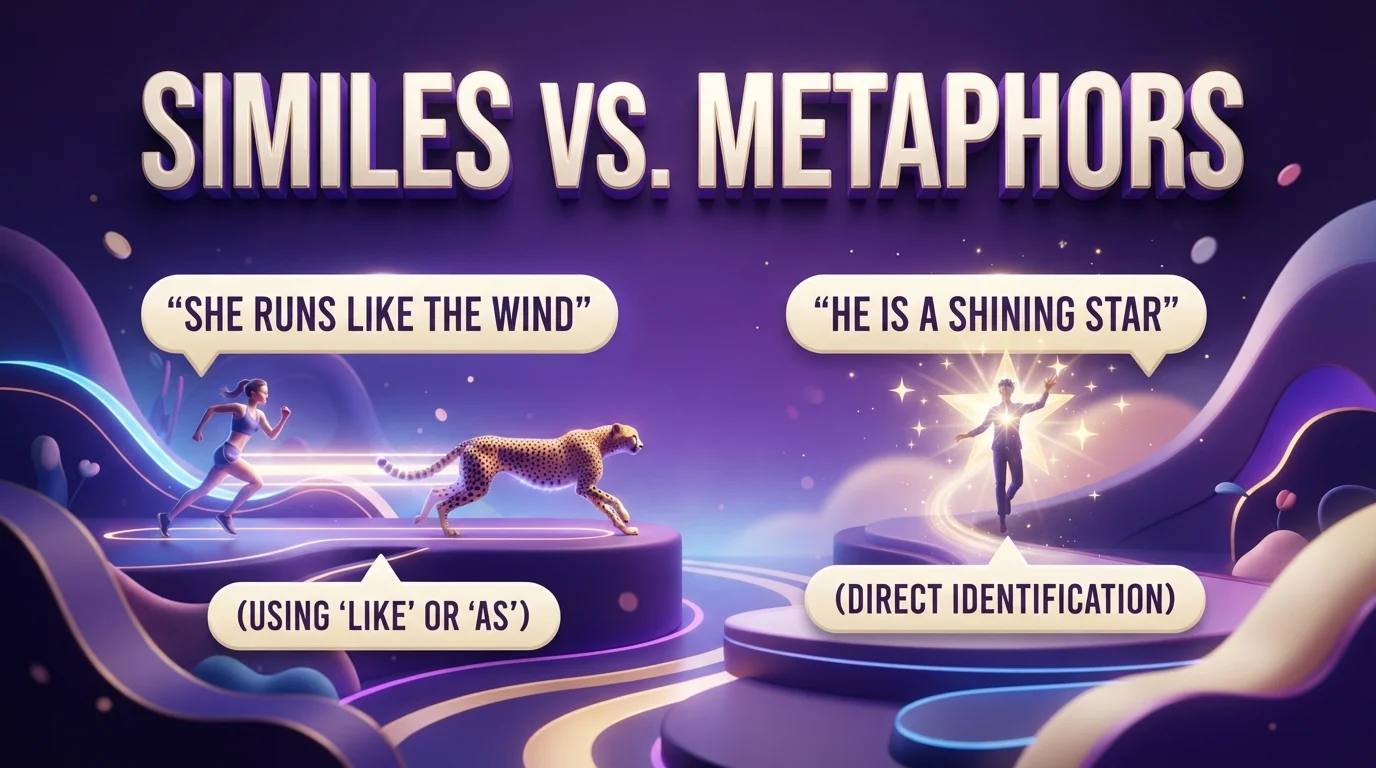
Similes vs. Metaphors
Similes and metaphors are both forms of figurative language, but they make comparisons differently.
| Simile | Metaphor |
|---|---|
| Makes the comparison explicit, often with “like” or “as” | Makes the comparison directly |
| The boy ran like a cheetah. | The boy was a cheetah on the track. |
| Usually makes the two things being compared easy to identify | Can make the comparison feel more direct or imaginative |
| Often easy for beginners to recognize | May require more interpretation |
Easy Way to Remember
Simile:
The clouds were like cotton.
Metaphor:
The clouds were cotton.
Neither form is automatically better. The right choice depends on the sentence, audience, and effect you want.
How to Improve a Weak Simile
Not every first attempt will be strong.
Suppose you write:
The dog was like an animal.
The comparison does not tell the reader much because animal is too general.
Ask:
What quality am I trying to describe?
Maybe the dog is energetic.
Try:
The dog bounced around like a rubber ball.
Now the reader has a specific image of movement.
Quick Editing Test
When you create a simile, ask:
- What am I comparing?
- What quality do they share?
- Is the comparison clear?
- Does it create an image?
- Does it fit my reader?
- Does it make the sentence better?
If the answer to the last question is no, you may not need the simile at all.
Writing Tips for Better Similes
Use Familiar Comparisons When Teaching
For beginners, comparisons involving animals, weather, food, sports, toys, and everyday objects are usually easy to picture.
Use Fresh Comparisons in Creative Writing
Once the basic pattern is comfortable, experiment with less predictable images that still have a clear connection.
Match the Simile to the Mood
A funny comparison can make a scene playful.
A storm comparison can make a scene dramatic.
A soft nature comparison can create a peaceful mood.
Think About the Reader
A comparison that makes sense to a young child may not be the right choice for an older audience. Choose images your intended reader can understand without extra explanation.
Don’t Force a Simile
If a sentence is already clear and effective, it may not need one.
Writer’s Insight
The purpose of a simile isn’t simply to make writing “fancier.” Its real job is to help the reader understand or experience something more clearly.
Practice Your Own Similes
Now it’s your turn. The goal is not to find one perfect answer. The goal is to practice making meaningful comparisons.
Complete the Simile
Finish each sentence with your own comparison.
- The baby was as quiet as ______.
- The runner moved like ______.
- The sun was as bright as ______.
- My backpack was as heavy as ______.
- The rain sounded like ______.
After completing each one, ask yourself: What quality connects my two things?
Turn a Plain Sentence Into a Simile
Change these sentences.
1. The dog was energetic.
Try:
The dog was as energetic as ______.
2. The classroom was noisy.
Try:
The classroom sounded like ______.
3. The girl was nervous.
Try:
The girl felt as nervous as ______.
4. The snow was bright.
Try:
The snow looked like ______.
Improve a Weak Simile
Look at:
The boy was fast like something fast.
The comparison is too vague to create a useful picture.
One possible improvement is:
The boy ran like a cheetah.
Now make your own version without using a cheetah.
Think beyond the most obvious answer. What else moves quickly?
Create a Simile From an Emotion
Choose one:
- happy
- sad
- angry
- nervous
- excited
- lonely
- proud
- scared
Now complete:
I felt as ______ as ______.
For example:
I felt as excited as a puppy seeing its favorite toy.
The goal is to connect an invisible feeling with something readers can imagine.
Simile Challenge for Young Writers
Choose one ordinary object:
- pencil
- backpack
- shoe
- phone
- desk
- bicycle
- lunchbox
Describe it using a simile.
Then ask:
Can I make the comparison more specific?
For example:
My backpack was as heavy as a mountain.
That’s imaginative, but it may be more exaggerated than necessary.
A more specific comparison could be:
My backpack felt as heavy as a sack of books.
Both create an image, but the second gives the reader a more believable reason for the heaviness.
Using Similes in Different Types of Writing
Similes can appear in many kinds of writing, but their purpose changes with the situation.
Fiction
Use similes to reveal characters, settings, emotions, and action.
Poetry
Use them to create imagery, rhythm, and emotional associations.
Essays
Use them when a comparison helps explain or illustrate an idea. Don’t add one simply to decorate a sentence.
Speeches
A memorable comparison can make an idea easier for an audience to picture.
Scripts and Dialogue
Characters can use informal or funny comparisons to show personality.
Children’s Writing
Keep comparisons familiar, vivid, and easy to visualize.
The Key Rule
The type of writing determines the kind of simile that works best.
A silly comparison may be perfect in a children’s story but distracting in a serious school essay. Good writers choose the comparison according to the purpose of the writing.
Social Media Caption Ideas
For age-appropriate creative posts or school-related content, simple similes can make captions more expressive.
Examples:
“Smiling like the sun after a rainy day.”
“Running like a rocket toward the weekend!”
“My new drawing is bright like a box of crayons.”
The comparison should add an image or feeling. If removing it makes the caption clearer and just as interesting, it may not be necessary.
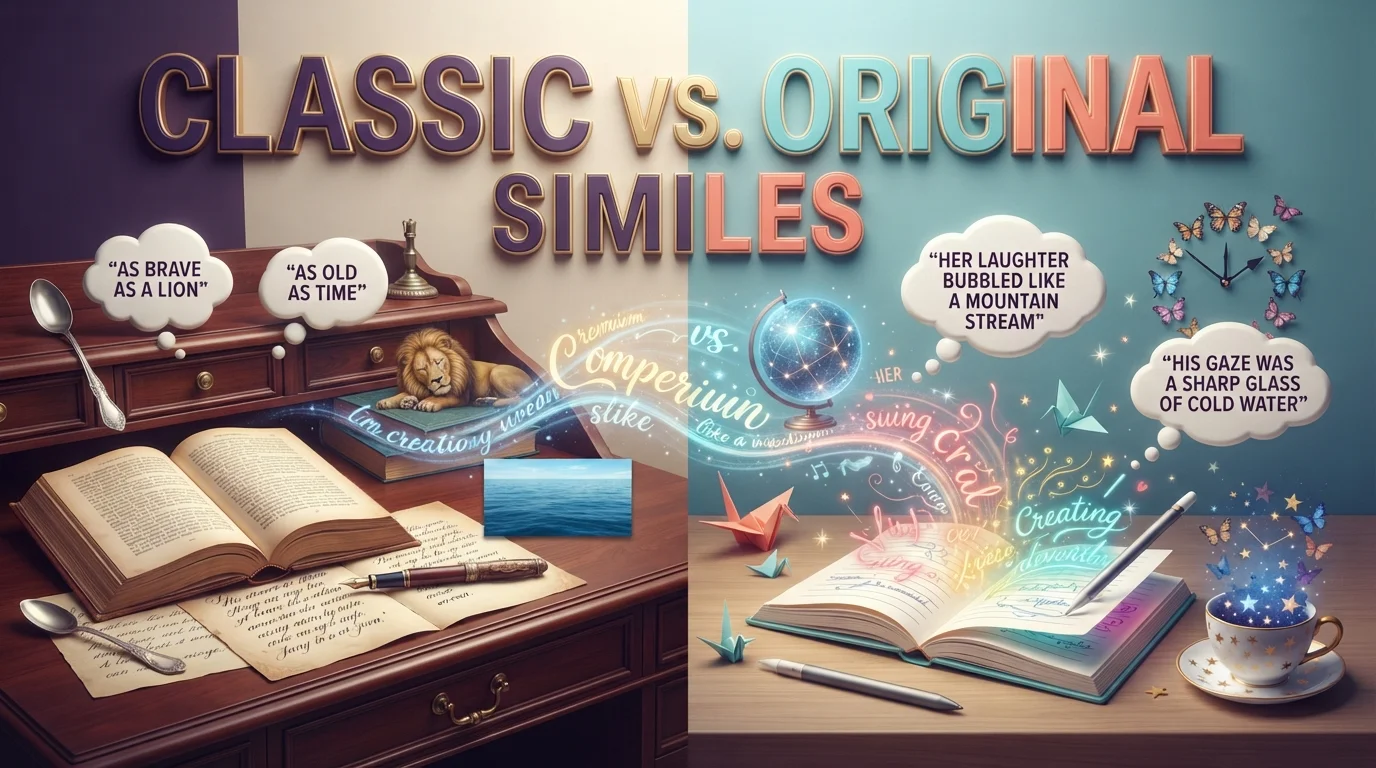
Classic vs. Original Similes
Classic similes are useful because readers recognize them quickly.
Examples:
- As busy as a bee
- As quiet as a mouse
- As light as a feather
- As cold as ice
- As brave as a lion
Original similes give writers an opportunity to develop their own voice.
For example:
The playground was buzzing like a spaceship full of excited astronauts.
It is not a traditional expression, but the comparison creates a specific, energetic scene.
Which Should Kids Use?
Both.
Classic similes help children understand the basic pattern and build confidence. Original comparisons encourage them to notice details and develop their own descriptive style.
How to Avoid Overusing Similes
Consider a paragraph like this:
The moon was like a lamp. The stars were like diamonds. The clouds were like pillows. The wind was like a whisper. The trees were like giants.
Every sentence contains a comparison. Instead of making the paragraph stronger, the repeated pattern can make the writing feel predictable.
A better approach is to combine ordinary description with one or two purposeful similes.
Better Writing Principle
Use a simile when it adds something the plain sentence cannot communicate as effectively.
That habit helps young writers use figurative language with purpose rather than simply adding it because it sounds creative.
A Simple Simile Checklist for Kids
Before finishing your writing, check:
Did I compare two different things?
Did I use “like” or “as” where appropriate?
Is the shared quality clear?
Does the comparison make sense?
Does it create a picture in the reader’s mind?
Does it fit the mood?
Is it appropriate for my audience?
Have I avoided using too many similes?
Does the simile make the sentence stronger?
If most answers are yes, your simile is probably doing its job.