
What Is a Simile for Snow?
A simile for snow is a comparison that describes snow by connecting it to another image, usually with words such as like or as.
For example:
The snow was as white as fresh paper.
Or:
Snowflakes drifted through the air like feathers falling from the sky.
The first comparison emphasizes color and appearance. The second emphasizes movement and lightness.
A strong snow simile can help communicate:
- Color
- Texture
- Movement
- Quantity
- Brightness
- Softness
- Silence
- Coldness
- Beauty
- Weather conditions
- Mood
- Atmosphere
That is why snow similes are useful in creative writing, poetry, storytelling, school assignments, and descriptive paragraphs.
50 Similes for Snow
Snow was like a white blanket
A familiar comparison that suggests snow covering the ground completely.
Snow spread across the meadow like a white blanket.
Snow was as white as fresh paper
This emphasizes the clean, bright appearance of newly fallen snow.
The field looked as white as fresh paper after the storm.
Snowflakes fell like feathers
This comparison emphasizes the gentle movement of individual flakes.
Snowflakes floated down like feathers drifting from the sky.
Snow sparkled like diamonds
Useful when sunlight or artificial light reflects from snow.
The snow-covered hill sparkled like diamonds beneath the morning sun.
Snow covered the ground like frosting on a cake
This creates a playful image of snow coating a landscape.
The rooftops looked like cakes covered with fresh frosting.
Snow looked like powdered sugar
A particularly useful comparison for fresh, light snow.
A thin layer of snow covered the garden like powdered sugar.
Snow fell like confetti
This gives snowfall a lively, celebratory quality.
Snow fell from the sky like white confetti.
Snowflakes danced like tiny ballerinas
This emphasizes movement and delicacy.
The snowflakes danced like tiny ballerinas around the streetlights.
Snow was as soft as cotton
A simple comparison for the apparent softness of fresh snow.
The new snow looked as soft as cotton.
Snow covered the trees like icing
This works particularly well for winter landscapes.
The branches were covered like cupcakes decorated with icing.
Similes for Falling Snow
Falling snow can be gentle, heavy, slow, fast, peaceful, or chaotic. Choose a comparison that matches its movement.
Snowflakes fell like tiny stars
Snowflakes drifted down like tiny stars falling from the night sky.
Snow fell like white petals
The snow came down like white petals floating from invisible flowers.
This gives the scene a delicate, poetic quality.
Snowflakes floated like feathers
The flakes floated through the air like feathers carried by a gentle breeze.
Snow fell like scraps of white paper
Snowflakes fluttered down like scraps of white paper released from a window.
This can create a more everyday, visual image.
Snowflakes swirled like dancers
The flakes swirled around the porch light like dancers moving across a stage.
Snow came down like a curtain
Heavy snow fell like a white curtain descending over the town.
This works especially well for dense snowfall.
Snow fell like dust from the sky
Fine snow drifted down like pale dust from the clouds.
This can describe light, powdery snowfall.
Snowflakes moved like butterflies
The flakes moved through the still air like white butterflies.
This emphasizes graceful, unpredictable movement.
Similes for Fresh Snow
Fresh snow has qualities that differ from old, dirty, packed, or melting snow.
Fresh snow was like a clean canvas
The untouched field looked like a clean canvas waiting for its first brushstroke.
This comparison is particularly useful for writers because footprints can then become part of the imagery.
Fresh snow was as white as porcelain
The garden looked as white as porcelain beneath the new snow.
Fresh snow looked like powdered sugar
The rooftops appeared like pastries dusted with powdered sugar.
Fresh snow was like a thick quilt
The ground looked like a thick quilt pulled over the sleeping earth.
Fresh snow was as smooth as silk
The untouched snow appeared as smooth as silk beneath the pale morning light.
This comparison focuses on visual smoothness rather than literal texture.
Similes for Snow-Covered Ground
A landscape covered in snow can be described in many ways depending on its appearance.
The ground looked like a white carpet
Snow stretched across the field like a white carpet.
The earth looked like a frosted cake
The hills looked like a giant cake covered in white frosting.
The field looked like a blank page
The untouched field looked like a blank page waiting for footprints.
This is especially effective in storytelling because it creates a sense of possibility.
The landscape looked like a painting
The snow-covered valley looked like a painting framed by dark trees.
The ground looked like sugar
The path appeared as though someone had scattered sugar across the earth.
Similes for Snow on Trees
Snow can dramatically change the appearance of trees.
Trees looked like white sculptures
The snow-covered trees stood like white sculptures along the road.
Branches looked like frosted fingers
The branches stretched upward like frosted fingers against the gray sky.
Trees looked like candles covered in wax
The snow-covered evergreens looked like enormous candles coated in white wax.
Branches looked like silver lace
Frost and snow covered the branches like delicate silver lace.
Trees stood like ghosts
The snow-covered trees stood in the fog like pale ghosts.
This comparison creates a mysterious or slightly eerie atmosphere.
Similes for Snowflakes
Individual snowflakes invite more delicate comparisons.
Snowflakes were like tiny stars
Individual snowflakes glittered like tiny stars under the streetlights.
Snowflakes were like feathers
The snowflakes drifted down like soft feathers.
Snowflakes were like flower petals
White flakes floated past the window like petals from a winter flower.
Snowflakes looked like pieces of lace
The flakes looked like tiny pieces of lace against her dark coat.
Snowflakes were like confetti
The sky released snowflakes like handfuls of white confetti.
Each comparison emphasizes something different: brightness, softness, delicacy, pattern, or movement.
Similes for Heavy Snow
Heavy snow requires a different kind of imagery from gentle snowfall.
Snow fell like a thick curtain
Snow fell like a thick white curtain, hiding the mountains behind it.
Snow came down like a waterfall
Snow seemed to pour from the sky like a frozen waterfall.
Snow covered the road like a blanket
Within an hour, snow had covered the road like a heavy blanket.
Snow piled up like mountains of flour
Snow piled beside the driveway like enormous mounds of flour.
Snowstorm clouds looked like a wall
The approaching snowfall looked like a white wall moving across the valley.
These comparisons communicate density, quantity, and reduced visibility.
Similes for Snow in Poetry
Poetry often benefits from snow comparisons that create atmosphere rather than simply describing weather.
Consider:
Snow drifted down like whispers from the winter sky.
The moon shone on the snow like a silver lamp over a sleeping world.
The frozen field stretched out like a blank page beneath the stars.
Snowflakes danced like pale sparks in the darkness.
The forest stood silent like a cathedral covered in white.
These comparisons can create feelings of peace, mystery, isolation, beauty, or wonder.
Similes for Snow in Descriptive Writing
If you are writing a descriptive paragraph, think about the particular characteristic you want the reader to notice.
For whiteness
The snow was as white as fresh paper.
For softness
The snow looked as soft as cotton.
For brightness
The snow glittered like diamonds.
For movement
Snowflakes floated like feathers.
For coverage
Snow spread across the landscape like a white blanket.
For silence
The snow-covered forest felt like a room after everyone had left.
For mystery
The trees appeared like pale figures behind a curtain of snow.
This approach helps you choose an image intentionally rather than inserting a random winter comparison.
Similes for Snow in Stories
Snow can influence the mood of an entire scene.
For a peaceful scene:
Snow settled over the village like a soft blanket, muffling every sound.
For a mysterious scene:
The trees stood in the snowfall like silent figures watching from the darkness.
For an exciting scene:
Snow flew through the air like white confetti as the children raced down the hill.
For a lonely scene:
The empty road disappeared into the snow like a path leading nowhere.
The same weather can therefore create very different emotional effects depending on the comparison and surrounding context.
Similes for Snow for Kids and Students
Younger writers often benefit from clear, easy-to-understand comparisons.
Here are some simple options:
- Snow is like a white blanket.
- Snow is as white as paper.
- Snowflakes fall like feathers.
- Snow sparkles like diamonds.
- Snow looks like powdered sugar.
- Snow covers trees like icing.
- Snowflakes fall like confetti.
- Snow feels as soft as cotton.
- Snow looks like a blank page.
- Snow shines like tiny stars.
Example Paragraph
Snow fell gently from the sky like feathers. Soon, the ground looked like a white blanket, and the trees were covered like cakes with frosting. Under the morning sun, the snow sparkled like diamonds.
This type of imagery works well for elementary and middle-school descriptive writing.
Beautiful Similes for Snow
If the goal is to create an elegant or poetic winter scene, try comparisons that focus on light, delicacy, and atmosphere.
- Like pearls scattered across velvet
- Like lace floating through the air
- Like stars drifting downward
- Like white petals falling from the clouds
- Like silver dust beneath moonlight
- Like a soft veil covering the earth
- Like crystals spread across a window
- Like tiny pieces of winter lace
Example
Under the moonlight, the snow looked like silver dust scattered across the earth.
The comparison creates a more atmospheric image than simply saying the snow was beautiful.
Funny Similes for Snow
Snow can also be described humorously.
For example:
The snow covered my car like powdered sugar on an oversized doughnut.
My backyard looked like a giant bowl of vanilla ice cream.
The snow piled against the door like a very determined roommate who refused to leave.
The kids ran through the yard like popcorn popping in a pan.
Humorous similes work best when the surrounding writing has a playful tone.
Snow Similes for Different Writing Purposes
| Writing Purpose | Useful Comparison | Main Effect |
|---|---|---|
| School writing | White blanket | Clear and simple |
| Poetry | White petals | Delicate |
| Children’s story | Powdered sugar | Playful |
| Winter description | Fresh canvas | Visual |
| Mystery | Pale ghosts | Unsettling |
| Romance | Silver lace | Soft and elegant |
| Adventure | White curtain | Dramatic |
| Humor | Cake frosting | Playful |
| Peaceful scene | Soft quilt | Comforting |
| Snowstorm | Waterfall | Intense |
The strongest simile is the one that supports the purpose and mood of the writing.
How to Create Your Own Similes for Snow
You can create original snow comparisons by focusing on what you actually want the reader to notice.
1. Decide What the Snow Is Doing
Is it:
- falling?
- melting?
- covering the ground?
- sparkling?
- blowing?
- piling up?
- sticking to trees?
- disappearing?
2. Identify Its Most Noticeable Quality
Maybe the snow is:
- white
- soft
- delicate
- heavy
- bright
- silent
- cold
- endless
- mysterious
3. Brainstorm Matching Images
For soft, you might think of:
- cotton
- feathers
- blankets
- wool
For bright, think of:
- diamonds
- stars
- mirrors
- glass
For delicate, think of:
- petals
- lace
- butterflies
- silk
For heavy, think of:
- curtains
- waterfalls
- walls
- thick blankets
4. Connect the Two
Use like or as.
Snowflakes floated like feathers.
5. Add a Specific Detail
Instead of:
The snow was like cotton.
Try:
The fresh snow looked like cotton spread across the garden.
The added context makes the image easier to visualize.
How to Make Snow Similes More Original
Many snow descriptions rely on familiar images such as blankets, diamonds, cotton, frosting, and feathers. These are useful because readers understand them immediately, but creative writers may sometimes want a less predictable comparison.
Start by asking:
What does this particular snow remind me of?
For example, instead of automatically writing:
Snow covered the ground like a blanket.
You could write:
Snow covered the field like an untouched sheet of paper waiting for the first sentence.
The second comparison introduces an idea of possibility and exploration.
Originality does not mean making the comparison strange for its own sake. The image should still be understandable.
Common Mistakes When Writing Snow Similes
1. Repeating “white as snow”
If the subject is already snow, saying something is “white as snow” may add very little.
Choose a comparison that reveals another quality.
2. Using the same image repeatedly
A page filled with blankets, cotton, diamonds, and feathers can quickly become repetitive.
Vary the sensory focus.
3. Ignoring movement
Snow that is falling should not necessarily be described the same way as snow lying still on the ground.
Think about motion as well as appearance.
4. Choosing an image that clashes with the mood
A playful cake-frosting comparison may not belong in a suspenseful winter scene.
The comparison should support the atmosphere.
5. Making the comparison unnecessarily complicated
A simile should clarify or enrich the image, not make readers work to understand it.
Simple imagery can be powerful.
6. Using too many comparisons
One carefully chosen snow simile can often create a stronger image than several stacked together.
Snow Simile vs. Metaphor
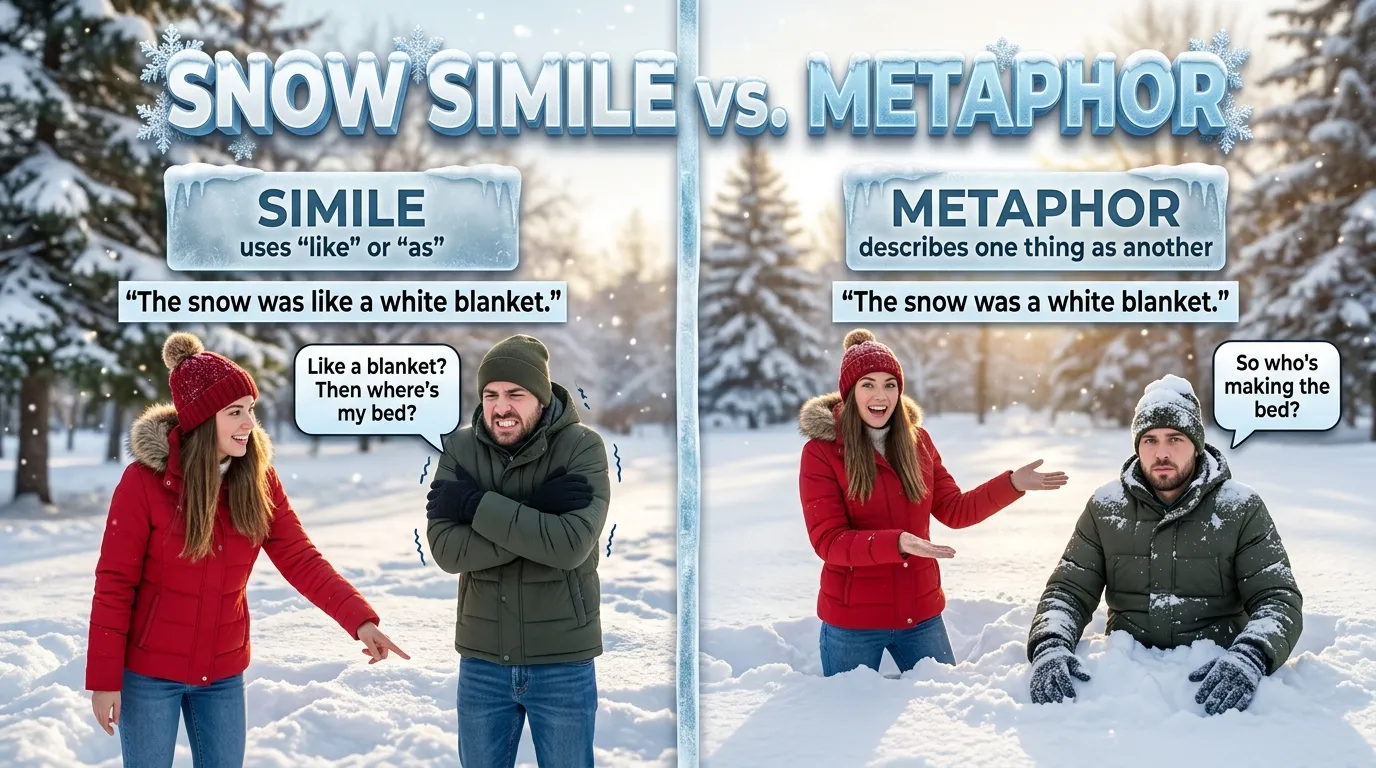
A simile makes a comparison using a word such as like or as.
Snow covered the field like a white blanket.
A metaphor makes the comparison directly.
The field was a white blanket.
Both create imagery, but the grammatical structure is different.
Simile
Snowflakes were like feathers.
Metaphor
Snowflakes were feathers.
The simile signals that the two things are being compared, while the metaphor presents one thing figuratively as another.
Snow Similes and Personification
Snow can also be described through personification, which gives it human qualities.
For example:
Snow whispered against the window.
That is personification because snow is given a human-like action.
You can combine personification with a simile:
Snow whispered against the window like a child asking to come inside.
This creates a more imaginative scene by combining multiple literary devices.
Practice: Create Your Own Snow Similes
Try these exercises to develop your own comparisons.
Exercise 1: Falling Snow
Complete:
Snowflakes fell like __________________________.
Exercise 2: Fresh Snow
Complete:
The fresh snow looked as white as __________________________.
Exercise 3: Snow on Trees
Describe snow-covered branches using a comparison that does not involve blankets or frosting.
Exercise 4: Snowstorm
Describe heavy snowfall using an image that communicates movement and intensity.
Exercise 5: Quiet Snow
Create a simile that describes how peaceful a snow-covered landscape feels.
Exercise 6: Snow at Night
Compare moonlit snow to something that naturally reflects light.
Exercise 7: Originality Challenge
Write three snow similes without using:
- blanket
- cotton
- diamonds
- feathers
- frosting
This forces you to explore less familiar imagery.
Turning Plain Snow Sentences Into Stronger Descriptions
Plain
Snow covered the ground.
With a simile
Snow covered the ground like a clean white blanket.
Plain
Snowflakes were falling.
With a simile
Snowflakes drifted downward like pale feathers.
Plain
The snow was bright.
With a simile
The snow glittered like scattered diamonds beneath the morning sun.
Plain
The trees were covered in snow.
With a simile
The trees stood like white sculptures along the edge of the forest.
The goal is not simply to make a sentence longer. The comparison should give the reader a clearer mental picture or stronger atmosphere.