
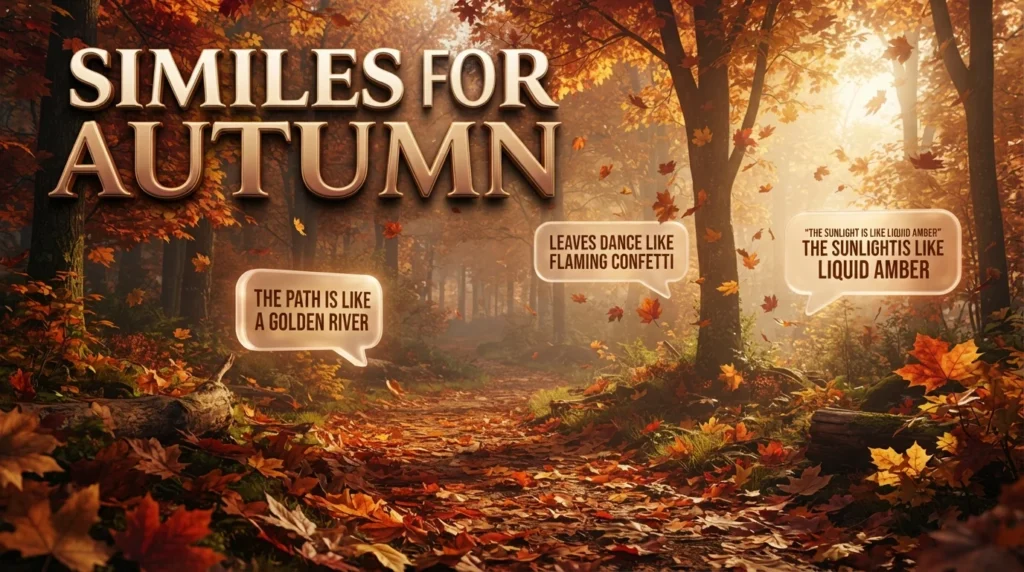
What Is an Autumn Simile?
An autumn simile is a comparison that uses like or as to describe something connected with fall.
For example:
The leaves glowed like embers in the evening light.
The leaves aren’t actually burning embers. The comparison helps the reader imagine their intense red-orange color and warm appearance.
Another example is:
The morning air was as crisp as a fresh apple.
Here, the freshness and crispness of an apple give the reader a familiar way to imagine cool autumn air.
Similes are a form of figurative language, and fall is especially useful for practicing them because the season provides strong visual and sensory details. Educational fall-writing activities commonly encourage students to build similes around sight, sound, smell, taste, and touch.
60+ Similes for Autumn
Here are original autumn comparisons covering the season’s colors, weather, landscapes, sounds, harvest, atmosphere, and emotions.
Autumn Colors and Leaves
- The autumn leaves glowed like stained glass in the afternoon sun.
- The maple trees burned like lanterns along the hillside.
- The forest looked as colorful as a painter’s overflowing palette.
- The leaves were as red as polished garnets.
- The golden branches shimmered like ribbons in the breeze.
- The oak leaves looked like small bronze shields.
- The hillside spread out like a quilt stitched from red, orange, and gold.
- The trees were as bright as flames without the smoke.
- The yellow leaves flickered like tiny flags in the wind.
- The forest floor was scattered like a mosaic of autumn colors.
- The leaves covered the sidewalk like a blanket of copper.
- The birch trees stood like pale candles among the darker woods.
- The last green leaves clung to the branches like children refusing to leave a playground.
- The hills looked as though someone had brushed them with a giant box of crayons.
- The autumn canopy glowed like a ceiling of colored glass.
Autumn color is one of the most common starting points for fall similes because changing foliage provides strong visual imagery. Current examples across the search results frequently focus on gold, red, orange, embers, paintings, and other color-rich comparisons.
Similes for Falling Autumn Leaves
Falling leaves aren’t only about color. Their movement, sound, and changing patterns can create very different images.
- The leaves drifted like paper boats on an invisible stream.
- Golden leaves fluttered like tiny parachutes from the trees.
- The leaves spun like dancers beneath the branches.
- Brown leaves tumbled like coins from a shaken pocket.
- The leaves floated downward as gently as feathers.
- Leaves scattered across the yard like confetti after a celebration.
- The maple leaves spiraled like little helicopters.
- The leaves skittered across the pavement like startled mice.
- Red leaves sailed through the air like miniature kites.
- The final leaves dropped like quiet letters from the trees.
Notice how each comparison emphasizes a different quality.
- Parachutes → slow, floating movement
- Dancers → graceful movement
- Coins → falling individually
- Feathers → softness
- Confetti → abundance and celebration
- Kites → movement through the air
That is what makes a useful simile more than a decorative phrase: the comparison gives the reader a specific way to visualize the subject.
Similes for Autumn Air and Weather
Fall weather can be refreshing, gentle, rainy, windy, sharp, or surprisingly warm.
- The morning air was as crisp as a freshly picked apple.
- The October breeze felt like cool water against my face.
- The chilly wind slipped through my coat like a thin blade.
- The morning was as fresh as a window opened after summer rain.
- The fog settled over the fields like a gray blanket.
- The rain tapped against the windows like impatient fingertips.
- The clouds hung over the town like heavy wool blankets.
- The wind rushed through the trees like a late train.
- The first frost sparkled like crushed glass across the grass.
- The autumn drizzle fell as softly as whispered secrets.
The comparison should match the weather you’re actually describing. A gentle breeze doesn’t need to sound violent, while a cold gust might benefit from a sharper image.
Similes for Autumn Wind
Wind can change the entire personality of an autumn scene.
- The wind whispered through the branches like someone telling a secret.
- The autumn gusts raced through the trees like children released from school.
- The wind rattled the bare branches like dry bones.
- The breeze moved through the leaves like fingers through loose hair.
- The cold wind swept across the field like a broom clearing dust.
- The wind chased the leaves down the street like playful puppies.
- The evening breeze curled around the porch like a cool ribbon.
These examples show how the same natural element can create different moods.
A whisper creates quietness.
A broom suggests sweeping movement.
Playful puppies create a lighter, more energetic mood.
Similes for Autumn Trees and Forests
Trees provide some of the strongest imagery in autumn writing because their appearance changes dramatically throughout the season.
- The trees stood as tall as watchtowers above the valley.
- The bare branches looked like fingers reaching toward the sky.
- The forest stood like a cathedral beneath the fading light.
- The old oak looked as strong as a weathered fortress.
- The trees appeared like giant torches along the road.
- The bare woods were as quiet as an empty theater.
- The branches stretched like dark veins across the evening sky.
- The forest looked like a sea of copper beneath the clouds.
A comparison involving a forest can establish more than appearance. It can also create a mood.
For example:
The forest stood like a cathedral beneath the fading light.
This creates a sense of stillness, scale, and quiet wonder.
Similes for Autumn Sunsets
Autumn sunsets can be especially effective in poetry and descriptive prose because the season naturally combines warm colors with fading daylight.
- The autumn sunset glowed like a furnace behind the hills.
- The sky looked as if it had been painted with melted copper.
- The last sunlight stretched across the fields like golden silk.
- The horizon burned like a row of distant lanterns.
- The evening sky was as soft as peach-colored silk.
- The sunset spread across the clouds like spilled honey.
- The fading light clung to the treetops like the last warmth of a fire.
The strongest sunset similes usually focus on light, color, texture, or movement rather than simply saying that the sunset is beautiful.
Similes for Autumn Sounds
Fall has a recognizable soundscape: crunching leaves, rattling branches, rain, distant wind, and quiet evenings.
- The leaves crunched under my shoes like thin crackers.
- The branches rattled like old wooden shutters.
- Rain drummed against the roof like a thousand tiny fingers.
- The dry grass whispered like paper beneath the wind.
- The leaves rustled like pages turning in an enormous book.
- The wind hummed through the chimney like a distant singer.
- The forest crackled like a campfire beneath our footsteps.
Sound-based similes can be particularly useful when a descriptive paragraph already has plenty of visual details. Adding sound gives the reader another way into the scene.
Similes for Autumn Harvest
Autumn is closely associated with harvest, orchards, pumpkins, farms, and seasonal abundance.
- The pumpkin patch looked like a field scattered with orange lanterns.
- The cornfields stretched across the valley like golden waves.
- The apples filled the baskets like polished red marbles.
- The pumpkins rested in the field like sleeping orange giants.
- The harvest baskets were as full as overflowing treasure chests.
- The wheat fields shimmered like gold beneath the afternoon sun.
- The orchard looked like a treasure garden beneath the changing leaves.
Harvest imagery can shift the tone of an autumn passage toward abundance, warmth, rural life, celebration, or gratitude.

Similes for Cozy Autumn Feelings
Autumn isn’t only about outdoor scenery. For many readers, fall also suggests warm drinks, sweaters, fireplaces, books, blankets, and quiet evenings.
- The cabin felt as cozy as a favorite sweater.
- The fireplace glowed like a small sun in the corner of the room.
- The warm cider felt like a hug on a chilly evening.
- The quiet autumn evening settled over the house like a soft blanket.
These comparisons are useful when the goal isn’t to describe what autumn looks like, but what it feels like.
How to Choose the Right Autumn Simile
Not every beautiful comparison works in every sentence.
Start by deciding what you actually want the reader to notice.
If you want to emphasize color
Choose an image that has a strong, recognizable color.
The maple leaves glowed like stained glass.
If you want to emphasize movement
Choose something that moves in a similar way.
The leaves spun like dancers.
If you want to emphasize sound
Choose something that produces a comparable sound.
The branches rattled like old shutters.
If you want to emphasize texture
Choose something familiar to touch.
The fallen leaves felt as dry as paper.
If you want to emphasize mood
Choose an image that carries the emotional quality you need.
The empty forest was as quiet as a deserted theater.
This approach is more effective than randomly inserting a fall-related comparison into a sentence.
Autumn Similes for Descriptive Writing
A descriptive paragraph becomes stronger when its similes serve different sensory purposes.
Consider this example:
The autumn park was alive with color. Red maple leaves glowed like stained glass above the path, while dry leaves crunched like thin crackers beneath my shoes. A cool breeze slipped between the trees like a whispered secret. Somewhere beyond the hill, rain tapped softly against a roof.
Notice that the paragraph doesn’t repeat the same type of comparison.
It uses:
- Sight: stained glass
- Sound: thin crackers
- Movement/feeling: whispered secret
- Atmosphere: soft rain
This kind of variety gives the scene depth.
Educational fall-writing resources similarly encourage writers to consider multiple senses rather than relying only on what autumn looks like.

Autumn Similes for Students
Students can create strong fall descriptions without using complicated vocabulary.
Simple examples
- The leaves were as red as apples.
- The air was as cool as ice water.
- The trees looked like giant paintings.
- The wind sounded like a whistle.
- The leaves fell like feathers.
- The pumpkins were as orange as the setting sun.
- The grass was wet like a freshly washed floor.
- The morning was as quiet as an empty classroom.
The key is not complexity. A simple comparison that readers immediately understand can be more effective than an elaborate image that feels forced.
Autumn Similes for Poems
Poetry gives you more freedom to use unusual associations and compressed imagery.
For example:
Leaves drift like old letters,
each one carrying
a message from summer.
Or:
The sunset melts like copper
along the edge of the hills,
while the wind turns
the trees’ last pages.
The comparisons don’t have to explain the entire scene. They can simply give the reader a strong image and allow the surrounding poem to provide the meaning.
Autumn Similes for Stories
In fiction, similes can help establish setting, reveal character, or create atmosphere.
For example:
The leaves scraped across the porch like nervous footsteps.
This does more than describe sound. The word nervous can also contribute to an uneasy mood.
Compare it with:
The leaves skipped across the porch like children racing home.
Now the same basic movement feels playful.
The comparison changes the emotional interpretation of the scene.
Autumn Similes for Different Moods
Autumn doesn’t have one fixed mood. Your comparison can make the same season feel peaceful, joyful, mysterious, lonely, or nostalgic.
| Mood | Example | Effect |
|---|---|---|
| Peaceful | The evening was as quiet as a sleeping garden. | Still and restful |
| Cozy | The cabin felt like a warm sweater. | Comfortable |
| Joyful | Leaves flew like confetti. | Playful and energetic |
| Mysterious | Fog crept through the trees like a silent visitor. | Uncertain and atmospheric |
| Nostalgic | The old park looked like a photograph from childhood. | Reflective |
| Lonely | The empty road stretched like a forgotten ribbon. | Isolated |
| Dramatic | The trees burned like distant torches. | Powerful and intense |
This is why there isn’t one universally “best” autumn simile. The right comparison depends on what the writer wants the reader to feel.
How to Create Your Own Autumn Similes
You can create an original autumn simile by starting with something you actually observe.
1. Choose a fall detail
For example:
Falling leaves
2. Identify its most noticeable quality
Perhaps they are:
- Slow
- Light
- Colorful
- Spinning
- Numerous
- Fragile
3. Find an image with the same quality
If the leaves are light and floating, you might think of:
- feathers
- parachutes
- paper
- butterflies
- snowflakes
4. Make the comparison
The leaves floated like tiny parachutes.
5. Make it more specific if needed
Instead of:
The leaves fell like parachutes.
Try:
The golden leaves drifted like tiny parachutes toward the quiet sidewalk.
Now the sentence provides color, movement, and setting.
6. Check the tone
If you’re writing a playful children’s story, “tiny parachutes” may work beautifully.
If you’re writing a melancholy poem, you might prefer:
The leaves descended like old letters returning to earth.
The underlying subject is the same, but the emotional effect changes.
How to Make Autumn Similes More Original
Many autumn comparisons are familiar: golden leaves, colorful paintings, falling rain, blankets, fire, and crisp apples.
Familiar imagery isn’t automatically bad. Sometimes a recognizable comparison is exactly what a beginner needs.
But if you want your writing to stand out, look beyond the first comparison that comes to mind.
Instead of:
The leaves fell like rain.
Try asking:
What else falls, floats, spins, scatters, or drifts?
You might arrive at:
The leaves drifted like unfinished letters through the afternoon air.
The goal isn’t to make a comparison strange just for the sake of originality. The image should still be understandable.
Common Mistakes When Using Autumn Similes
1. Using the same image repeatedly
If every autumn description involves gold, fire, or blankets, the writing can quickly become predictable.
Mix visual, auditory, tactile, and emotional comparisons.
2. Choosing a comparison that doesn’t match the quality
A comparison should have a clear relationship with the subject.
If you’re describing quietness, a comparison with a fireworks display probably won’t help unless you’re deliberately creating contrast.
3. Overloading one paragraph
Too many similes can make writing feel artificial.
Compare:
The leaves were like gold, the sky was like glass, the wind was like a wolf, the trees were like flames, and the grass was like velvet.
with:
The trees glowed like distant flames above the quiet path. Dry leaves crackled beneath my shoes as the wind moved through the branches.
The second version gives the comparisons space to work.
4. Confusing similes and metaphors
A simile generally uses like or as:
The leaves were like golden coins.
A metaphor makes the comparison directly:
The leaves were golden coins.
Both are legitimate literary devices, but they aren’t constructed in the same way.
5. Using a comparison without a purpose
Before keeping a simile, ask:
What does this comparison help the reader understand?
If the answer is “nothing,” the sentence may be stronger without it.
Autumn Simile vs. Metaphor
A simile explicitly compares two things using like or as.
The autumn leaves were like stained glass.
A metaphor makes the comparison directly.
The autumn leaves were stained glass.
Both create imagery, but a simile signals the comparison more clearly.
For students learning figurative language, remembering the structural difference is usually enough:
Simile → like/as comparison
Metaphor → direct comparison
Why Autumn Is So Useful for Similes
Autumn offers writers several layers of sensory material at once.
You can see:
- Red leaves
- Orange pumpkins
- Golden fields
- Gray skies
- Bare branches
You can hear:
- Crunching leaves
- Rustling trees
- Rain
- Wind
- Crackling fires
You can feel:
- Chilly air
- Damp leaves
- Warm sweaters
- Cool wind
You can smell:
- Wet earth
- Wood smoke
- Apples
- Cinnamon
- Fallen leaves
You can taste:
- Apple pie
- Hot cider
- Pumpkin bread
- Seasonal soups
That makes autumn particularly useful for descriptive writing. Educational resources explicitly encourage using the season’s five senses as prompts for creating fall similes.
Quick Guide: Which Autumn Simile Should You Use?
If you need a comparison quickly, start with your writing goal.
For colorful leaves:
The leaves glowed like stained glass.
For falling leaves:
The leaves floated like tiny parachutes.
For crisp air:
The morning air was as crisp as a fresh apple.
For strong wind:
The wind rushed through the trees like a late train.
For autumn rain:
Rain tapped against the roof like tiny fingers.
For a quiet forest:
The forest was as quiet as an empty theater.
For a cozy evening:
The evening settled over the house like a soft blanket.
For a harvest scene:
The cornfields stretched like golden waves.
For an autumn sunset:
The last sunlight spread across the fields like golden silk.
For nostalgia:
The old park looked like a photograph from childhood.