

What Is a Simile for Addiction?
A simile for addiction compares addiction, craving, dependence, or its effects to something familiar, usually with “like” or “as.”
For example:
His craving was like a wave that kept returning to shore.
The comparison does not literally mean the craving is a wave. Instead, the wave represents its repeated, difficult-to-ignore nature.
Addiction can involve different experiences, so a useful simile should identify the particular quality being described.
It might communicate:
- A powerful pull
- Repetition
- Loss of control
- Emotional exhaustion
- Isolation
- Shame
- Consequences
- Fear
- Persistence
- Hope
- Recovery
Best Similes for Addiction
Here are some concise options for writers who need a strong comparison quickly.
| Simile | What it suggests |
|---|---|
| Like a riptide | A powerful pull that is difficult to resist |
| Like a vine wrapping around a tree | Gradual growth and increasing restriction |
| Like a song stuck on repeat | Persistent thoughts or cravings |
| Like gravity | A constant downward pull |
| Like a magnet | Strong attraction |
| Like a knot tightening | Increasing difficulty and restriction |
| Like a train without brakes | Momentum that feels difficult to stop |
| Like an endless loop | Repetitive behavior |
| Like a shadow | Something that follows a person |
| Like a heavy chain | Restriction and burden |
| Like a leaking boat | Ongoing problems that require constant attention |
| Like a fire that keeps spreading | Escalation over time |
| Like a maze | Confusion and difficulty finding a way out |
| Like quicksand | A situation that seems increasingly difficult to escape |
| Like a storm inside the mind | Emotional and mental turmoil |
| Like a cracked mirror | A damaged or distorted self-image |
| Like a weight on the shoulders | Emotional burden |
| Like a locked door | Feeling unable to move forward |
| Like a scar | A lasting reminder of past pain |
| Like a bridge being rebuilt | Recovery and reconstruction |
Similes for the Grip of Addiction
One of the most common ways writers portray addiction is as something that gradually gains control. These comparisons emphasize attraction, restraint, or a feeling of being unable to break away.
Like a riptide
His addiction was like a riptide, pulling him farther away from the life he wanted.
A riptide is useful imagery because its danger is not always obvious from the surface. The comparison emphasizes a force that can carry someone away despite attempts to resist.
Like a magnet
The habit pulled her back like a magnet drawing iron toward itself.
This is a simple comparison for an attraction that feels persistent.
Like a vine wrapping around a tree
The addiction grew like a vine wrapping around a tree, slowly taking up more of his life.
This emphasizes gradual progression rather than an instant transformation.
Like a chain
The addiction felt like a chain that became heavier with every passing year.
The image focuses on restriction and burden.
Like quicksand
Each attempt to ignore the problem felt like stepping deeper into quicksand.
This comparison suggests a situation that becomes harder to escape as it continues.
Similes for Cravings
A craving can be persistent, distracting, sudden, or overwhelming. The comparison should match the particular experience.
Like an itch you cannot reach
The craving was like an itch he could never quite reach.
This captures a nagging sensation that demands attention.
Like a song stuck on repeat
The thought of using again was like a song stuck on repeat in her mind.
This works particularly well for recurring thoughts.
Like a buzzing fly
The urge was like a buzzing fly that would not leave him alone.
The image emphasizes irritation and persistence rather than overwhelming force.
Like a wave returning to shore
The craving came back like a wave returning to shore.
This is useful when cravings repeatedly return even after periods of calm.
Like a fire under the skin
The urge felt like a fire under his skin, difficult to ignore.
This creates a more intense and physical image.
Similes for Addiction’s Repetitive Cycle
Some writing about addiction focuses on repetition—the same behavior, regret, promise, and return happening again and again.
Like a wheel that never stops turning
The cycle of addiction was like a wheel that never stopped turning.
The comparison emphasizes repetition without suggesting forward progress.
Like a record stuck on one track
His routine felt like a record stuck on one track, replaying the same mistakes.
This works well in reflective writing.
Like running on a treadmill
Trying to escape the cycle felt like running on a treadmill without getting anywhere.
The image emphasizes effort without meaningful progress.
Like walking in circles
Every promise to change felt like walking in circles and ending up in the same place.
This is straightforward and accessible for student writing.
Like a revolving door
The pattern became like a revolving door, bringing him back to the same place.
This is particularly effective when describing repeated attempts and setbacks.
Similes for Feeling Trapped by Addiction
Addiction can be described through images of confinement without suggesting that a person is defined by the condition.
Like being caught in a web
The habit felt like being caught in a web, with every movement creating another thread.
The comparison emphasizes entanglement.
Like a locked room
She felt as though addiction had become like a locked room with no obvious key.
This communicates emotional confinement.
Like a maze
His thoughts became like a maze with every path leading back to the same craving.
The maze represents confusion and difficulty finding a way forward.
Like a cage with a door that feels unreachable
Recovery looked like a cage with an open door that still felt impossibly far away.
This comparison can communicate the gap between knowing that change is possible and feeling capable of making it.
Like a puppet on strings
He felt like a puppet on strings, pulled toward the same behavior again and again.
This emphasizes perceived loss of control.
Similes for the Mental Struggle of Addiction
Addiction is not only about outward behavior. Writers may also need to describe internal conflict, bargaining, denial, or intrusive thoughts.
Like a storm in the mind
His thoughts were like a storm in the mind, loud and difficult to settle.
This creates a broad image of internal turmoil.
Like two voices arguing in one room
Her mind was like two voices arguing in one room, one asking her to stop and the other making excuses.
This emphasizes internal conflict.
Like a fogged window
Denial was like a fogged window, making the consequences difficult to see clearly.
The image suggests distorted awareness.
Like a courtroom with no quiet
His mind became like a courtroom where the same argument was debated every night.
This works well for writing about repeated rationalization.
Like a compass spinning in a storm
His sense of direction felt like a compass spinning in a storm.
This conveys uncertainty and confusion.
Similes for the Emotional Weight of Addiction
Some comparisons focus on the emotional burden rather than the behavior itself.
Like a heavy backpack
The shame felt like a heavy backpack he carried everywhere.
This makes emotional weight tangible.
Like a shadow that follows you
The past followed her like a shadow she could never completely outrun.
This can work for reflective writing about long-term consequences.
Like carrying a stone in your chest
The guilt felt like carrying a stone in his chest.
The image communicates heaviness and emotional discomfort.
Like wearing a coat in summer
The shame felt like wearing a heavy coat on the hottest day of the year.
This suggests something uncomfortable that remains difficult to remove.
Like a cloud that refuses to move
The sadness was like a cloud that seemed unwilling to move away.
This is useful for a quieter, less dramatic tone.
Similes for the Consequences of Addiction
Consequences can affect routines, relationships, finances, work, health, trust, and a person’s sense of self. In creative writing, concrete imagery can communicate these effects without turning the person into the problem.
Like a leaking boat
His life felt like a leaking boat, with new problems appearing faster than he could repair them.
The image communicates ongoing damage and exhaustion.
Like a crack spreading through glass
The damage to their relationship was like a crack spreading through glass.
This is useful for describing deteriorating trust.
Like a house losing its foundation
His routine became like a house losing its foundation, unstable beneath an ordinary-looking surface.
The comparison emphasizes hidden structural problems.
Like a debt gathering interest
The consequences were like a debt gathering interest, becoming harder to ignore over time.
This focuses on cumulative consequences.
Like dominoes falling one after another
One problem led to another like dominoes falling across a table.
This is useful when describing a sequence of consequences.
Similes for Addiction and Isolation
Addiction can affect relationships and create feelings of loneliness. These comparisons can help describe that emotional experience.
Like an island in a crowded ocean
He felt like an island in a crowded ocean, surrounded by people but unable to connect.
This emphasizes loneliness rather than physical separation.
Like a wall growing between two people
The addiction became like a wall growing between them, brick by brick.
The gradual construction of the wall makes the comparison particularly effective.
Like speaking through thick glass
She felt like she was speaking through thick glass, unable to make others understand what she was experiencing.
This emphasizes emotional distance.
Like a room with the lights turned off
His isolation felt like a room with the lights turned off while everyone else was outside.
This gives loneliness a strong visual quality.
Similes for Shame and Guilt
Shame and guilt are related but not identical emotions, so writers should use the comparison that fits the scene.
Like a stain that will not wash out
The shame felt like a stain that would not wash out.
This suggests persistence and self-consciousness.
Like a stone in your pocket
His guilt was like a stone in his pocket, always present even when no one else could see it.
This makes an invisible emotion physical.
Like a mask
Her shame was like a mask she wore even when nobody asked her to hide.
The comparison focuses on concealment.
Like a weight around the heart
The guilt felt like a weight around his heart.
This is more emotional and poetic.
Similes for the Effects on Relationships
When writing about addiction and relationships, it is useful to focus on the changing relationship rather than labeling the person.
Like a bridge losing its supports
Their trust became like a bridge losing its supports one piece at a time.
This suggests gradual deterioration.
Like a thread beginning to fray
Their relationship was like a thread beginning to fray at the edges.
A quieter comparison suitable for reflective prose.
Like a door slowly closing
Every broken promise was like another door slowly closing between them.
This emphasizes repeated disappointment.
Like a photograph fading in sunlight
Their old closeness became like a photograph fading in sunlight.
This creates a melancholy tone.
Similes for Recovery
Recovery writing benefits from imagery that allows for setbacks without suggesting that one difficult moment erases progress.
Like rebuilding a bridge
Recovery was like rebuilding a bridge one section at a time.
This emphasizes patience and reconstruction.
Like learning to walk again
Starting over felt like learning to walk again, one uncertain step at a time.
This highlights gradual progress.
Like planting a garden
Recovery was like planting a garden: progress appeared slowly, but each small act mattered.
This creates a hopeful and patient image.
Like climbing a long staircase
Recovery felt like climbing a long staircase, with each step bringing a different challenge.
The staircase communicates effort and gradual movement.
Like sunrise after a long night
Hope arrived like sunrise after a long night.
This is especially effective in poetry and reflective writing.
Similes for Resilience After Addiction
When the subject shifts toward rebuilding a life, comparisons can emphasize strength, adaptation, and renewed direction.
Like a tree growing new branches
His life was like a tree growing new branches after losing several to a storm.
The image allows room for both damage and growth.
Like a cracked road being repaired
Recovery was like a cracked road being repaired, imperfect but usable again.
This avoids suggesting that recovery must erase every past difficulty.
Like a compass finding north
She felt like a compass slowly finding north again.
This works well for rediscovering direction.
Like a house being rebuilt after a storm
Their family life was like a house being rebuilt after a storm, one room at a time.
The comparison emphasizes restoration.
Similes for Addiction in Creative Writing
The strongest literary comparisons often avoid simply saying that addiction is “bad.” Instead, they show how it behaves within a character’s life.
Character description
The craving followed him like a second shadow, appearing whenever the room became quiet.
This creates a sense of persistent presence.
Dialogue
“It feels like a train without brakes,” she said. “I know where I’m going, but I can’t seem to stop.”
This allows the simile to reveal the character’s internal experience naturally.
Poetry
The urge returned like a tide,
pulling at the shore of every quiet thought.
The image can be developed beyond a single sentence when the form allows it.
Descriptive prose
By midnight, the apartment was silent, but his thoughts moved like a storm behind closed windows.
The comparison helps create atmosphere without explaining every emotion directly.
How to Choose the Right Simile for Addiction
A useful simile begins with the specific experience, not the broad word “addiction.”
Ask what you actually want the reader to understand.
If you mean irresistible pull
Consider:
- Magnet
- Riptide
- Gravity
- Current
- Hook
If you mean repetition
Consider:
- Loop
- Wheel
- Treadmill
- Revolving door
- Record on repeat
If you mean emotional burden
Consider:
- Backpack
- Stone
- Chain
- Shadow
- Heavy coat
If you mean confusion
Consider:
- Maze
- Fog
- Spinning compass
- Tangled path
- Storm
If you mean recovery
Consider:
- Bridge being rebuilt
- Garden growing
- Staircase
- Sunrise
- New road
The comparison becomes more effective when it communicates one dominant quality clearly.
How to Create Your Own Similes for Addiction
You can create an original comparison without relying on familiar phrases.
Identify the exact experience
Instead of starting with “addiction,” complete this thought:
What does this experience feel like?
Maybe it feels:
- Repetitive
- Consuming
- Restrictive
- Exhausting
- Lonely
- Confusing
- Persistent
- Fragile
- Hopeful
Find a concrete image
Think about something in the physical world that behaves in the same way.
For example, if the experience feels repetitive, consider:
- A spinning wheel
- A loop
- A revolving door
- A record repeating one section
Connect the two
Use like or as.
The cycle felt like a revolving door.
Add the specific reason
The cycle felt like a revolving door, always bringing him back to the same decision.
Now the comparison has a clear relationship instead of being decorative.
Check the tone
A serious recovery essay may call for restrained imagery. A poem can support more unusual or emotionally charged comparisons.
Ask whether your simile sounds:
- Serious
- Compassionate
- Reflective
- Dark
- Hopeful
- Poetic
- Direct
Familiar vs. Fresh Addiction Similes
Some comparisons are widely recognizable. That is not automatically a problem.
For example, comparing addiction to a chain, cage, or magnet is immediately understandable. These can be useful when clarity matters.
For creative writing, however, a more specific image can feel fresher.
Compare:
Addiction was like a chain.
with:
Addiction was like a vine growing through the cracks of a house, slowly turning every room into its own.
The second comparison contains more movement and context.
The goal is not to make every simile unusual. It is to choose imagery that genuinely communicates the experience.
Common Mistakes When Using Addiction Similes
Treating addiction as a character flaw
Figurative language should describe an experience rather than reduce a person to a stereotype.
Instead of:
He was an addict who was like a broken machine.
A more human-centered approach is:
His addiction felt like a machine that kept pulling him into the same cycle.
The second sentence keeps the focus on the experience.
Making every comparison extremely dramatic
Not every scene needs imagery involving destruction, darkness, fire, or war.
A quiet comparison can sometimes be more powerful.
The craving was like a notification that would not disappear.
This may be more appropriate for contemporary writing about behavioral or digital habits.
Confusing different experiences
Craving, withdrawal, dependence, shame, and recovery are not interchangeable concepts. A simile should describe the specific experience the writer intends.
Using too many similes together
Several comparisons in one paragraph can compete for attention.
One precise image is usually stronger than a string of loosely related ones.
Forgetting the human context
Addiction affects people differently. Figurative language is a way of describing an experience, not a universal definition of what every person with an addiction feels.
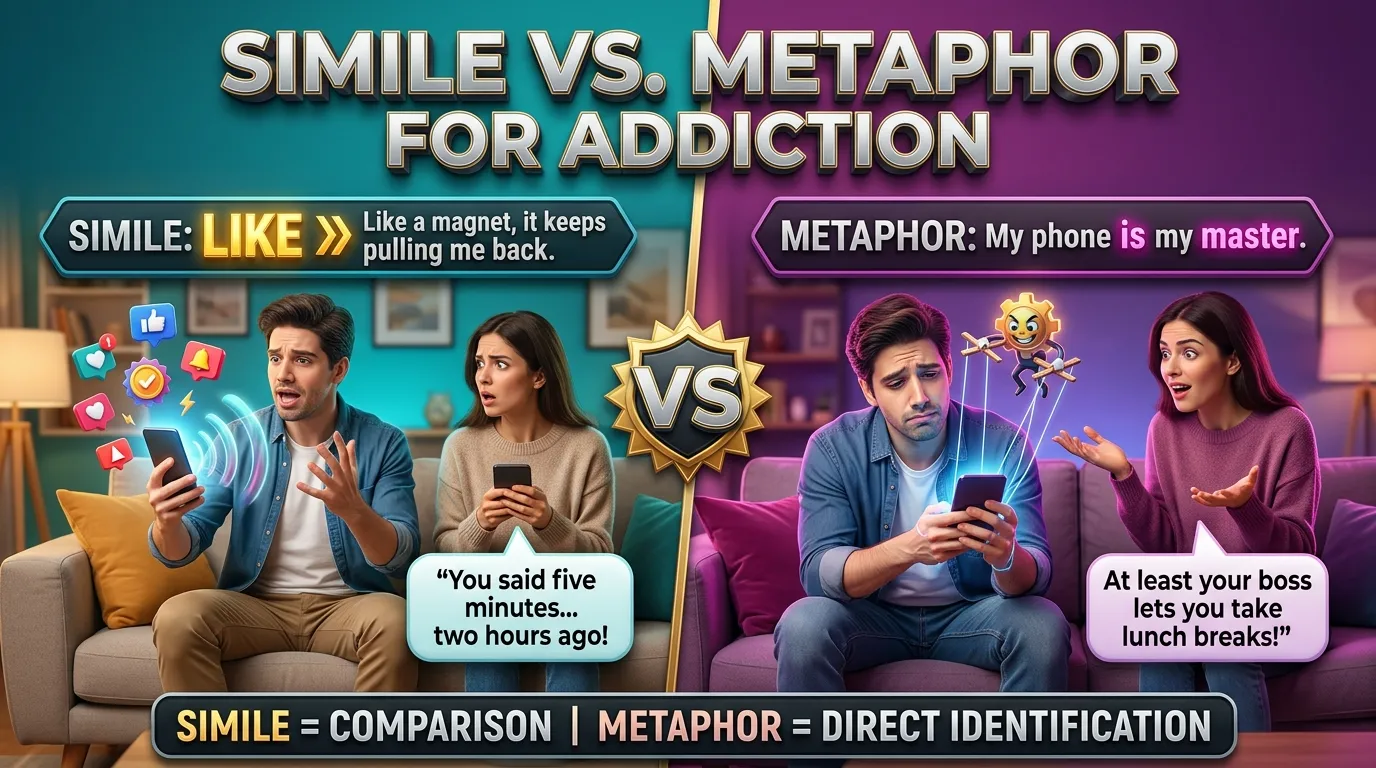
Simile vs. Metaphor for Addiction
A simile makes a comparison using “like” or “as.”
The craving was like a storm.
A metaphor makes the comparison directly:
The craving was a storm.
Both can create vivid imagery. A simile makes the comparison explicit, while a metaphor can make it feel more immediate or compressed.
For students, it can help to remember:
Simile: The addiction was like a chain.
Metaphor: The addiction was a chain.
Why Similes Can Make Addiction Easier to Describe
Addiction can involve abstract experiences that are difficult to explain directly. A writer may know that a character feels trapped, overwhelmed, or pulled toward something but struggle to make that experience tangible.
A comparison gives the reader something concrete.
Compare:
The craving was intense.
with:
The craving was like a fire alarm going off inside his head.
The second sentence gives intensity a recognizable image.
Good figurative language can therefore help writers communicate:
- Internal conflict
- Emotional pressure
- Repetition
- Compulsion
- Isolation
- Loss
- Recovery
- Hope
Similes should complement the writing rather than replace accurate language about addiction.