

What Does Autocracy Mean?
Autocracy is a system of government in which political power is concentrated in the hands of one ruler, who exercises substantial authority over the state. Depending on the system, that authority may face few effective constitutional, legislative, or public constraints.
Autocracy is related to dictatorship and authoritarianism, but the terms are not always interchangeable. Autocracy emphasizes concentrated rule by one person, while authoritarianism describes a broader pattern of political power that restricts meaningful opposition and limits political freedoms.
A simile can help explain these concepts by comparing political authority to something familiar, such as a closed door, a powerful storm, or a machine controlled by one operator.
Best Similes for Autocracy
These comparisons represent different aspects of autocratic rule, from centralized authority to restrictions on freedom.
Simile | Meaning |
|---|---|
Like an iron fist wrapped around a nation | Strict, forceful control |
Like a locked cage with no open door | Restricted freedom |
Like a ship controlled by a single captain | Power concentrated in one leader |
Like a throne towering over a silent crowd | Authority separated from ordinary people |
Like a shadow covering an entire city | |
Like a puppet master pulling every string | Control over people or institutions |
Like a wall blocking every opposing voice | Suppression of dissent |
Like a storm that allows no calm | Constant fear or instability |
Like a gate guarded by a single keeper | Access controlled by one authority |
Like a river forced into a narrow channel | Independent choices constrained by power |
Like a bell that only one person may ring | Decisions controlled by a single ruler |
Like a classroom where only the teacher may speak | Little room for disagreement |
Similes for Autocracy With Meanings and Examples
1. Like an Iron Fist Wrapped Around a Nation
This simile portrays a ruler’s authority as forceful and difficult to resist. The image of an iron fist suggests strict control over institutions, public behavior, or political opposition.
Example: The government tightened its grip on public life like an iron fist wrapped around a nation.
2. Like a Locked Cage With No Open Door
A locked cage symbolizes confinement and a lack of freedom. This comparison can describe a political environment in which citizens have few meaningful opportunities to challenge authority or influence decisions.
Example: To the dissidents, the political system felt like a locked cage with no open door.
3. Like a Ship Controlled by a Single Captain
A ship needs direction, but a captain who refuses all advice represents power concentrated in one individual. This simile is especially useful when discussing the absence of shared decision-making.
Example: The country was governed like a ship controlled by a single captain who ignored every warning from the crew.
4. Like a Throne Towering Over a Silent Crowd
This image emphasizes the distance between a ruler and the people governed. The silent crowd suggests that ordinary citizens have little opportunity to question or influence decisions.
Example: The ruler stood above the assembly like a throne towering over a silent crowd.
5. Like a Puppet Master Pulling Every String
A puppet master controls the movements of puppets. This simile suggests that one authority directs institutions or individuals while leaving them little independent influence.
Example: Critics described the administration as operating like a puppet master pulling every string.
6. Like a Wall Blocking Every Opposing Voice
A wall creates a barrier. Here, it represents obstacles that prevent criticism, protest, or political opposition from reaching those in power.
Example: The restrictions worked like a wall blocking every opposing voice.
7. Like a Bell That Only One Person May Ring
A bell can signal an announcement or summon attention. When only one person is allowed to ring it, the image suggests that decisions and public messages come from a single authority.
Example: Public debate became like a bell that only one person may ring, with every major announcement coming from the ruler.
8. Like a River Forced Into a Narrow Channel
A river naturally spreads through the landscape, but a narrow channel restricts its course. This comparison suggests that people’s choices and public institutions are confined by centralized authority.
Example: Political life flowed like a river forced into a narrow channel, with little room for independent movements.
9. Like a Gate Guarded by a Single Keeper
A gatekeeper decides who may enter or pass. This simile illustrates a ruler’s control over opportunities, public participation, or access to political power.
Example: The path to public office seemed like a gate guarded by a single keeper.
10. Like a Shadow Covering an Entire City
A shadow that covers a city suggests that a ruler’s influence reaches far beyond the central government and affects everyday life.
Example: Fear of official punishment spread like a shadow covering an entire city.
Similes for Absolute Power
Absolute power refers to authority that faces few meaningful restraints. These similes emphasize the scale, concentration, and reach of a ruler’s influence.
Like a mountain casting its shadow over a valley: One powerful presence dominates everything below it.
Like a sun around which every planet must turn: Institutions and individuals revolve around one central authority.
Like a key that opens every door: One person controls access to nearly every important decision.
Like a conductor commanding an orchestra without consultation: Every action is directed by one authority.
Like a hand resting on every lever of a machine: The ruler influences multiple systems and institutions.
Like a river whose course no one may question: Decisions proceed without meaningful challenge.
Example: Power in the kingdom operated like a sun around which every planet had to turn, leaving independent institutions with little room to act.
Similes for Oppression Under Autocracy
Oppression involves the unjust or harsh exercise of power over people. The following similes emphasize fear, restrictions, and the burdens people may experience under repressive rule.
Similes That Describe Restricted Freedom
Like a bird behind iron bars: Unable to exercise its freedom.
Like a road ending at a locked gate: Prevented from moving forward.
Like a voice trapped inside a sealed room: Unable to reach an audience.
Like a book chained to a shelf: Knowledge or ideas kept inaccessible.
Like a window covered with heavy curtains: Prevented from seeing what lies beyond.
Example: The people felt like birds behind iron bars, watching the open sky but unable to fly freely.
Similes That Describe Fear and Intimidation
Like a candle trembling in a dark hallway: Vulnerable and uncertain.
Like footsteps echoing through an empty prison: Surrounded by an atmosphere of fear.
Like a storm cloud hanging over a village: Living under a constant threat.
Like a whisper swallowed by a roaring machine: Individual voices overwhelmed by a powerful system.
Like a deer frozen beneath a hunter’s gaze: Afraid to move or react.
Example: Public meetings became tense, like a candle trembling in a dark hallway, as people worried about the consequences of speaking openly.
Similes for a Dictator or Autocratic Ruler
These comparisons describe the behavior or public image of a ruler who seeks to centralize authority. They are figurative characterizations, not universal descriptions of every autocratic leader.
Like a king who mistakes silence for loyalty: Confusing the absence of criticism with genuine support.
Like a commander who demands obedience without explanation: Expecting compliance rather than discussion.
Like a gardener who allows only one plant to grow: Preventing competing ideas or leaders from flourishing.
Like a judge who writes the rules and gives every verdict: Controlling both the standards and their application.
Like a chess player who refuses to let anyone else touch the pieces: Keeping control of every move.
Like a lighthouse keeper who insists that only one path is safe: Claiming exclusive authority over direction and judgment.
Example: The ruler acted like a gardener who allowed only one plant to grow, treating alternative political ideas as threats rather than opportunities for debate.
Similes for Life Under Autocracy
A political system affects more than government offices. Depending on the level of control, it can also influence public discussion, education, media, civic participation, and daily decisions.
These similes describe possible experiences of living under a highly restrictive system.
Like walking on eggshells in your own home: Being careful because ordinary actions may carry risks.
Like reading from a script written by someone else: Having little control over what can be said publicly.
Like living behind a curtain that never opens: Having limited access to information.
Like walking through a maze designed by someone who holds the map: Depending on an authority that controls the available paths.
Like planting seeds in soil that never receives sunlight: Struggling to develop ideas or initiatives.
Like speaking into a microphone that has been switched off: Trying to express an opinion without being heard.
Example: Independent journalists described their work as like speaking into a microphone that had been switched off when their reporting could not reach the public.
Similes for Resistance to Autocracy
Not every simile about autocracy needs to focus on control or oppression. Writers can also use comparisons to describe courage, civic participation, and efforts to challenge concentrated power.
Like a small flame refusing to die in the wind: Maintaining hope despite pressure.
Like a seed splitting concrete: Gradually breaking through strong barriers.
Like a river carving a path through stone: Creating change through persistence.
Like a bell ringing through a sleeping town: Drawing attention to an ignored issue.
Like a single candle illuminating a dark room: Offering hope or clarity in difficult circumstances.
Like a chorus growing louder with every new voice: Building collective strength through participation.
Example: The reform movement grew like a river carving a path through stone, gaining momentum through sustained public effort.
Short Similes for Autocracy
Use these concise comparisons when you need a brief image for an essay, classroom response, speech, or piece of creative writing.
Like a locked cage.
Like an iron fist.
Like a ship with one captain.
Like a throne above the crowd.
Like a puppet master.
Like a wall against dissent.
Like a gate with one keeper.
Like a river in a narrow channel.
Like a bell with one ringer.
Like a shadow over a city.
Like a bird behind bars.
Like a voice behind glass.
Like a machine with one operator.
Like a candle in a storm.
Like a seed beneath concrete.
Some of these are shortened versions of longer comparisons. For formal academic writing, consider using a complete simile and explaining the specific political feature it represents.
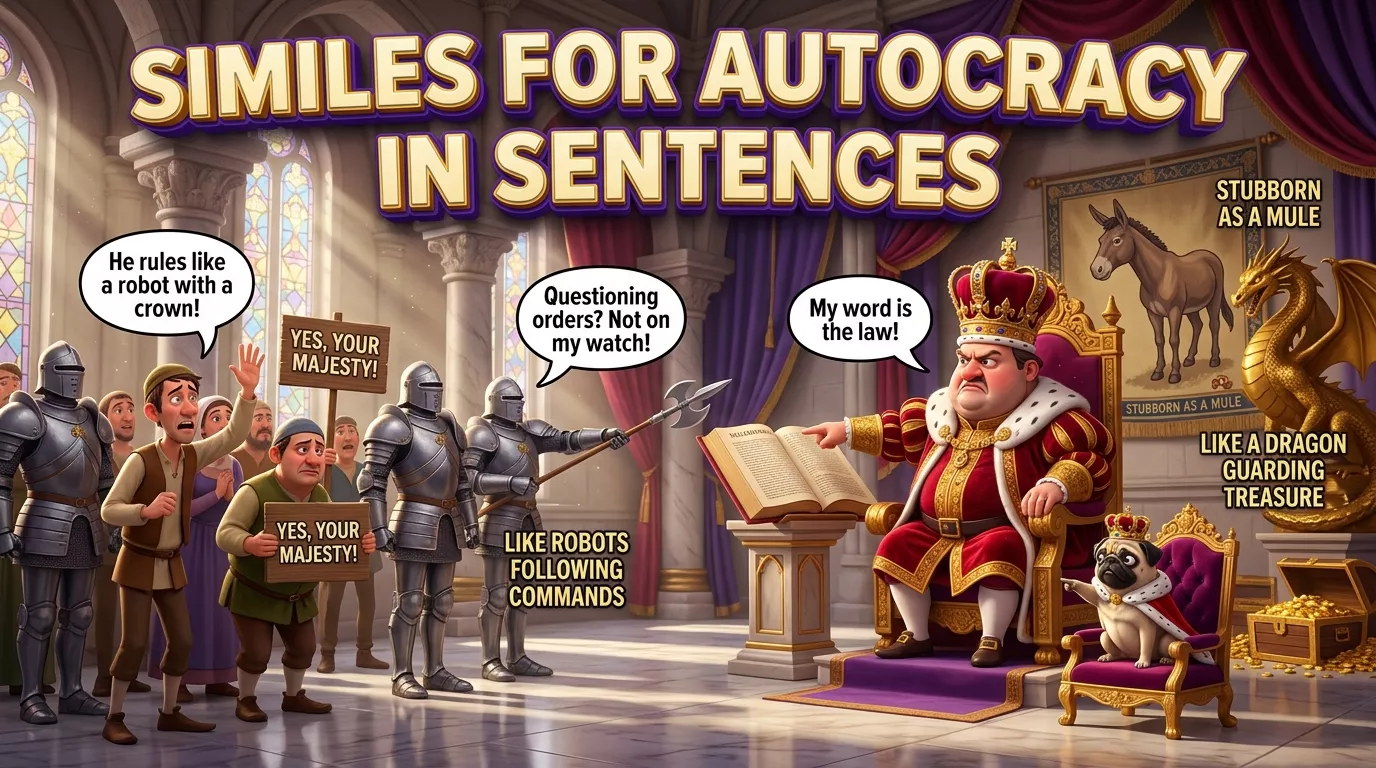
Similes for Autocracy in Sentences
The following examples show how these comparisons can fit into paragraphs and political analysis.
Centralized power: The ruler governed like a captain who refused to share the wheel, making major decisions without meaningful consultation.
Restricted freedom: For the opposition, the political system felt like a locked cage with no open door.
Control of public debate: Criticism met barriers like a voice trapped inside a sealed room.
Fear of punishment: Citizens spoke cautiously, like people walking on eggshells in their own homes.
Control of institutions: The administration operated like a hand resting on every lever of a machine.
Limited information: Independent reporting struggled to reach readers, like a message sealed inside a bottle.
Political resistance: Activists continued their work like seeds splitting concrete.
Public unity: Different groups joined together like a chorus growing louder with every new voice.
Lack of accountability: The leader acted like a judge who wrote the rules and delivered every verdict.
Suppression of alternatives: Competing ideas struggled to grow like plants kept beneath a heavy shadow.
How to Write Your Own Similes for Autocracy
Creating an original simile starts with identifying the political feature you want to explain. Avoid choosing a comparison simply because it sounds dramatic; choose one that communicates a specific idea.
Identify the Main Feature
Decide what aspect of autocracy you want to describe:
Concentrated power: Think of a machine with one operator or a ship with one captain.
Restrictions on freedom: Consider a locked gate, a cage, or a road blocked by a wall.
Control of information: Imagine a closed window, a sealed letter, or a microphone switched off.
Public fear: Use an image such as a candle in a storm or someone walking on eggshells.
Resistance: Consider a seed splitting concrete or a river carving through stone.
Connect It to a Familiar Image
Choose an object, place, or situation that shares the feature you identified.
For example, if you want to describe a ruler’s control over public decisions, you might compare the government to a machine that only one person can operate.
Explain the Comparison Clearly
A simile is more effective when its meaning is easy to understand.
Instead of writing:
The government was like a machine.
Write:
The government operated like a machine with one operator, leaving little room for independent decisions.
The second version explains what the image represents rather than leaving readers to guess.
Keep the Comparison Accurate
Autocratic systems differ across countries and historical periods. Some concentrate power in one ruler more completely than others, and their institutions, public freedoms, and political practices vary. In academic writing, connect the simile to a specific documented feature instead of presenting the comparison as a complete definition of every autocracy.

What Is the Difference Between a Simile and a Metaphor About Autocracy?
A simile compares two things using words such as like or as. A metaphor describes one thing as another without explicitly stating the comparison.
Figurative device | Example |
|---|---|
Simile | Autocracy was like a locked cage surrounding public life. |
Metaphor | Autocracy was a locked cage surrounding public life. |
Literal description | Autocracy concentrates political authority in one ruler. |
The simile and metaphor communicate similar imagery, but the literal description explains the political concept more directly. In analytical writing, figurative language works best when it supports rather than replaces accurate explanation.