

What Is a Simile for Dancing?
A simile for dancing compares a dancer’s movement, rhythm, energy, or style to something else, usually using like or as.
For example:
He danced like a flame flickering in the wind.
The comparison helps readers visualize the movement rather than simply being told that the dancer was energetic.
Dancing similes can describe:
- Grace
- Speed
- Rhythm
- Energy
- Balance
- Flexibility
- Joy
- Passion
- Freedom
- Playfulness
- Smoothness
- Strength
65+ Similes for Dancing
1. Dancing like a butterfly
This suggests light, delicate, and graceful movement.
Example:
She danced like a butterfly floating from flower to flower.
2. Dancing like a leaf in the wind
A natural comparison for flowing, effortless movement.
Example:
He moved across the floor like a leaf carried by the wind.
3. Dancing like a flame
This suggests lively, unpredictable movement.
Example:
She danced like a flame flickering in the breeze.
4. Dancing like flowing water
This emphasizes smoothness and continuity.
Example:
Her body moved like flowing water.
5. Dancing like a bird
A good comparison for freedom and lightness.
Example:
He danced like a bird released from its cage.
6. Dancing like a wave
This works for rhythmic, sweeping movement.
Example:
She moved like a wave rolling toward the shore.
7. Dancing like a spinning top
This emphasizes rapid turning.
Example:
The dancer spun like a top across the stage.
8. Dancing like a feather
This suggests delicacy and weightlessness.
Example:
She floated across the floor like a feather in the air.
9. Dancing like rain
This can describe quick, rhythmic movement.
Example:
His feet moved like rain tapping against a rooftop.
10. Dancing like a ribbon
A strong image for flowing arms and graceful movement.
Example:
Her arms moved like ribbons in the wind.
11. Dancing like a spring breeze
This creates a light and joyful image.
Example:
She danced like a spring breeze through a field of flowers.
12. Dancing like a whirlwind
This suggests fast, energetic movement.
Example:
He spun across the floor like a whirlwind.
13. Dancing like a deer
This emphasizes agility and graceful movement.
Example:
She leaped like a deer crossing a meadow.
14. Dancing like a wave on the ocean
This works for continuous, flowing motion.
Example:
The dancers moved together like waves on the ocean.
15. Dancing like a butterfly in sunlight
This combines grace with joy.
Example:
She danced like a butterfly in sunlight, light on every step.
16. Dancing like a firecracker
A playful comparison for sudden, energetic movement.
Example:
He danced like a firecracker bursting into the night.
17. Dancing like a drumbeat
This suggests precise rhythm.
Example:
Her feet moved like a drumbeat beneath the music.
18. Dancing like a river
A natural comparison for smooth, continuous motion.
Example:
The group flowed across the stage like a river.
19. Dancing like a storm
This emphasizes power and intensity.
Example:
He danced like a storm sweeping across the stage.
20. Dancing like sunlight
This creates a bright, joyful image.
Example:
She danced like sunlight spilling through an open window.

Similes for Graceful Dancing
Graceful dance descriptions often benefit from imagery associated with nature and gentle movement.
- Like a feather floating through air
- Like a swan gliding across water
- Like a ribbon in the breeze
- Like water flowing over stones
- Like a butterfly drifting between flowers
- Like a cloud moving across the sky
- Like silk sliding over glass
- Like a leaf carried by wind
- Like a flower opening
- Like mist moving across a lake
Example
She danced across the stage like a swan gliding over still water.
Similes for Fast Dancing
For speed, use comparisons involving movement, spinning, or sudden action.
- Like a whirlwind
- Like lightning across the sky
- Like a spinning wheel
- Like a racing river
- Like a hummingbird
- Like sparks from a fire
- Like a spinning top
- Like a gust of wind
- Like a racing flame
- Like a bird darting through the air
Example
He danced like a whirlwind, barely seeming to touch the floor.
Similes for Energetic Dancing
Energetic dancing can feel explosive, powerful, and full of life.
- Like fireworks bursting in the sky
- Like a firecracker
- Like a storm breaking loose
- Like sparks flying from a fire
- Like electricity running through a wire
- Like waves crashing against rocks
- Like a wild horse running free
- Like thunder rolling across the mountains
- Like a drumbeat coming alive
- Like flames leaping from a fire
Example
She danced like fireworks exploding across the night sky.
Similes for Joyful Dancing
Joyful movement often works best with bright and playful imagery.
- Like a child running through sprinklers
- Like sunlight through a window
- Like a butterfly in spring
- Like birds released into the sky
- Like flowers swaying in a breeze
- Like bubbles floating through the air
- Like music made visible
- Like a puppy racing through grass
- Like a summer breeze
- Like laughter given a body
Example
The children danced like butterflies released into a sunny garden.
Similes for Romantic Dancing
For romantic scenes, choose imagery that emphasizes closeness, rhythm, and connection.
- Like two waves meeting at the shore
- Like leaves moving together in the wind
- Like two flames leaning toward each other
- Like a slow river joining the sea
- Like two birds moving through the same current of air
- Like flowers swaying together in a breeze
- Like two shadows moving as one
- Like silk drifting beside silk
- Like moonlight dancing across water
- Like two hearts keeping the same rhythm
Example
They danced together like two flames leaning toward each other in the breeze.
Similes for Ballet
Ballet often calls for comparisons that emphasize balance, precision, lightness, and control.
- Like a feather floating through air
- Like a swan gliding across a lake
- Like a bird hovering above the ground
- Like a flower opening slowly
- Like a ribbon suspended in air
- Like a cloud drifting across the sky
- Like a leaf falling in slow motion
- Like water flowing over smooth stones
- Like a pendulum moving perfectly in rhythm
- Like a figure drawn across silk
Example
The ballerina moved like a feather caught in a gentle breeze.
Similes for Dancing in the Rain
Dancing in rain gives you natural imagery involving water and movement.
- Like children splashing through puddles
- Like leaves caught in a storm
- Like waves playing with the shore
- Like raindrops skipping across glass
- Like flowers bending beneath rainfall
- Like a river released from its banks
- Like birds bathing in a summer shower
- Like droplets bouncing from a fountain
- Like a storm celebrating its arrival
- Like sunlight breaking through rain
Example
They danced in the rain like children discovering puddles for the first time.
Similes for Dancing at a Party
Party dancing is often energetic, spontaneous, and playful.
- Like sparks flying from a bonfire
- Like popcorn popping in a pan
- Like fireworks on the Fourth of July
- Like waves at a crowded beach
- Like a room full of bouncing springs
- Like birds fluttering around a feeder
- Like flames jumping from a campfire
- Like music had taken over their bodies
- Like children released from school
- Like a festival coming alive
Example
Everyone danced like sparks flying from a giant bonfire.
Similes for Dancing Alone
Dancing alone can communicate freedom, privacy, confidence, or emotion.
- Like a leaf dancing with the wind
- Like a flame dancing without a fire
- Like a bird flying across an empty sky
- Like waves moving without a shore
- Like music carrying a feather
- Like a shadow following its own rhythm
- Like a flower swaying in an empty field
- Like a cloud wandering across the sky
- Like a river following its own path
- Like a star moving through darkness
Example
She danced alone like a leaf following the rhythm of the wind.
Similes for Dancing With Joy
- Like sunlight bursting through clouds
- Like fireworks on a summer night
- Like a bird discovering its wings
- Like flowers opening in spring
- Like waves racing toward the beach
- Like children released into a playground
- Like sparks jumping from a fire
- Like a breeze running through tall grass
- Like laughter spreading through a room
- Like music turned into movement
Example
He danced with joy like a bird discovering its wings.
Similes for Powerful Dancing
Powerful dancing needs imagery that communicates strength rather than simply speed.
- Like thunder breaking across the sky
- Like waves crashing against cliffs
- Like a storm hitting the coast
- Like a mountain shaking beneath an earthquake
- Like flames consuming dry wood
- Like a drumbeat pounding through the ground
- Like a river cutting through stone
- Like lightning striking the earth
- Like a wild horse charging forward
- Like wind tearing through the trees
Example
The dancer moved with power like a storm crashing into the shore.
Similes for Slow Dancing
Slow dancing allows comparisons that emphasize smoothness and connection.
- Like waves gently reaching the shore
- Like clouds drifting across the moon
- Like leaves floating on calm water
- Like smoke curling through still air
- Like a slow river
- Like silk moving in a breeze
- Like candlelight flickering against a wall
- Like two feathers falling together
- Like moonlight crossing a lake
- Like flowers swaying at dusk
Example
They moved slowly like two leaves drifting across still water.
How to Choose the Right Simile for Dancing
The best comparison depends on how the dancer moves and what the scene should feel like.
For graceful dancing
Think about:
feathers, swans, ribbons, water, leaves
For energetic dancing
Think about:
fireworks, sparks, storms, waves, flames
For joyful dancing
Think about:
sunlight, butterflies, birds, flowers, summer breezes
For romantic dancing
Think about:
flames, waves, moonlight, silk, gentle wind
For powerful dancing
Think about:
thunder, storms, crashing waves, lightning
For slow dancing
Think about:
water, clouds, candlelight, drifting leaves
A strong simile should match both the movement and the emotional tone.
How to Create Your Own Simile for Dancing
Creating an original dance simile starts with observing the movement.
1. Notice what the dancer is doing
Are they:
- Spinning?
- Leaping?
- Gliding?
- Stomping?
- Swaying?
- Moving quickly?
- Moving slowly?
- Dancing in a group?
2. Identify the movement’s strongest quality
Maybe it is:
- Graceful
- Fast
- Powerful
- Playful
- Smooth
- Wild
- Romantic
- Joyful
- Precise
3. Find a matching image
A dancer who glides might remind you of:
water, clouds, feathers, or a swan.
A dancer who moves explosively might remind you of:
fireworks, lightning, or a storm.
4. Connect the two
Use like or as:
She glided like a feather across the stage.
5. Add context when needed
Instead of simply saying:
He danced like a storm.
Try:
He danced like a storm breaking across the stage, every movement sharp and powerful.
The added context helps establish exactly what the comparison means.
Common Mistakes When Writing Similes for Dancing
Using only “danced like a professional”
This tells readers very little about the actual movement.
Describing every dancer as graceful
Dance can be graceful, awkward, explosive, playful, sharp, wild, controlled, or deliberately clumsy.
Using unrelated comparisons
The comparison should have a recognizable connection to the movement.
Overusing common imagery
Butterflies, flames, waves, and feathers are useful, but relying exclusively on them can make descriptions feel predictable.
Forgetting the music
Dance and rhythm are closely connected. Sometimes the strongest comparison describes how the dancer responds to the beat.
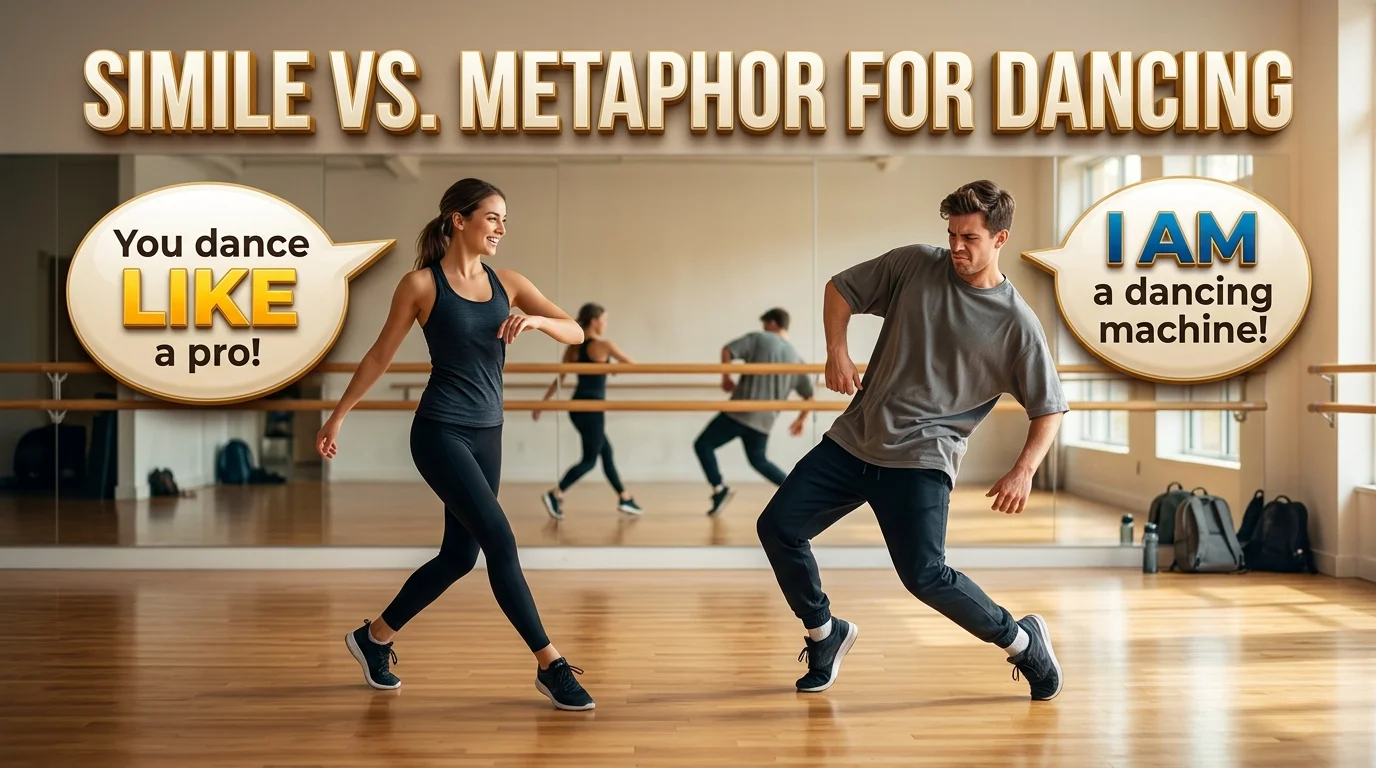
Simile vs. Metaphor for Dancing
A simile makes the comparison explicit:
She danced like a butterfly.
A metaphor makes the comparison directly:
She was a butterfly across the stage.
Both create imagery, but the simile uses a comparison word such as like or as.
Quick List of Similes for Dancing
- Like a butterfly
- Like a feather
- Like a leaf in the wind
- Like flowing water
- Like a flame
- Like a bird
- Like a wave
- Like a spinning top
- Like falling rain
- Like a ribbon
- Like a spring breeze
- Like a whirlwind
- Like a deer
- Like fireworks
- Like a firecracker
- Like a drumbeat
- Like a river
- Like a storm
- Like sunlight
- Like a swan
- Like silk in the breeze
- Like lightning
- Like sparks from a fire
- Like moonlight on water
- Like flowers swaying in a field