
What Is a Simile for Christmas?
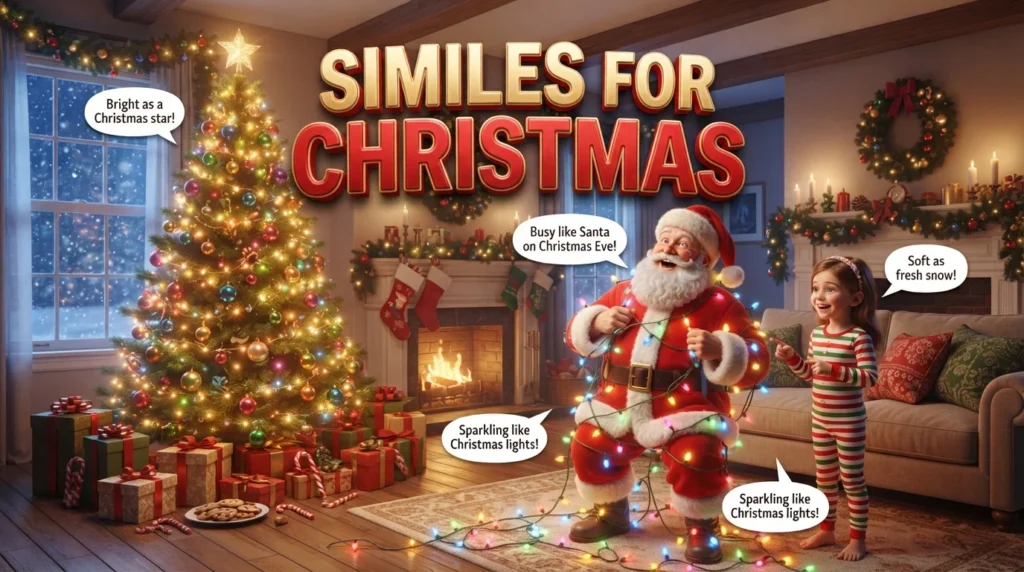
A Christmas simile is a comparison that uses like or as to connect a Christmas-related subject with another image.
For example:
The Christmas lights twinkled like stars scattered across the night.
The lights aren’t actually stars. The comparison helps the reader imagine their brightness and scattered appearance.
Another example:
Christmas morning felt like a door opening into a world of possibilities.
Here, the comparison focuses on anticipation and wonder rather than appearance.
A simile is therefore more than a decorative phrase. It gives readers a familiar image through which they can understand another experience.
100+ Similes for Christmas
Similes for Christmas Lights
Christmas lights are naturally suited to comparisons involving brightness, stars, fire, and color.
- The Christmas lights twinkled like stars scattered across the sky.
- The house glowed like a lantern in the winter darkness.
- The lights were as bright as tiny suns.
- Colored bulbs shone like jewels along the roof.
- The tree lights flickered like fireflies in a forest.
- The windows glowed like warm beacons on a snowy night.
- The Christmas lights sparkled like diamonds beneath the moon.
- The porch looked as bright as a little holiday village.
- The lights stretched across the house like a ribbon of stars.
- The tree shimmered like a constellation brought indoors.
Rather than using “bright” repeatedly, think about what the brightness resembles. Stars, lanterns, fireflies, jewels, candles, and reflections can each create a different mood.
Similes for a Christmas Tree
A Christmas tree can be described through its height, color, fragrance, decorations, shape, and glow.
- The Christmas tree stood like a green giant in the living room.
- Its branches were as full as a forest after summer rain.
- The ornaments hung like jewels from every branch.
- The tree sparkled like a sky full of stars.
- The evergreen smelled as fresh as a winter forest.
- The tinsel shimmered like silver rain.
- The golden star rested on top like a crown.
- The decorated tree looked like a tiny enchanted forest.
- The branches stretched outward like welcoming arms.
- The tree glowed like a beacon in the corner of the room.
The Christmas tree is also useful for emotional writing because it can represent tradition, anticipation, family memories, celebration, or home depending on the surrounding context.
Similes for Christmas Ornaments
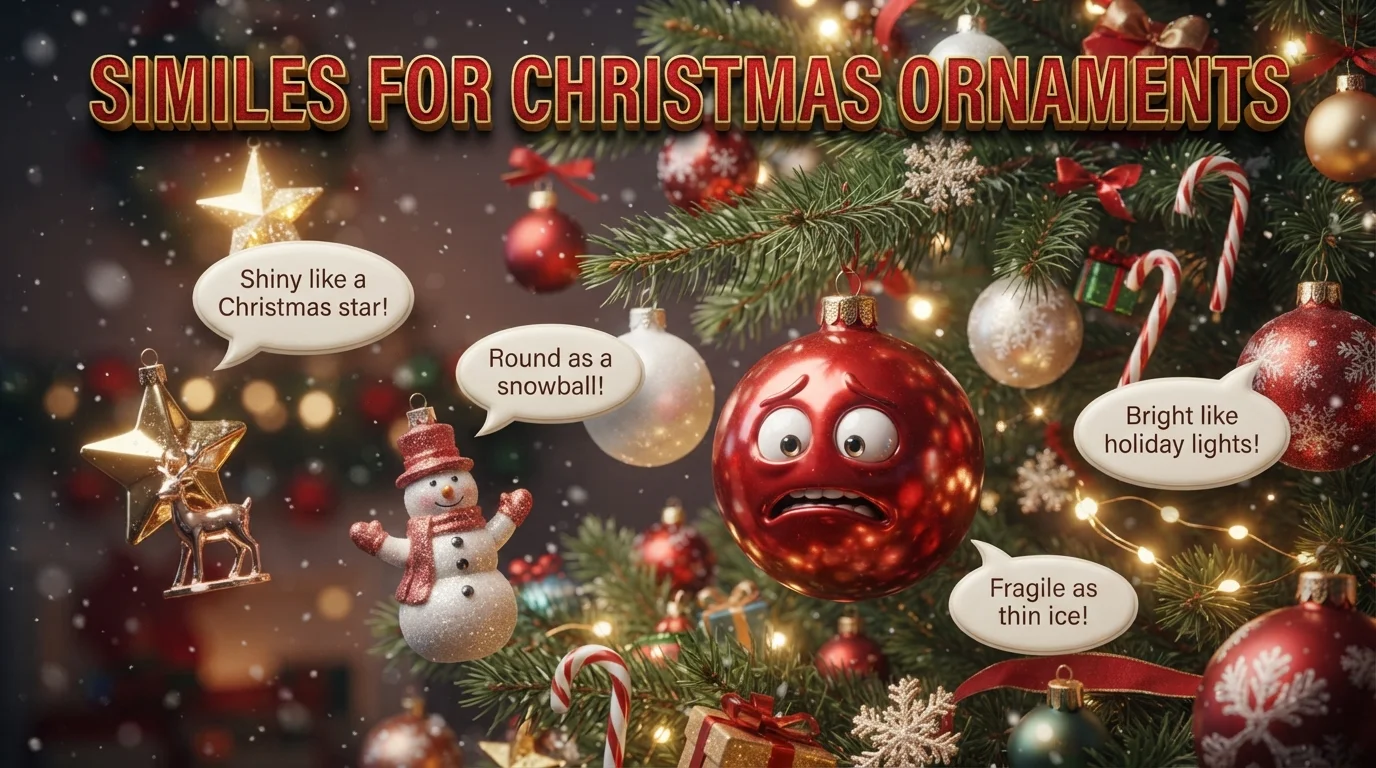
- The ornaments glittered like pieces of colored glass.
- The red baubles shone like polished berries.
- The silver ornaments sparkled like drops of moonlight.
- The delicate decorations hung like jewels from the branches.
- The old ornament looked as fragile as a soap bubble.
- The ornaments swayed like tiny dancers whenever the branches moved.
- The golden decorations glowed like miniature suns.
- The handmade ornaments looked like little pieces of family history.
- The glass ornaments reflected the lights like tiny mirrors.
- The decorations covered the tree like colorful confetti.
Similes for Christmas Snow
Snow is one of the most familiar Christmas images, so choosing a more specific comparison can make your writing less predictable.
- Snow fell like feathers from a pale winter sky.
- The ground looked as white as fresh paper.
- Snow covered the rooftops like a soft blanket.
- The flakes drifted like tiny pieces of lace.
- The snow sparkled like sugar beneath the morning sun.
- The yard looked like a white canvas waiting for footprints.
- The snow was as soft as powdered sugar beneath our boots.
- Snowflakes floated through the air like tiny dancers.
- The snowy street shone like polished glass.
- The hills looked like white waves frozen in place.
Snow can create very different moods. A soft snowfall might suggest peace and quiet, while a blizzard can make a Christmas scene feel wild, isolated, or tense.
Similes for Christmas Morning
Christmas morning is often associated with anticipation, excitement, surprise, and family activity.
- The children were as excited as explorers discovering a hidden treasure.
- Christmas morning burst into the house like a ray of sunlight.
- The children raced downstairs like runners hearing the starting signal.
- Their excitement bubbled like soda in a freshly opened bottle.
- Their faces lit up like Christmas lights when they saw the presents.
- The room was as lively as a carnival.
- The children tore through wrapping paper like excited little tornadoes.
- The house filled with laughter like a theater after a great performance.
- Anticipation hung in the air like a held breath.
- The morning felt like a door opening into a world of surprises.
The comparison should match the emotion you want. Christmas morning can be joyful, chaotic, peaceful, nostalgic, funny, or magical, so there isn’t one universally correct image.
Similes for Christmas Presents
Gifts can be described through mystery, anticipation, appearance, movement, and surprise.
- The presents sat beneath the tree like colorful treasure chests.
- The wrapped boxes looked like secrets waiting to be discovered.
- The ribbons curled like bright strips of candy.
- The presents were stacked like colorful blocks.
- Each package looked as mysterious as a locked door.
- The wrapping paper was as bright as a holiday parade.
- The gifts waited beneath the tree like eager guests.
- The boxes were covered like tiny works of art.
- The children stared at the presents like detectives studying clues.
- The torn wrapping paper scattered across the floor like fallen leaves.
Similes for Christmas Eve
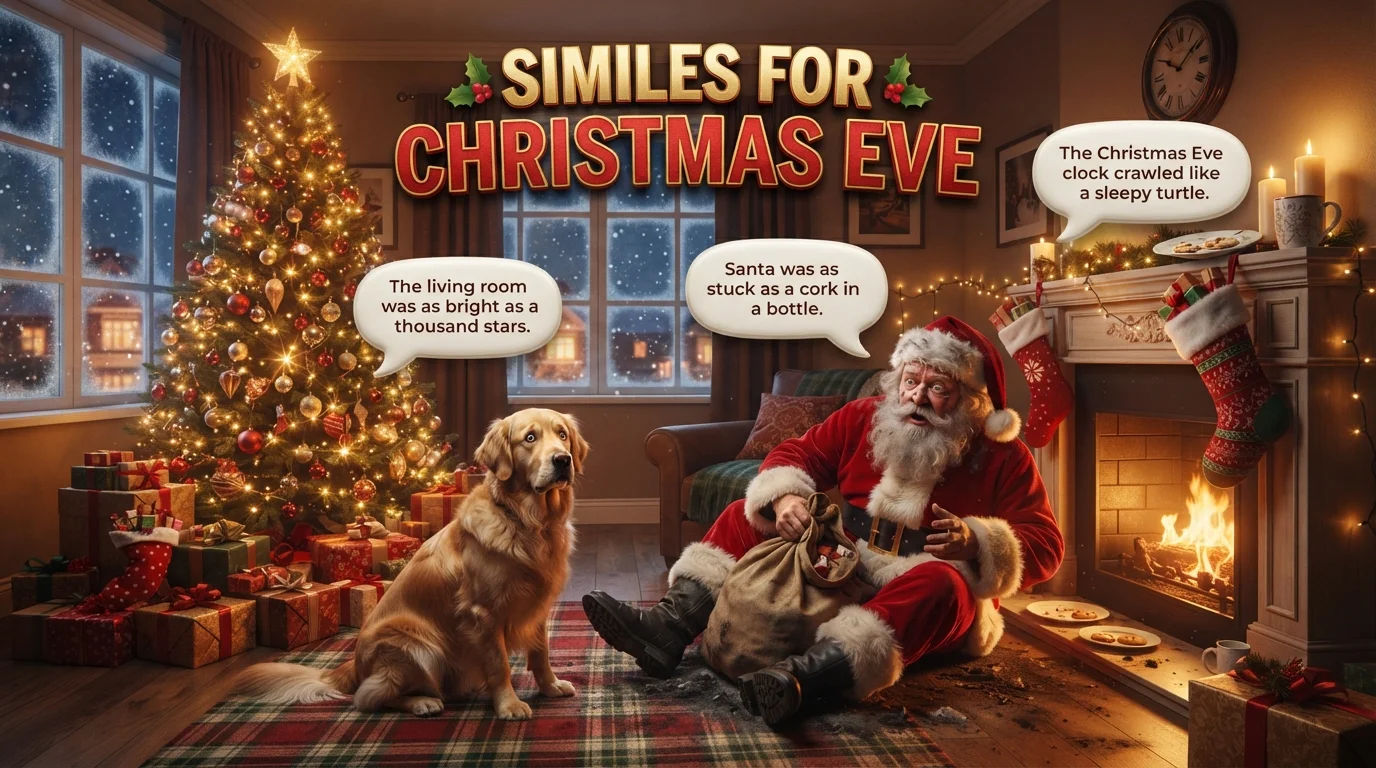
Christmas Eve can have a quieter, more suspenseful atmosphere than Christmas morning.
- The house was as quiet as a snow-covered field.
- Christmas Eve felt like waiting for the curtain to rise.
- The clock ticked like a patient drummer counting down the hours.
- The sleeping house rested like a village beneath the snow.
- The night seemed as still as a frozen lake.
- The fireplace glowed like a small sun against the darkness.
- The children waited like travelers watching for the first light of dawn.
- The anticipation hung in the room like a secret.
- The moon shone like a silver ornament in the sky.
- The quiet streets looked like scenes from a winter painting.
Similes for Christmas Cheer and Happiness
Not every Christmas simile has to describe an object. Comparisons can also express emotions.
- She was as happy as a child discovering an unexpected present.
- His smile was as bright as Christmas lights.
- Their laughter rang like bells.
- The children were as cheerful as carolers on Christmas morning.
- Joy spread through the room like sunlight.
- Her excitement bubbled like sparkling soda.
- His face glowed like a fireplace on a cold evening.
- The family’s happiness filled the house like warm music.
- Their excitement was like fireworks waiting to explode.
- The room felt as joyful as a holiday parade.
Similes for Christmas Warmth and Comfort
Christmas writing often focuses on warmth, especially when contrasting a cozy home with cold winter weather.
- The fireplace was as comforting as a familiar story.
- The room felt warm like a blanket fresh from the dryer.
- The hot cocoa was as comforting as a hug.
- The fire glowed like a golden hearth in a winter cabin.
- The kitchen smelled like a warm bakery on Christmas morning.
- The blanket felt as cozy as a nest.
- The house was warm like a shelter during a winter storm.
- The fireplace crackled like a quiet conversation.
- The cocoa steamed like a tiny cloud above the mug.
- The family gathering felt like coming home after a long journey.
Similes for Christmas Food
Christmas provides plenty of opportunities for sensory comparisons.
- The gingerbread smelled like a bakery filled with cinnamon.
- The cookies were as sweet as a spoonful of honey.
- The frosting sparkled like fresh snow.
- The candy canes were as bright as Christmas ornaments.
- The hot cocoa tasted like warmth in a mug.
- The gingerbread house looked like a tiny storybook cottage.
- The cinnamon aroma floated through the kitchen like a warm breeze.
- The cookies disappeared like snow beneath the winter sun.
- The dessert table looked like a miniature holiday bakery.
- The first bite of gingerbread felt like a little taste of Christmas morning.
Food descriptions become stronger when you move beyond “sweet” and “delicious.” Consider temperature, texture, aroma, color, sound, and emotional associations.
Christmas Similes by Mood
A useful way to choose a simile is to start with the mood rather than the object.
| Mood | Example Simile | Effect |
|---|---|---|
| Joyful | Like children discovering presents | Excitement |
| Peaceful | As quiet as falling snow | Calm |
| Warm | Like a blanket around your shoulders | Comfort |
| Magical | Like stars brought down to earth | Wonder |
| Nostalgic | Like an old photograph | Memory |
| Playful | Like wrapping paper caught in the wind | Energy |
| Mysterious | Like a present with no name | Curiosity |
| Cozy | As warm as a fireplace | Security |
| Chaotic | Like tangled Christmas lights | Disorder |
| Exciting | Like fireworks on Christmas Eve | Anticipation |
This approach helps you avoid choosing a comparison simply because it contains a Christmas-related object.
Funny Similes for Christmas
Christmas doesn’t always have to sound poetic. Humor can make holiday writing feel much more natural.
- The Christmas lights were as tangled as a pile of headphones.
- I was as busy as Santa on Christmas Eve.
- The kitchen looked like a tornado had discovered wrapping paper.
- The children attacked the presents like tiny treasure hunters.
- My living room was as messy as a wrapping-paper factory.
- My Christmas shopping list was as long as a winter scarf.
- After dinner, I felt like a stuffed stocking.
- The dog chased the wrapping paper like it had discovered its greatest enemy.
- Untangling the lights was like solving a puzzle designed by a mischievous elf.
- The family discussion became as loud as a room full of excited carolers.
Humorous comparisons work particularly well in captions, personal stories, informal writing, and children’s writing.
Christmas Similes for Kids
For younger writers, the best comparisons are usually concrete and easy to visualize.
- The tree was as green as an evergreen forest.
- The snow was as white as cotton.
- The lights twinkled like stars.
- The presents looked like colorful boxes of treasure.
- The cookies were as sweet as candy.
- The fireplace was as warm as a blanket.
- The bells sounded like tiny silver dancers.
- Santa’s beard was as white as snow.
- The ornaments shone like jewels.
- The children were as excited as puppies.
These simple comparisons can become the foundation for longer descriptive sentences.
Christmas Similes for School Writing
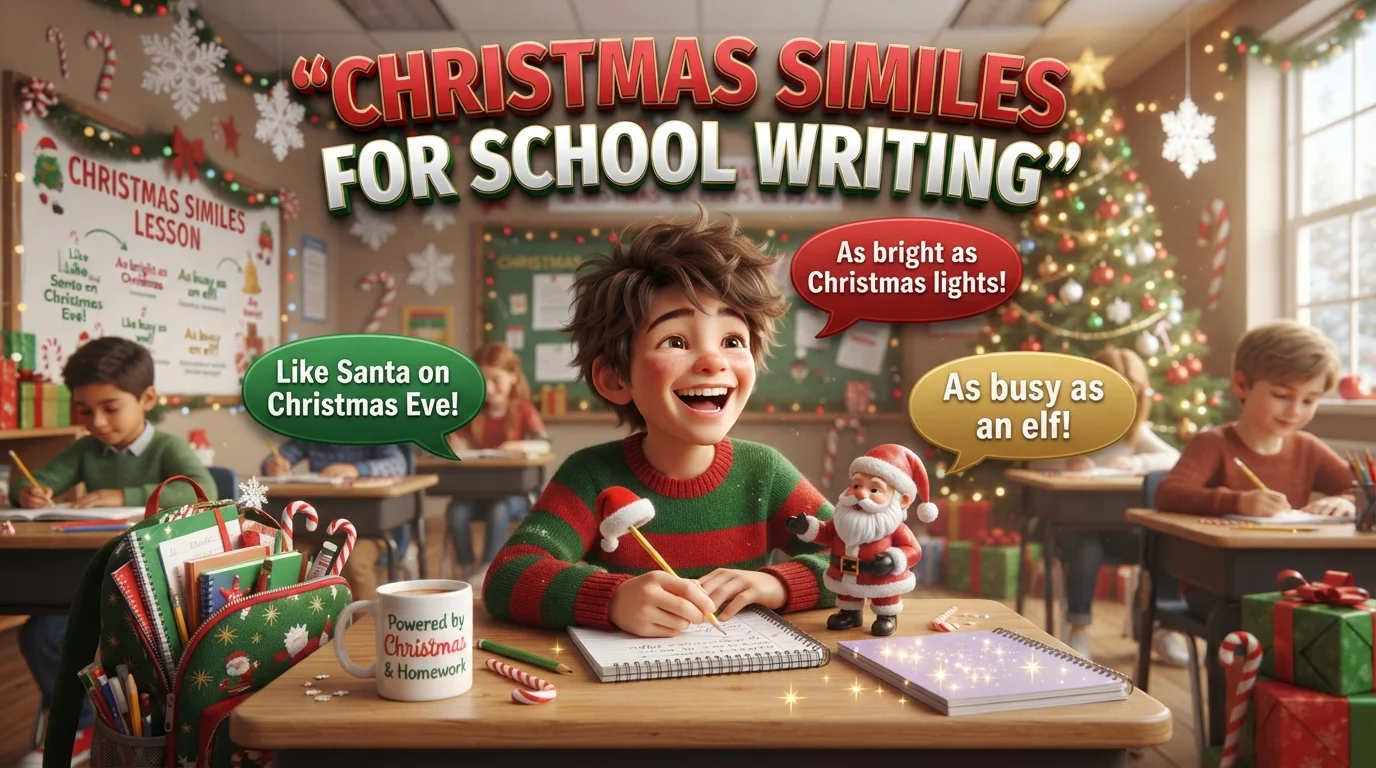
If you’re writing a Christmas paragraph or essay, try combining several senses instead of putting one simile in every sentence.
For example:
The Christmas tree stood in the corner like a glowing green giant. Its lights twinkled like stars, while the smell of cinnamon cookies drifted through the house like a warm invitation. Outside, snow covered the yard like a white blanket.
Notice that the comparisons aren’t all doing the same job.
- The tree comparison describes size and presence.
- The lights comparison describes appearance.
- The cinnamon comparison describes smell.
- The snow comparison describes appearance and coverage.
That gives the paragraph more variety.
How to Create Your Own Christmas Similes
You don’t need to memorize 100 comparisons to write effective Christmas descriptions.
Try this process.
1. Choose the thing you’re describing
For example:
Christmas lights
2. Decide what quality matters
Are they:
- bright?
- colorful?
- delicate?
- warm?
- flickering?
- scattered?
Suppose you choose scattered.
3. Find a familiar image
Think of something naturally scattered:
- stars
- fireflies
- glitter
- flowers
- sparks
4. Connect the two
The Christmas lights twinkled like fireflies.
5. Make it specific
Instead of stopping there:
The Christmas lights twinkled like fireflies scattered across the dark porch.
Now the comparison gives the reader a clearer scene.
6. Check the tone
For a children’s story, simple imagery may work best.
For poetry, you might choose something more unexpected.
For a humorous story, an unusual comparison can create personality.
Use Christmas Similes Through the Five Senses
Christmas is especially rich in sensory detail.
Sight
The tree sparkled like a constellation.
Sound
The bells rang like tiny silver voices.
Smell
The cinnamon aroma drifted like a warm breeze.
Taste
The cookies were as sweet as honey.
Touch
The blanket felt as soft as fresh snow.
Using multiple senses prevents Christmas writing from becoming a collection of visual descriptions.
Christmas Similes for Stories
Similes can also reveal character and movement.
Consider:
Mom moved around the kitchen like a conductor leading an orchestra.
This tells us that she is busy and directing many activities.
Or:
The children watched the wrapped gifts like detectives studying clues.
That communicates curiosity.
Or:
Grandpa’s laughter rolled through the room like distant thunder.
That gives his laughter a physical presence.
A good narrative simile doesn’t merely describe something—it can also tell the reader something about the person, place, or situation.
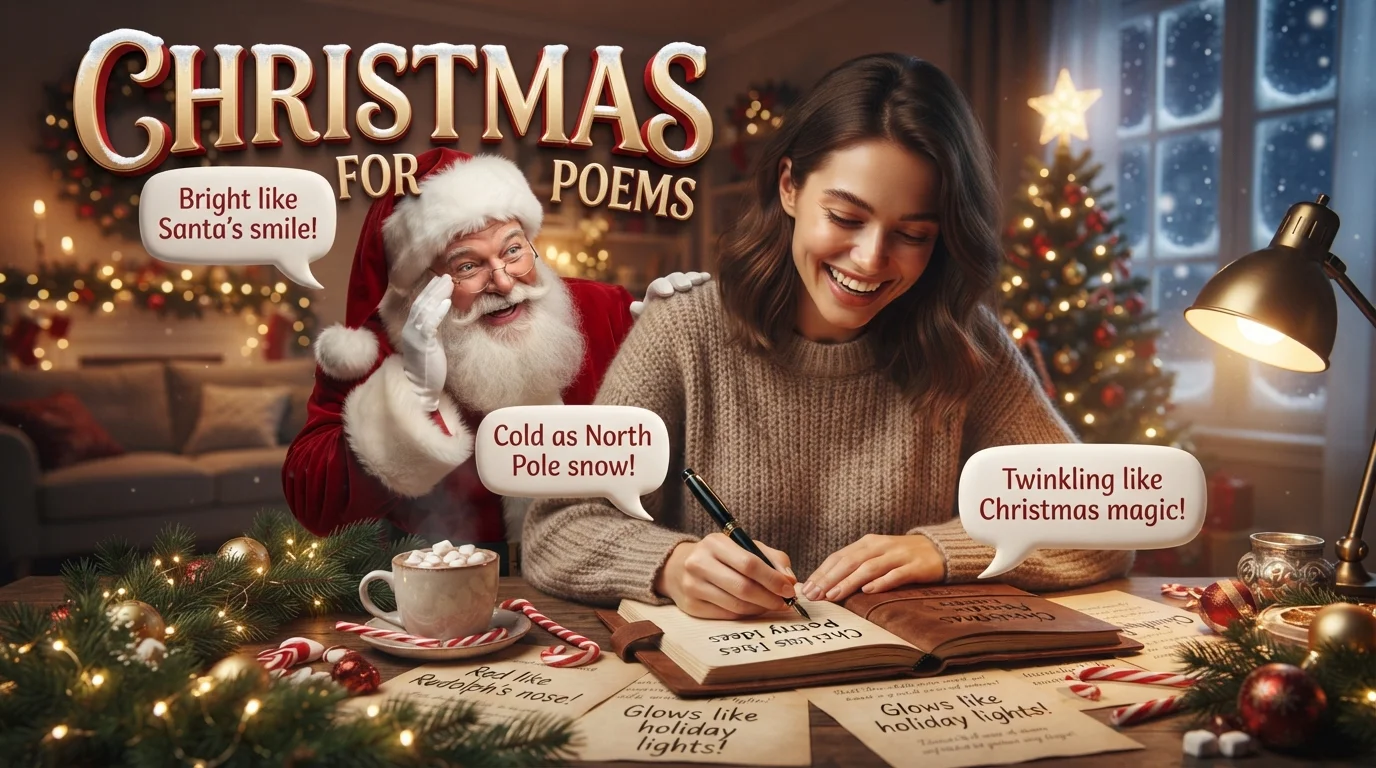
Christmas Similes for Poems
Poetry gives you more freedom to make emotional and imaginative connections.
For example:
Christmas lights shimmer
like stars caught in branches,
while snow settles
like a quiet blanket
over the sleeping town.
Or:
The old ornament hangs
like a photograph from another year,
holding a little Christmas
inside its faded glass.
These comparisons don’t simply describe decorations. They connect Christmas imagery with memory, time, silence, and emotion.
Christmas Simile vs. Metaphor
A simile uses words such as like or as.
The Christmas tree sparkled like a constellation.
A metaphor makes the comparison directly.
The Christmas tree was a constellation.
Both are forms of figurative language, but the grammatical construction is different.
A simple rule for students is:
Simile → comparison using like or as
Metaphor → direct comparison
Common Mistakes When Using Christmas Similes
Using the same comparison repeatedly
If every Christmas description involves stars, snow, or magic, the writing can quickly become predictable.
Instead, explore:
- texture
- sound
- smell
- movement
- memory
- humor
- contrast
- emotion
Making every simile positive
Christmas can also be:
- chaotic
- lonely
- quiet
- overwhelming
- nostalgic
- mysterious
- bittersweet
The correct comparison depends on the scene.
Forcing an unrelated Christmas reference
A comparison shouldn’t exist merely because it contains “Christmas.”
Ask:
What quality am I actually trying to communicate?
Then find an image that naturally expresses that quality.
Using too many similes
A paragraph doesn’t become better simply because every sentence contains a comparison.
One precise simile can be stronger than several predictable ones.
Confusing similes and metaphors
Remember that:
The snow was like a blanket.
is a simile, while:
The snow was a blanket.
is a metaphor.
20 Short Christmas Similes for Quick Reference
- As bright as Christmas lights.
- Like stars across the sky.
- As white as fresh snow.
- Like a warm fireplace.
- As sweet as Christmas cookies.
- Like a decorated forest.
- As soft as snowfall.
- Like a lantern in winter.
- As cheerful as Christmas morning.
- Like jewels on a tree.
- As cozy as a warm blanket.
- Like fireflies in the darkness.
- As exciting as opening presents.
- Like a winter postcard.
- As peaceful as falling snow.
- Like a ribbon of lights.
- As warm as hot cocoa.
- Like secrets wrapped in paper.
- As magical as a winter night.
- Like a tiny constellation indoors.